Imaging: How to Improve Soundstage, Scene Size and Environment
- BLOG
- by Tom Martin
- Jul 09, 2026
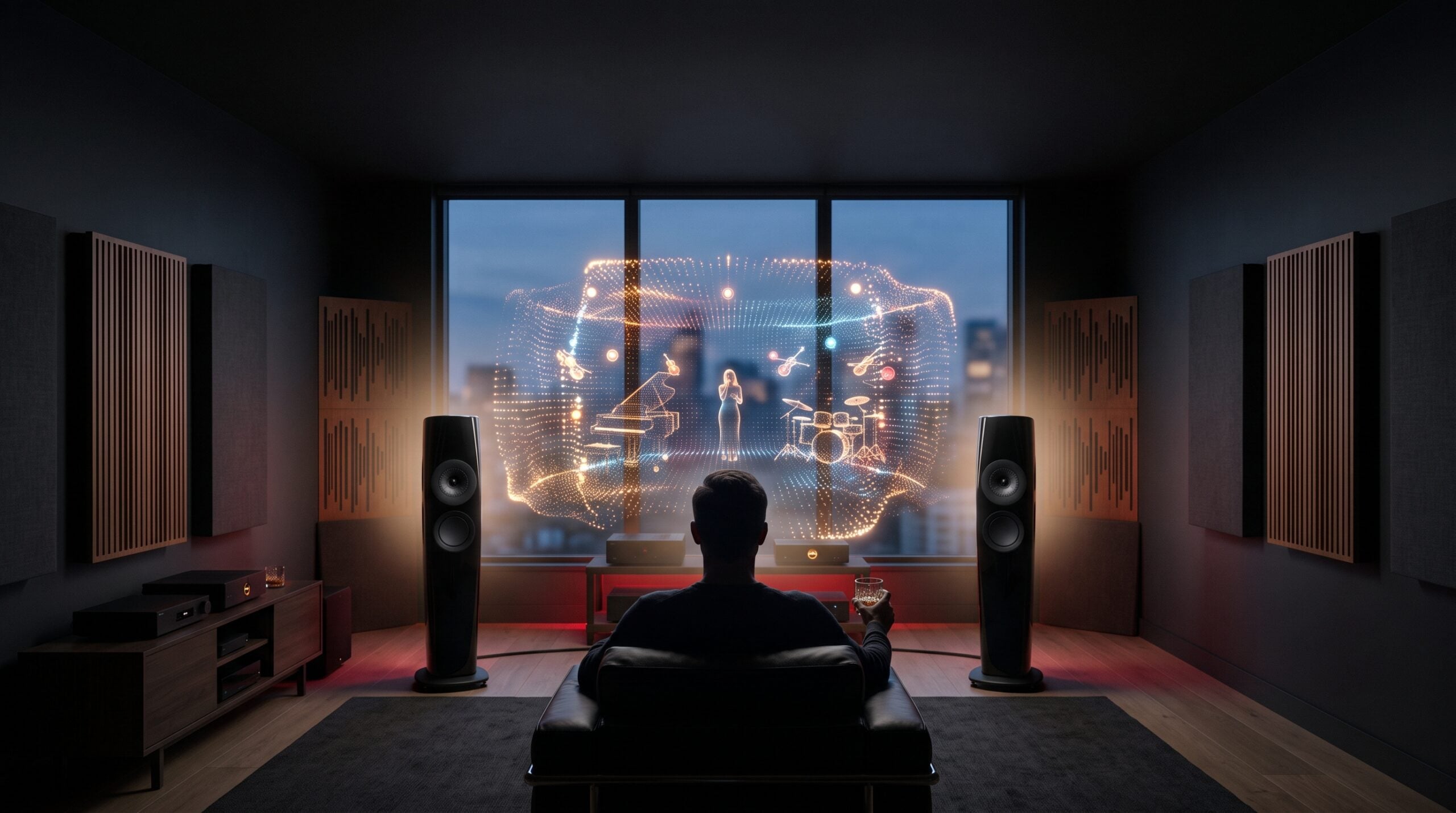
Spatial presentation, or imaging, is an important element of real music, and it matters to many listeners of reproduced music too. Stereo, in fact, is a technology designed specifically to render imaging in a believable way — that is, “like real music.”
Stereo imaging turns out to be produced by a complex interaction of equipment, room, and ear/brain. This paper addresses how the room affects imaging; a separate paper covers how equipment affects it. There can be many misunderstandings of how this works, so the aim here is to clarify.
How to read this document
This paper uses imaging as the overarching term for a stereo system’s spatial reproduction — the whole spatial picture it renders, not just the precision of placement. That may be broader than the imprecise or incomplete audiophile usage, where “imaging” is often conflated with source localization on the soundstage; here imaging is all aspects of spatiality in stereo reproduction. Scene size and environment are imaged too. Imaging, then, is used here to comprise all three listener-facing domains — soundstage, scene size, and environment — defined in Part 1. For the discrete elements of the soundstage we use the term virtual source: a specific thing the recording places in the soundstage, such as a violin or a singer. A system in a room has soundstage characteristics, scene size characteristics, and environment characteristics; these together define its imaging.
Imaging is easier to reason about if the result a listener wants (the “what”) is held separate from the means used to get it (the “how”). This paper defines the three domains as the “what,” then organizes everything else as “how”: for each domain, which physical levers move it, in which direction, and at what cost. The domains are perceptual targets, not measurements; each is anchored to a rigorous measurable correlate so the plain-language term and the physics stay locked together.
Two vocabularies of “how” run throughout. Passive treatment — reflection, diffusion, absorption, and distance/geometry — shapes the acoustic field in the air, after the loudspeaker. Signal-domain DSP — crosstalk cancellation, decorrelation, matrix upmixing, EQ — shapes the electrical signal, before the loudspeaker. They are not interchangeable, and the difference matters at specific points below, so each approach is tagged with its class as it appears.
Inline tags mark, first, which domain an approach serves, and second, its implementation class:
SOUNDSTAGE · TREATMENT soundstage via treatment. SCENE SIZE · DSP scene size via DSP. ENVIRONMENT · TREATMENT environment via treatment. ENABLING · TREATMENT an enabling move that clears the way for all three. CROSS-CUTS · SETUP a lever that cross-cuts domains via setup.
Part 1 — The three domains of imaging
The three domains named above map onto the standard timing partition of a room’s impulse response — direct sound, early reflections, late reflections — which is why they end up cleanly separable by treatment.
1 · Soundstage — where each sound is, and how big its “body” is
Plain definition. The position, the distance, and the intrinsic apparent size of every virtual source — where each one sits, how far away it is, and how large a body it presents. If you can point to the singer, and sense the piano as a wide body located in space rather than a dot, both are soundstage.
Rigorous correlate. Auditory localization — direction from interaural time and level differences (ITD / ILD), distance from the direct-to-reverberant ratio (D/R), and source extent from the spread of inter-channel differences a real (non-point) radiator produces.
Carried by. The direct sound and first arrivals from the musicians — including the source’s own radiating extent, captured by the microphones as a spread of inter-channel differences (phase and level). Genuinely encoded in the recording; the room’s job is not to destroy it.
“Good” target. Precise and stable, each source placeable and rendered at its own believable body-size — the stage neither collapsed onto the speakers nor smeared into a blur. (Encoded width survives stereo; encoded height mostly does not — see the note after the cards.)
2 · Scene size — the added and collective spread on top of the sources
Plain definition. Not the size a source has on its own (that encoded body is soundstage, above), but the added and collective spread built on top of it: how far the whole ensemble of emitting bodies — performers, amplifiers, PA — reaches left-to-right because of placement on stage (real or virtual), and how much each virtual source is further broadened beyond its recorded body by the playback room. In live sound, also the PA’s reinforcement and spatialization.
Rigorous correlate. Apparent Source Width (ASW) plus Apparent Source Height (ASH), taken as the reflection-added and ensemble broadening (the encoded per-source component is booked to soundstage).
Carried by. Early lateral reflections (for width) and early vertical reflections (for height) from the venue, conventionally within ~1–80 ms of the direct sound — plus, in live sound, PA reinforcement.
“Good” target. Larger than the bare sources would give, but proportional to the soundstage — a believable envelope around the sources and a natural ensemble spread, not a smeared exaggeration. Note asymmetry: recorded width is strongly controllable, height is not (see the Appendix), in stereo.
A front-to-back axis too. Scene size is three-dimensional: beyond width and height it has depth — the collective front-to-back extent of the scene — with two very unequal directions. Scene depth is the scene reaching behind the speaker plane; forward projection is the scene reaching ahead of it, toward the listener. The Appendix treats both: in short, scene depth is producible (mostly by preserving encoded cues), while forward projection has no reliable passive-treatment lever at all (although general increases in scene size may affect the perception of forward projection — this is less studied).
3 · Environment — the sense of the venue
Plain definition. The size and character of the space the performance seems to happen in — intimate club to large cathedral — carried by the later, diffuse sound arriving at the microphones after the direct sound and early reflections.
Rigorous correlate. Listener Envelopment (LEV) plus reverberance / perceived room size; the older German term Raumeindruck (room impression) is almost exactly this.
Carried by. The late field, after ~80 ms.
“Good” target. Appropriate to the recording’s venue, enveloping, and larger in spatial extent than the scene size but lower in level — the wash you sit inside, not a spotlight.
A performer’s size lives in two places
This split needs to be stated plainly, because it is easy to file all “width” under scene size and be wrong. A real instrument is not a point: a piano’s soundboard, a drum kit across a riser, a cello’s body and f-holes, even a singer’s mouth and chest all radiate from an extended area. A stereo microphone technique captures that angular extent as a spread of inter-channel differences (and decorrelation) in the direct, first-arrival sound. Because the ear reads width from inter-channel decorrelation no matter its origin, that encoded spread is heard as a virtual source with a body rather than a dot — and since it is carried by the direct sound and fixed in the recording, it is soundstage: a virtual source has a size, not just a position.
Scene size is then what gets added on top: the playback room’s early lateral and vertical reflections that broaden each virtual source further, the collective spread of the whole ensemble, and — in live sound — the PA’s reinforcement. Encoded per-source body = soundstage; added and collective broadening = scene size.
Two precisions keep this honest. First, width is conveyed by the recording, height mostly is not: two ear-height speakers reproduce real horizontal inter-channel cues, so a stereo-mic’d piano is rendered as a wide body, but median-plane height rides on pinna/spectral cues that standard stereo neither captures nor reproduces — so a source’s physical height collapses into timbre and a vague size impression rather than true vertical extent. Second, it is technique-dependent: a distant stereo pair encodes genuine angular extent (and the hall around it), whereas close-miking plus a pan-pot collapses a source toward a point and makes its width a mixing decision (stereo miking, double-tracking). How much encoded body exists therefore varies enormously by recording.
The domains nest, and should stay proportional
The three are not independent sliders to be maxed; they are a hierarchy that mirrors how energy actually decays in a real space. Level falls direct → early → late; spatial extent grows in the same order (a point, then a body, then a room); diffuseness grows too. A natural presentation preserves that order: a pinpoint soundstage, a proportionate scene size around it, and a larger, lower-level environment enclosing both. Distortions of the hierarchy read as unnatural — a pinpoint virtual source floating in a cavernous reverberant wash, or a huge source stranded in a dead space. So the goal is not “maximize each” but “keep them proportional and venue-appropriate” — which is really an instruction to preserve the natural impulse-response hierarchy rather than distort it. Of course, different listeners with different musical preferences may want somewhat different mixes and extents of the three areas of imaging.
| DOMAIN (“what”) | TIME WINDOW | ROOM ZONE | MEASURABLE CORRELATE | “GOOD” TARGET |
|---|---|---|---|---|
| Soundstage | Direct + first arrivals | Front wall, 1st-reflection pts | Localization + source extent | Precise; own body-size |
| Scene size | Early lateral ≈ 1–80 ms | Side/front walls, ceiling | ASW + ASH + depth | Larger but proportional |
| Environment | Late field > ≈80 ms | Rear wall, whole-room budget | LEV + reverberance | Venue-apt; large, low-level |
Part 2 — The levers, and why treatment and DSP are not interchangeable
Until now, we have mostly been talking about what is recorded. The listener then controls how the recording is presented, with four physical parameters — reflection, diffusion, absorption, distance — plus a distinct signal-domain class, DSP. The same parameter changes sign and target across domains: absorption at a first-reflection point enhances soundstage and starves scene size; diffusion at that same point serves scene size; absorption spread broadly sets (reduces the size of) environment. So the levers are few, but their role is domain-specific — which is exactly why the paper is organized by domain rather than by lever. The timing (by spatial position) of the treatment matters as much as the treatment type.
The one asymmetry to internalize up front: passive treatment can add or remove diffuse acoustic energy and can remove early reflections that smear the virtual sources, but it cannot create an inter-channel difference the two loudspeakers are not already producing. Its native territory is therefore the scene size and environment (managing reflected energy) and enabling the encoded soundstage by getting out of the way. Only DSP can invent decorrelation that was never recorded, or cancel interaural crosstalk to restore encoded soundstage cues stereo destroys at the ears. Neither class substitutes for the other.
One caveat frames the whole toolkit: this paper treats the loudspeaker as a fixed point source with a given radiation pattern, but that pattern is itself an equipment variable, not a room one. The speaker’s directivity determines what reflected energy the room even has to work with, and its diffraction, driver integration, phase behavior, and the electronics feeding it further shape how cleanly the encoded soundstage arrives. That is a large enough subject to warrant its own treatment; it is developed in the companion paper rather than here, so that this document can stay focused on the room.
NOTE Imaging Mechanism vocabulary used in the tables:
Reveal — surfaces cues already encoded in the recording (including removing masking, or restoring crosstalk-lost cues).
Add — introduces diffuse acoustic energy from a direction, enlarging a domain without being in the recording.
Invent — creates inter-channel decorrelation not in the source.
Global — biases a whole presentation (distance, height, decay) rather than placing a discrete cue.
Part 3 — Every approach, mapped to a domain
This is the map; the Appendix is the territory. LAYER names the domain an approach serves; CLASS its implementation and, where relevant, the traditional technology (absorption, diffusion, reflection, or DSP); MECH. how it acts (reveal / add / invent / global / limited). Two geometric columns are added: Δt is the arrival delay of the energy each lever addresses, relative to the direct sound; Δpath % is how much farther that delayed energy must travel, as a percentage of a nominal 3 m (about 10 ft) direct path (c ≈ 343 m/s, so ≈ 11% per ms). Both are representative ranges and are blank (—) where a lever acts on the direct sound or the whole decay rather than a single delayed arrival. The pattern to notice: soundstage rows are Reveal, most scene size and environment rows are Add / Invent / Global, and every XTC entry is soundstage. The lone outlier is forward projection, marked Limited — the one target with no dependable passive lever (see the Appendix).
| APPROACH | LAYER | CLASS | MECH. | Δt ms | Δpath % | TRADE-OFF / NOTE |
|---|---|---|---|---|---|---|
| SOUNDSTAGE — localization & depth layering | ||||||
| Front-wall absorption / diffusion | SOUNDSTAGE | Treat·abs/diff | Reveal | ≈2–6 | ≈25–70 | Removes early smearing so depth layering survives (b) |
| (b) Front wall — absorb or diffuse? The reflection’s delay is set almost entirely by how far the speakers sit out from the wall: delay ≈ 2 × (speaker-to-front-wall distance) ÷ c, about 5.8 ms per metre of pull-out. Short delays (speakers < ~0.85 m out, ≲ 5 ms) give severe comb filtering and leave a diffuser no room to develop — absorb. Longer delays (speakers ≳ 1 m out, ~6–15 ms) let the return read as air and depth and give a diffuser far-field room — diffuse, keeping the scattered return ≳ 10 dB below direct. The crossover is roughly 5 ms (≈ 0.85 m of pull-out); by ~15 ms the reflection is effectively in the reverberant field (the EBU early/late boundary). Below the crossover, absorb for precision; above it, diffuse for life. | ||||||
| First-reflection absorption (side walls, ceiling, floor) | SOUNDSTAGE | Treat·absorb | Reveal | ≈3–12 | ≈35–135 | Sharpens focus — but starves scene size width (a) |
| (a) First-reflection points are the mirror points on the side walls, ceiling, and floor where a single reflection from each speaker reaches the listener — found with the mirror trick (slide a mirror along each surface until you see a tweeter from the seat). Side walls and ceiling are the usual absorption or diffusion targets; the floor bounce is normally tamed with a thick rug rather than a panel. Per EBU Tech 3276, reflections earlier than ~15 ms should sit at least 10 dB below the direct sound. | ||||||
| Symmetric geometry / toe-in | SOUNDSTAGE | Setup | Reveal | 0 (direct) | 0 | L–R symmetry pins the center; toe trades focus vs. width |
| D/R ratio (near-field, deadness) | SOUNDSTAGE | Setup | Global | all | — | Sets stage distance; trades directly against environment |
| Modal control / bass trapping | ENABLING | Treat·absorb | Reveal | LF ring | — | Clears LF decay that masks clarity; enabling for all |
| XTC — beyond-speaker / forward / height | SOUNDSTAGE | DSP | Reveal | ≈0 | ~0 | Restores crosstalk-lost discrete cues; can shrink environment |
| SCENE SIZE — width (ASW) + height (ASH) + front-to-back depth | ||||||
| Side-wall reflection (live) | SCENE SIZE | Treat·reflect | Add | ≈3–30 | ≈35–340 | Early lateral widens ASW; costs soundstage focus (c, d) |
| (c) “Live” means the reflection point is left hard and reflective (untreated), returning early lateral energy — the opposite of an absorbed, or “dead,” point. | ||||||
| Side-wall diffusion | SCENE SIZE | Treat·diffuse | Add | ≈3–30 | ≈35–340 | Width with less comb coloration — the strong width lever (d) |
| (d) Beyond the single point (applies to the two side-wall rows above). The exact first-reflection point is where absorption most sharply sets soundstage precision, but width (ASW) is fed by early lateral energy from a broader swath of side wall — roughly from near the speaker back to and somewhat past that point. Diffusion for width is therefore applied over that wider region, not one spot. (Side-wall energy from behind the listener arrives later and feeds envelopment, not width.) | ||||||
| Wide / smooth speaker directivity | SCENE SIZE | Setup | Add | all | — | Feeds clean early lateral energy; precedence escape hatch |
| Ceiling reflection / diffusion | SCENE SIZE | Treat·ref/diff | Add | ≈3–12 | ≈35–135 | Weak ASH lever (no vertical decorrelation) (e) |
| (e) Ceiling — the same three choices as the side walls. Absorb (a “cloud” over the reflection zone) for the tightest vertical focus; diffuse for openness with less comb filtering; leave live for maximum spaciousness but at the risk of vertical comb filtering and softened focus. Caveat: because vertical reflections barely decorrelate the ears, a live or diffused ceiling adds “air” more than true height (ASH). | ||||||
| M/S ‘Side’ boost | SCENE SIZE | DSP | Reveal+ | 0 (direct) | 0 | Amplifies encoded width; fails on mono, hollows center |
| Decorrelation (all-pass / reverb) | SCENE SIZE | DSP | Invent | ≈0–30 | 0–340 | Creates width not in source; smears localization |
| Directional-band EQ (~8 kHz) | SCENE SIZE | DSP·EQ | Global | 0 (direct) | 0 | Lifts apparent height; physics-thin, spectral only |
| Scene depth (behind plane) | SCENE SIZE | Treat·absorb | Reveal | <~15 | <~170 | Preserve encoded depth; speakers “disappear” (f) |
| (f) Scene depth — where the treatment goes. Depth is won at the same surfaces that set soundstage: absorb the early reflections at the front wall and the side-wall and ceiling first-reflection points so the room stops announcing the speaker plane, and pull the speakers out (or use directional speakers). Once early smearing is controlled, the front wall can be diffused rather than dead, to add the sense of space behind the sources. No new location — a different goal for the same treatment. | ||||||
| Forward projection (ahead of plane) | SCENE SIZE | DSP/Setup | Limited | — | — | No researched passive lever; global more Direct/less Reverberant lean or XTC (→ soundstage); may seem more forward with growth of other scene elements |
| ENVIRONMENT — venue size & envelopment (LEV) | ||||||
| Rear-wall diffusion | ENVIRONMENT | Treat·diffuse | Add | >~30 | >~340 | Late lateral builds LEV; independent of soundstage |
| Total absorption / decay budget | ENVIRONMENT | Treat·absorb | Global | decay | — | Sets reverberance & room size; aim T30 ≈ 0.25–0.4 s (g) |
| (g) Total absorption — a T30 target. Aim for a broadband T30 (reverberation time taken over a 30 dB decay) of ≈ 0.25–0.4 s, kept reasonably uniform with frequency (avoid a bass-heavy tail). Dedicated critical-listening rooms target the lower end, ≈ 0.2–0.3 s — the ITU-R BS.1116 / EBU Tech 3276 reference range, which caps mean reverberation time near 0.3 s; livelier domestic music rooms sit ≈ 0.3–0.4 s. Below ~0.2 s tends to sound oppressively dead for music, while much above ~0.5 s starts to blur the soundstage. | ||||||
| Room size / distance to rear wall | ENVIRONMENT | Setup | Global | >~50 | >~570 | Later reflections → larger apparent venue |
| Added reverb / matrix upmixing | ENVIRONMENT | DSP | Invent | >~80 | >~900 | Synthesizes venue not in source (Constellation, LARES) |
| Shuffling (LF difference boost) | ENVIRONMENT | DSP | Invent | LF | — | Low-frequency envelopment (Blumlein / Gerzon) |
Part 4 — Putting it together, in any room
The first design question is which domain is actually deficient, because the extreme of one works against another. A workable general sequence follows the impulse response outward in time. First, set the soundstage floor with passive treatment — front-wall clarity, symmetric geometry, and modal control protect the encoded localization; this is subtractive and comes first because everything else adds energy on top of it. This same front-wall clarity, plus speakers that “disappear,” is also what lets the encoded scene depth project behind the plane. Second, balance the scene size against it with side-wall diffusion and speaker directivity, spending early lateral energy up to the point where soundstage precision starts to suffer — the one real trade-off. Third, dial the environment, which is nearly free: rear-wall diffusion and the overall absorption budget set envelopment and venue scale, kept proportional and lower in level. Finally, use DSP for what physics cannot reach — discrete height, virtual sources beyond the speakers, and forward projection ahead of the plane (which passive treatment cannot deliver) — remembering that crosstalk cancellation buys soundstage, not envelopment. Treatment and DSP are complementary layers, applied in that order; neither substitutes for the other.
Appendix — Details of How the Three Domains of Imaging Actually Work
This appendix expands the map in Part 3: for each domain, the mechanism, the individual levers, and then the trade-offs among them. (It corresponds to what earlier drafts carried as main-text Parts 3 and 4.)
A·1 Soundstage — precision by subtraction
Soundstage is a reveal-don’t-create problem: the localization cues are in the recording, and the room’s task is to stop early reflections from smearing them. The philosophy is subtractive and geometric.
SOUNDSTAGE · TREATMENT The front wall behind the speakers is the dominant lever. A strong early front-wall reflection fuses with the direct sound via the precedence effect and collapses depth through comb filtering; absorbing it yields the cleanest, most precise recession, diffusing it retains “air” while breaking up the specular return. SOUNDSTAGE · TREATMENT First-reflection points on side walls and ceiling, when absorbed, tighten source focus and kill comb filtering — but note the cost banked here: that same absorption removes the early lateral energy that scene size needs (the central trade-off, detailed in A·5). CROSS-CUTS · SETUP Symmetric geometry is non-negotiable: left-right symmetry pins the phantom center, and toe-in trades focus against width. ENABLING · TREATMENT Modal control (corner bass trapping) is enabling — it clears the low-frequency decay that muddies the clarity depth rides on.
SOUNDSTAGE · SETUP Stage distance is set by the direct-to-reverberant ratio (D/R, Zahorik’s primary distance cue): a more direct-dominant presentation — near-field geometry, a deader room — pulls the whole stage forward; a more reverberant one pushes it back. This is the one soundstage lever that can trade directly against, or for, the sense of environment, since the same reverberant energy is being dialed. SOUNDSTAGE · DSP Where the goal is discrete virtual sources beyond the physical speakers — wider than the baffles, ahead of them, or above them — that is mostly done with crosstalk cancellation, not treatment (see the XTC callout in A·5).
NOTE The room is not the only thing acting on the soundstage. Before any reflection exists, the loudspeaker’s radiation pattern decides what energy is launched into the room and in which directions — a smooth, controlled pattern lets the room preserve the encoded soundstage, a ragged one smears it no matter how the room is treated. Driver time alignment and inter-channel matching further set how tightly each source fuses to a point, and the electronics can cap the encoded channel separation that soundstage width depends on. These are equipment variables, developed in the companion paper; they are flagged here only so the reader does not attribute to the room what the speaker or electronics may have already decided.
A·2 Scene size — width by shaped addition, height by exception
Scene size is an additive problem: you enlarge the apparent bodies by adding early lateral (and, for height, early vertical) energy, then shape that energy to broaden without coloring. The width and height halves behave very differently. Note the baseline these levers build on: each source already arrives with an intrinsic, encoded body (Part 1) — the room adds to that, it does not create size from nothing, and over-adding smears the encoded body rather than enlarging it cleanly.
SCENE SIZE · TREATMENT Side-wall energy is the width engine. Live side walls add early lateral energy that lowers interaural cross-correlation (IACC_E) and widens ASW (Barron & Marshall’s lateral energy fraction). SCENE SIZE · TREATMENT Diffusion at the side-wall reflection point is the preferred form: it preserves the widening lateral energy while scattering the specular return in time and space, buying width with far less comb-filter coloration than a bare reflective wall. SCENE SIZE · SETUP Speaker directivity is the quiet partner here — wide, smooth off-axis output feeds clean early lateral energy, and its spectral smoothness is what lets the added energy widen without coloring (the precedence escape hatch of A·5).
Height is the exception. SCENE SIZE · TREATMENT A ceiling reflection adds above-energy that the pinna filters as elevation, but it is a weak, blunt lever: the two ears are separated horizontally, so vertical reflections barely decorrelate them, and ASH rides mostly on spectral/pinna cues rather than on interaural difference. SCENE SIZE · DSP This is why height is where signal-domain tools earn their keep: directional-band or “pitch-height” EQ energizing the ~8 kHz band (Blauert’s directional bands; Cabrera, Ferguson) lifts apparent elevation globally, and crosstalk cancellation is the only route to genuine discrete height. SCENE SIZE · DSP For width, DSP offers M/S ‘Side’ boost (amplifies encoded width, fails on mono) and all-pass/reverb decorrelation (genuinely invents width not in the recording, at the cost of source focus).
A·3 Scene size, front-to-back — scene depth and forward projection
Scene size has a third axis beyond width and height: front-to-back depth. It splits into two directions that could hardly be more unequal in how well the research understands them. As with width, keep the parallel in mind — an individual source’s distance is soundstage (localization by D/R and level); the collective front-to-back extent of the whole scene is scene size. A useful working definition (after Geoff Martin): scene depth is the spread between the nearest and farthest apparent source distances.
Scene depth — the scene behind the plane — is well understood and producible, mostly by preserving what is already encoded. SCENE SIZE · TREATMENT The depth information lives chiefly in the recording: each source’s own D/R, its reverberant tail, level differences among sources, and recorded early reflections at the right times and gains. This is reveal-first — a recording with no depth cues cannot be given depth by any room. The room’s decisive job is not to collapse it. The dominant failure mode is well documented: strong early reflections in the listening room (especially from wide-dispersion speakers exciting the side walls) tell the ear how far away the loudspeakers are, and once the brain has that reference it anchors the whole scene at the speaker plane — a close-mic’d voice then cannot sound closer than the speakers, and a distant one cannot recede. SCENE SIZE · SETUP The fixes are the familiar two: absorption at the early-reflection points and front wall, and/or directional speakers (dipole, constant-directivity) that excite the room less, so the speakers acoustically “disappear” and the encoded depth projects behind them — the Linkwitz “scene behind the speakers” result. Modest enhancement is available on top of preservation: a well-treated or diffusive front wall and adequate speaker-to-front-wall distance (a longer initial time-delay gap) deepen the sense of space behind the sources. But this preserves and enhances encoded depth; it does not manufacture depth from a flat recording.
Forward projection — the scene ahead of the plane — is the honest gap: passive room treatment has no reliable lever for it. It is worth saying plainly rather than implying otherwise. What the literature and practice show can pull virtual sources ahead of the speakers is narrow and mostly not a room matter. SCENE SIZE · RECORDING First, encoded out-of-phase content: strong inter-channel anti-phase (L−R) energy can throw a virtual source outside the speakers and occasionally ahead, but it is content-dependent, present in few recordings, and unstable — the precedence effect tends to pull such sources back toward the nearest speaker. SOUNDSTAGE · DSP Second, and the only reliable method, crosstalk cancellation (XTC / BACCH): by cancelling interaural crosstalk it un-anchors the sources from the speakers so the listener perceives the recording’s original source locations — which can sit ahead of, above, and around — but this is DSP placing discrete virtual sources, so it is soundstage, not a diffuse scene enlargement (consistent with the XTC callout in A·5). SCENE SIZE · SETUP Third, the one — blunt — passive contribution: a very high direct-to-reverberant ratio (near-field geometry, a deadened room) makes the whole scene lean toward the listener, the “in your face” presentation, shifting apparent distance forward and sometimes to or past the plane. That is a global apparent-distance shift of the entire scene, not the placement of chosen virtual sources ahead of it. So the verdict for forward projection is: a recording (out-of-phase) or DSP (XTC) effect, with the room able only to lean the whole scene forward via D/R — there is no passive-treatment method to project a scene, or a chosen source, ahead of the speaker plane.
A·4 Environment — the near-free domain
Environment is the most independent of the three, because it lives past the precedence fusion window: late energy grows envelopment without much disturbing the first-arrival cues that fix the soundstage. This is the domain you can dial most freely.
ENVIRONMENT · TREATMENT Rear-wall diffusion (behind the listener) is the primary lever: it returns late, diffuse lateral energy that builds LEV while, being late and scattered, leaving localization largely intact. ENVIRONMENT · TREATMENT The total absorption budget sets the decay time and thus reverberance and perceived room size — more absorption shrinks the apparent venue, less enlarges it. ENVIRONMENT · SETUP Room size and the listener’s distance from the rear wall set when late reflections arrive, and hence the apparent scale of the space. ENVIRONMENT · DSP Where a room is too small or too dead to carry the recording’s venue, environment is the domain DSP can honestly synthesize: added reverberation and electronic architectural acoustics (Meyer Constellation, LARES), matrix upmixing, and low-frequency “shuffling” (Blumlein/Gerzon) all manufacture envelopment that was never in the two channels. The caveat is proportionality — keep the synthesized environment lower in level than the scene size, or the hierarchy inverts and the result reads as artificial.
A·5 The trade-offs, stated plainly
The tripartition terminology earns its keep here: it localizes exactly which trade-offs are real and which are nearly free.
The one real trade-off — soundstage ↔ scene size. These two share the early-arrival window and fight over it. The same early lateral energy that widens the scene size also smears the soundstage, so “precise soundstage AND a wide scene” is not two independent knobs — it is a single balance struck along one axis. The escape hatch is Toole’s: the precedence effect lets localization key off the first-arriving wavefront while later early energy still builds ASW, provided the loudspeaker’s off-axis response is smooth enough that the added energy is a spectral copy of the direct sound rather than a colorant. So the balance is winnable — but as a balance achieved through directivity plus precedence, not through maximizing both at once. Absorb the first reflection and you buy soundstage at the scene size’s expense; diffuse it and you shift the balance back toward scene.
The near-free knob — environment. Because envelopment is built past the fusion window, environment is substantially independent of soundstage: you can grow the late field with rear-wall diffusion and a longer decay without much harming localization. It is the domain to reach for first when the deficit is “the space feels too small,” because it costs the least elsewhere — subject only to keeping it proportional and lower in level.
The physics ceiling — width is cheap, height is dear. Within scene size, width and height are not equally reachable by treatment. Width has a potent lateral driver because the ears are horizontally separated; height has no acoustic equivalent, because median-plane reflections do not decorrelate the ears. So ASW responds strongly to side-wall diffusion, while ASH responds weakly to anything passive — which is precisely why height is the domain most dependent on DSP.
The XTC trap — a soundstage tool constantly mistaken for the others
Crosstalk cancellation (Polk SDA, Theoretica BACCH) plants virtual sources outside, above, and ahead of the speakers, so it looks like it is enlarging the scene size or the environment. Mechanically it does neither. It cancels the interaural crosstalk that destroys the recording’s encoded discrete-source cues at the ears, so those cues finally land correctly. That is soundstage work, and it is reveal-only: XTC adds no diffuse energy of its own.
The tell is envelopment. A live room or a decorrelator enlarges scene size and environment by adding decorrelated energy and lowering IACC. XTC does the reverse at the ears — it tightens inter-ear separation to sharpen placement. A well-set-up XTC system can therefore present a huge, precisely-mapped soundstage inside a relatively smaller-feeling environment. So, reach for XTC when the deficit is soundstage (imprecise or speaker-bound placement), not when the deficit is envelopment — there it does the opposite of what you want.
Tags: SETUP IMAGING SOUNDSTAGE
Trending Articles
See all
High End Vienna 2026: Loudspeakers Under $50k
- Jun 17, 2026

The 2026 AXPONA Show: Robert Harley on Electronics
- Apr 16, 2026



By Tom Martin
More articles from this editor
Read Next From Blog
See all
Dynamic Range and Choosing Amplifier Power
- Jul 09, 2026
Best Streamers: Tech Comparison
- Jul 09, 2026
Optimizing Network Connections and Wiring for Audio
- Jul 08, 2026