


After 21 years at Munich’s MOC convention hall, the world’s premier high-end audio show moved this year to new digs in Vienna, Austria. To say that the industry viewed this move with trepidation is an understatement. Would consumers show up in a new city? How would the rooms sound? Would important international distributors and dealers come to Vienna? Would be venue work for a hi-fi show?
All these concerns were quickly put to rest as this year’s show got underway. The Austria Center exhibit hall is a much better venue for a show, with its wide hallways, spacious areas, and overall, much better-sounding listening rooms. Attendance was strong, both from international business visitors and consumers. Every exhibitor I spoke with was thrilled with the new venue and attendance. The official attendance was as follows:
- 10,603 trade visitors from 93 countries
- 11,957 visitors from 76 countries
- 549 media representatives from 45 countries
- 23,109 visitors in total from 104 countries
- 500 exhibitors from 41 countries with almost 1000 brands
My beat for this show was digital source components and amplification. It’s a lot to cover, but I was able to discover several new and exciting products.
Five Most Significant Introductions
Wadax Studio Collection
The Spanish digital specialist has been busy expanding its range of Studio products that bring the company’s unique technology to lower price points. The Studio DAC ($42,950) incorporates streaming features from the Studio Player(reviewed in Issue 358) but features new digital conversion technology called RAXA that reportedly delivers lower noise, greater speed, improved harmonic rendering, and a larger soundstage. In addition to a wide range of standard connection options, it includes the AKASA optical input for interfacing with the Studio Transport. The Studio Transport ($39,500) is CD and SACD compatible and features technology from the mighty Reference Transport. The Studio ecosystem is designed to offer 10 performance levels so that users can slowly build their systems by adding the AKASA interface, Studio Clock, Studio Power Supply, and other products in the Studio series. Many manufacturers in Vienna were using the Wadax Studio components in their demonstration rooms.
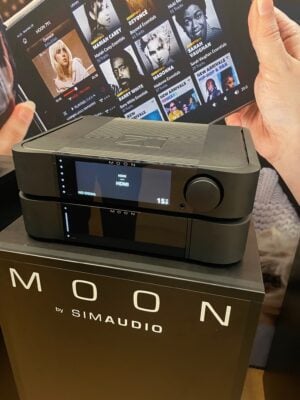
Moon Compass 491 Streaming DAC/Preamp and 461 Stereo Amplifier
Moon Audio has added to its well-received Compass collection with a new streaming DAC/preamplifier and power amplifier. The Compass 491 streaming DAC is based on Moon’s proprietary MiND 2 streaming platform that supports all the major streaming services. Although the 491 is Roon Ready, users can select music and manage their libraries through Moon’s own app. The full-featured phono section appears to be a serious circuit rather than an add-on, with mm/mc compatibility along with selectable gain and cartridge loading. The Compass 491 replaces the 390 and sells for $6500.
The Compass 461 stereo power amplifier replaces the 330A with more power, a vastly larger power supply, and technology trickled down from Moon’s flagship North collection. As is a Moon tradition, the 461 features a robust power supply. In fact, the 461’s power supply has triple the current capability of its predecessor thanks to an innovative new design that is a hybrid of switching and linear techniques. The sonic result is reportedly greater dynamic headroom and the ability to drive low-impedance loudspeakers with ease. Price: $5000.
In the demo I heard of both new Compass pieces driving a pair of $14k Dynaudio speakers, the sound was exceptionally smooth, dynamic, and engaging. This was one of the best of the non-stratospherically priced systems I heard.
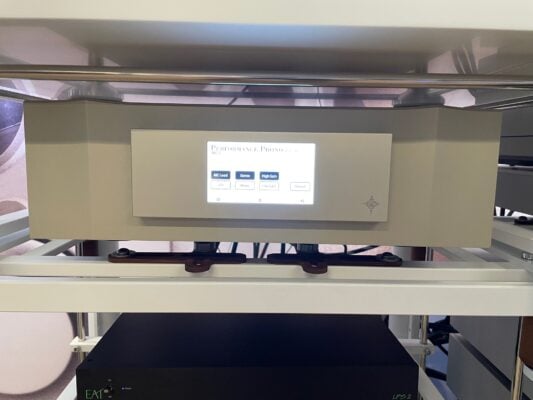
Constellation Performance Phono Phonostage
In addition to the Western hemisphere debut of the company’s Statement monoblock amplifiers that I reviewed in the previous issue, Constellation showed for the first time the Performance Phono phono preamplifier. It is a Class A, fully balanced design using hand-matched pairs of N-channel and P-channel transistors. Unusually, two passive RIAA networks are employed, one on each leg of the balanced signal. The entire circuit floats on a compliant elastomeric “raft” to isolation the circuitry from vibration (with the massive gain required in a phonostage, microphonics are an issue). The power supply is housed in a separate slim chassis, and is a switch-mode design, a first for Constellation in a phonostage. To keep switching noise out of the sensitive audio circuitry, the rectified DC undergoes six cascaded regulation stages. That is, the output of one regulator feeds the input of the next, and down the line. After six stages, the DC is completely noise-free. Cartridge loading is via a front-panel display. Price: $54,000.
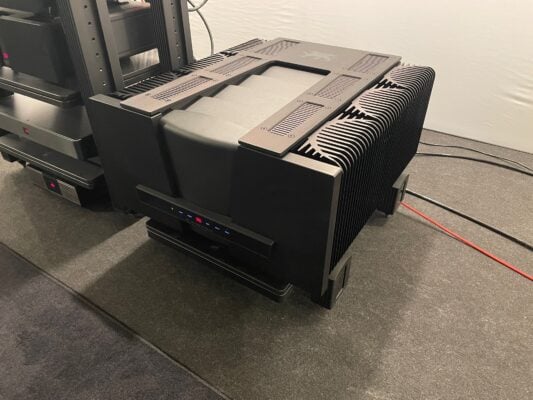
Gryphon Helios Preamplifier and Hyperion Power Amplifier
Gryphon used the Vienna event to launch two new products, the Helios preamplifier and Hyperion stereo power amplifier. The Helios replaces the long-running Pandora preamp, and features parts and technologies derived from Gryphon’s flagship Commander preamplifier. The Helios is a dual-chassis design, with each audio channel and its power supply housed in separate chassis. The fully Class A design features just two JFETs and one resistor in the input stage and like all Gryphon designs uses no global negative feedback. All inputs can be named with individual memory of input gain. The Helios can be fitted with an optional PS3 balanced phono module and a DAC 3 module. An optional outboard power supply increases performance. Price: $29,800, with the optional PSU 5 power supply priced at $20,800.
The Hyperion is a pure Class A power amplifier with new and improved JFET input stage and dual bipolar output transistors along with dual power transformers. The power supply features a whopping 500,000 microfarads of filter capacitance. Price: $80,200 for the stereo amplifier, and a pair can be run as monoblocks at $160,400. As with all Gryphon products, the Helios and Hyperion feature spectacular industrial design and lavish metalwork.
Dan D’Agostino Master Audio Systems Progression Neo
D’Agostino used the Vienna show to introduce a new line of three products, called Progression Neo, replacing the original Progression series. The Progression Neo preamplifier uses a JFET input stage taken from the company’s flagship Relentless preamp. The power supply features an oversized custom transformer encased in a potted module, and the supply has 66% higher rail voltage compared to its predecessor for wider dynamic range. The front panel has an LCD screen, and in a nice touch, this display is duplicated on the bi-directional remote control. An iOS app allows control of the preamplifier via Bluetooth. An optional streaming card is available. In a first for D’Agostino, the Progression Neo includes an HDMI input with eARC (enhanced Audio Return Channel) so that the Progression Neo can accept audio from a television. Price: $25,000.
The Progression Neo amplifier can be had as a stereo amplifier or monoblock. Both amplifiers have a 1800VA custom toroidal transformer and 96,000 microfarads of filter capacitance. The Progression Neo Stereo outputs 250Wpc into 8 ohms and, in typical D’Agostino fashion, can double its output power as the impedance is halved, all the way down to 2 ohms where it delivers 1000W. The monoblock outputs 400W into 8 ohms and can also double its power with each halving of impedance. Using completely redesigned circuitry taken from the Momentum Z monoblock, the Progression Neo has a fully complementary signal path and precision-balanced circuitry. Each input stage is independently regulated for greater channel separation. Price: $25,000 for the stereo unit.
Auspices Debuts
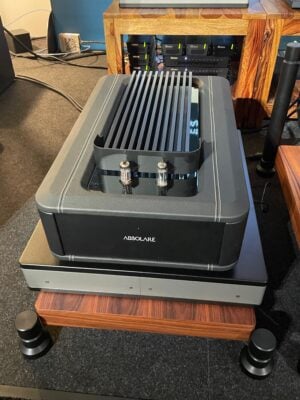
Absolare Altius Two Hybrid Monoblock Amplifier
Absolare produced a beautiful sound with its Eternum preamplifier driving the all-new Altius 2 power amplifier, a hybrid design with a tube input stage and a solid-state output stage. This is an entirely new version of the company’s hybrid power amplifier, with a more sophisticated architecture, cost-no-object parts (including Mundorf and Duelund Infinity-grade capacitors), silver-gold-palladium internal connections, a new power supply, and Echole Infinity internal wiring. The amplifier drove the AlsyVox Botticelli XX full-range ribbon speakers through Echole cabling and produced wonderful combination of resolution with warmth and liquidity. Price: $120,000 for a pair.
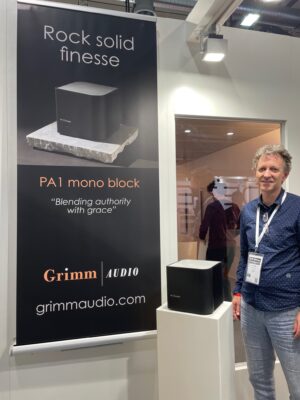
Grimm Audio PA-1 Power Amplifier
It is not often that a novel power amplifier topology debuts, but the new PA-1 from Grimm Audio certainly qualifies as innovative. The output stage is composed of 92 small-signal transistors mounted to a circuit board that also serves as a heatsink. The output devices are always in a stable thermal environment so that the crossover point between waveform polarities isn’t constantly shifting with signal-induced temperature changes. The PA-1 mono amplifier outputs 200W into 4 ohms, and reportedly combines the sonic benefits of Class A design with the efficiency of AB. The pair of PA-1s sounded superb in Grimm’s demonstration using a pair of stand-mount speakers Grimm developed to showcase the PA-1; Grimm’s other loudspeakers are active. Price: €23,500 per pair, with delivery expected in October.
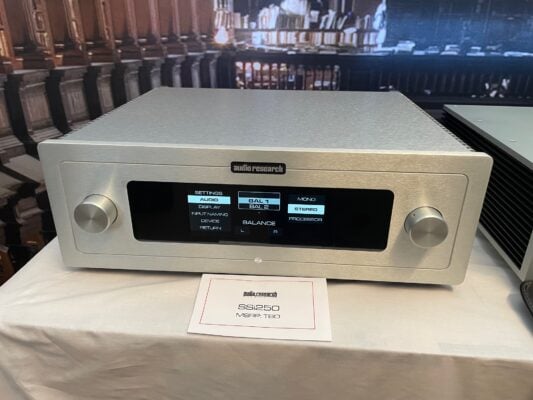
Audio Research Corporation SSi250 Integrated Amplifier
ARC has been on a tear recently, releasing a wide range of new models. The latest addition to the line is the SSi250 all-solid-state integrated amplifier. It is rated at 250Wpc and can accept phono and DAC modules. The SSi250 is essentially the company’s LS3 preamplifier coupled to the S200 in one chassis. Pricing has not been set but is expected to come in at around $18,000.
Ideon Nous Streaming Preamplifier/DAC
Ideon Audio introduced the Nous, a complete digital playback platform incorporating a fully balanced DAC, network streamer, and analog preamplifier in one chassis. The Nous supports all the major streaming services plus NAS rendering, Audirvana integration, and Roon Bridge operation. Unlike many streamers that are based on a generic computer platform, Nous has been designed from the ground up for high-performance audio. The company touts its expertise in high-end DACs, as well as clock management, power supply design, and analog amplification. Ideon’s Real-Time Core technology allocates rendering resources for audio playback, minimizing computational interference and timing inconsistencies. Nous also introduces a new playback application for library management, user interface, and metadata. The signal path is fully differential through the DAC and output stage. A digitally controlled analog potentiometer adjusts the analog output volume. Two fully balanced analog inputs are provided, along with the standard suite of digital inputs for external sources. This looks like a serious piece of digital engineering. Pricing has not been announced.
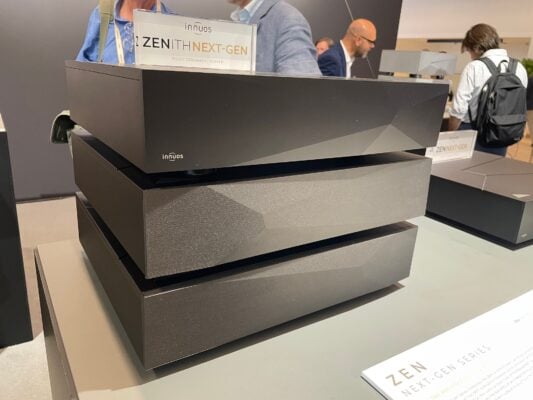
Innuos Network Switches and Next-Gen Flow
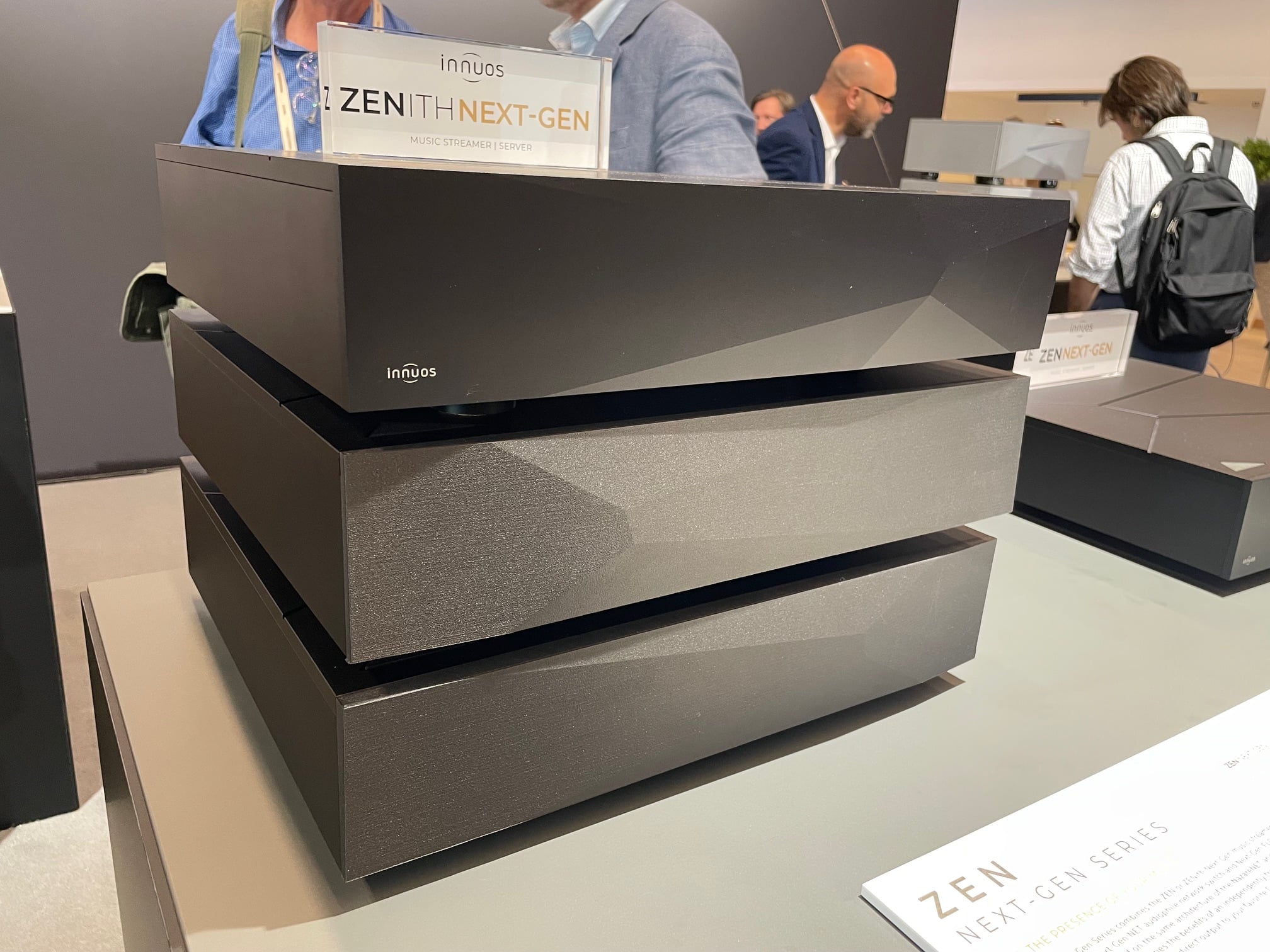
The Portuguese digital specialist Innuos introduced four new products at Vienna, all of which benefit from new technologies developed for the company’s flagship Nazaré streamer. The four products are not new streamers but rather additional boxes that will elevate the performance of the company’s streamers. The four products are three network switches and one USB reclocker.
The Net 1 is the entry point to Innuos’ network-switch family. The compact chassis matches the form factor of the Stream 1 and can be upgraded with an optional LPS1 power supply. Price: $1680, or $2100 with the LPS1 power supply.
The Net 3 is a full-sized chassis with more sophisticated power supply, fiber-optic connectivity, and a trickle-down version of the company’s WaveNET board. Price: $7600.
The Next-Gen Net is a high-end network-switch designed for the company’s ZEN and ZENith Next-Gen servers, but it will also work with the company’s Statement. The Net’s power supply is derived from the ZENith Next-Gen and features a scaled-down WaveNET version of the company’s flagship Nazaré streaming system. Price: $15,200.
The final product is the Next-Gen Flow, a USB reclocking output device that can be fitted with a range of proprietary output modules to maximize performance with those DACs with a proprietary input (e.g., EMM Labs, MSB, and others). The Next-Gen Flow can be added to ZEN, ZENith, and Statement server systems. Available in Q4, the Next-Gen Flow will sell for $15,200.
In Other News
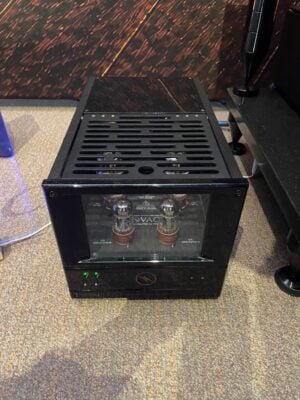
VAC showed a new compact monoblock power amplifier, the Essence 90iQ. It delivers 90W via a pair of Gold Lion KT88 output tubes. Given the “iQ” in the product’s name, it incorporates VAC’s Patented iQ Automatic Continuous Bias System that continuously keeps output tubes optimally biased. The input and driver circuits are adapted from VAC’s upper-end amplifiers, employing two 6SN7GTB octal twin triodes operating in a Class A1 in a direct-coupled configuration. Price: $22,000 per pair.
Kalista S/SC Streamer and Streaming DAC
Kalista, the French company known for its excellent digital source components introduced the DreamPlay S and DreamPlay SC. The DreamPlay S is a dedicated streamer with 100% of the focus on streaming sound quality. The DreamPlay S/C incorporates a DAC. As with all the company’s products, the industrial design, build-quality, and overall execution are spectacular.
AudioQuest DragonFly Copper
AudioQuest’s massively popular DragonFly series of DACs in the form factor of a USB stick (more than 300,000 sold) has been expanded with the introduction of the DragonFly Copper. The new model has double the output power yet consumes 25% less current. Its heart is a new 32-bit ESS Sabre DAC. The copper case is designed to drain RF noise, just as in AudioQuest’s copper barrels on their interconnects. Price: $250.
Cambridge EVO 300 Integrated Amplifier
The EVO 300 is Cambridge’s most powerful integrated amp to date, offering 300Wpc via Ncore-x Class D modules. Cambridge’s StreamMagic Gen 4 engine offers support for all the major streaming services, and the ESS DAC supports the highest-resolution PCM and DSD datastreams. A mm phonostage, balanced XLR inputs, and HDMI eARC round out the connectivity. The preamplifier stage is fully balanced. Price: $3999.
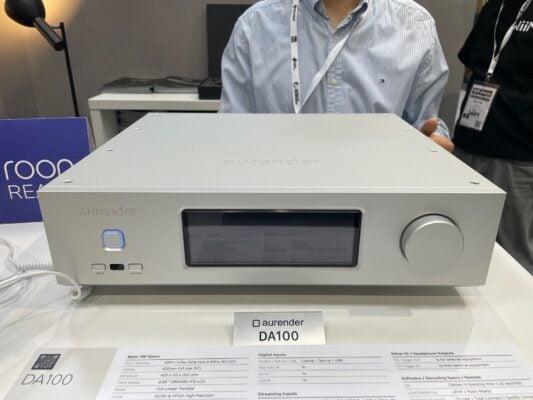
Aurender DA100 DAC
Server specialist Aurender introduced the DA100 streaming DAC and gave me a preview of an entirely new version of its excellent Conductor music-management app. The DA100 offers all the streaming services along with a high-end DAC with dual-mono architecture with AK4499 DAC chips. The analog output stage is a fully discrete Class A design. Four independent toroidal transformers supply power to the extensive regulation stages. The unit features a jitter-reduction technique using a custom oscillator built into a field-programable gate array. The DA100 can be used as a DAC only by bypassing the streaming functions for lower noise. Price: $3900.
dCS MCD 16-Channel DAC
Data Conversion Systems (dCS) launched an unusual product, a 16-channel DAC designed for elaborate high-end immersive audio installations. The MCD is more of a custom installation product that something you walk into a dealer to buy. It is rack-mountable, and eschews the elaborate chassis work for which the company is known. The MCD a modular device with 16 slots that accept the 16 DAC cards, each of which contains the company’s Ring DAC. No price was announced, but I heard that it will come in at about $60,000. I heard a pair of MCDs in an over-the-top 15.8.8-channel immersive demonstration with Perlisten speakers and Trinov processing.
RH’s Best of Show
Best Sound (cost-no-object)
The three systems featuring AlsyVox full-range ribbon speakers all had different virtues, but each of them conveyed the magic of full-range planers executed at the highest level. The Caravaggio XX in the Soulution room (with Critical Mass System Olympus Ultra equipment racks) had stunning speed, coherence, and resolution. Unfortunately, the room was too big for the speaker, leading to an overly lean tonal balance. Yet, the bass rolloff was easy to listen past considering the stunning disappearing act it pulled off.
The AlsyVox Botticelli XX in the Absolare room driven by Absolare’s new Altius 2 hybrid monoblocks in a smaller “sound cabin” was more intimate, with stunning transparency, shockingly wide dynamics, gorgeous rendering of timbre, and a full and satisfying tonal balance. Finally, AlsyVox itself showed the second-from-top Raffaello XX, also in a “sound cabin.” This system, driven by Aries Cerat amplification, demonstrated that full-range ribbons can deliver a full measure of bass extension and dynamics in addition to their myriad other virtues.
Best Sound (for the money)
The new Moon Compass 491 streaming DAC/preamplifier and Moon Compass 461 stereo power amplifier driving a pair of Dynaudio Confidence floorstanding speakers. This system, priced at about $25,000 without cables or equipment rack, that the virtues of high-end audio—musical communication, expression, and involvement—can be achieved in a smaller-scale system.
The speaker bargain of the show had to be the Audiovector R5 ($22,500). Featuring a host of technical improvements, the new speaker had the resolution, clarity, refinement, and soundstaging of a much more expensive speaker. The bass extension, definition, and dynamic authority were equally impressive. Watch for a review.
Most Significant Introduction
The Wadax Studio Collection. This growing family of products brings Wadax’s advanced technologies and superb sound quality to a wider audience, with products tailored precisely for different system configurations. Moreover, Studio series provides owners with a clear upgrade path in the future.
Most Coveted Product
The new Constellation Performance Phono phonostage. In addition to hearing the Performance Phono in an excellent sounding system that included Constellation’s Statement power amplifier and Wilson Sasha loudspeakers, I was given a technical briefing of the unit’s impressive design and build.
Most Innovative Product
Grimm Audio PA-1 monoblock amplifier. The PA-1 addresses a form of distortion (crossover points that constantly shift with signal-induced heat) that affects all Class A/B amplifiers with an innovative output stage built from 92 small-signal transistors mounted on a heat-conducting circuit board.
Trending Articles
See all
Denon DCD-1700NE CD/SACD Player
- Dec 09, 2025
Monitor Audio Hyphn Loudspeaker
- Jan 31, 2026
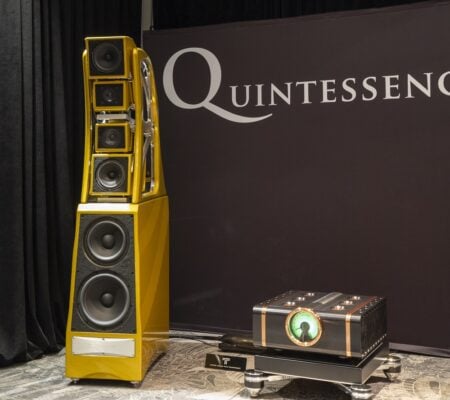
The 2026 AXPONA Show: Loudspeakers $50k and Up
- Apr 17, 2026


By Robert Harley
My older brother Stephen introduced me to music when I was about 12 years old. Stephen was a prodigious musical talent (he went on to get a degree in Composition) who generously shared his records and passion for music with his little brother.
More articles from this editor
Read Next From Show
See all
Vienna Show Highlights | Tom Martin reports
- Jun 13, 2026
High End Vienna 2026: Loudspeakers $50,000 and Up
- Jun 10, 2026
AXPONA 2026: New, Impressive and Good Value
- Jun 09, 2026
The 2026 AXPONA Show: Loudspeakers under $50,000
- Apr 21, 2026

