


Year in and year out, I attend shows in venues I’m intimately familiar with. For better and worse (mostly the latter), I’ve come to know the acoustic challenges of the big rooms and the small ones in Chicago, in Munich, in Denver, in Las Vegas (back when there were shows in Denver and Las Vegas). But it’s been quite a while since I’ve attended a show in an entirely new and unfamiliar spot.
This time around, that is exactly what I did, as the High End Society pulled up its Munich stakes and moved to Vienna’s ACV (Austria’s convention center in Vienna).
Like the rest of the press, I didn’t know what to expect sonically, but, as it turned out, the move was mostly for the better. Where everything (save for a handful of astonishing outliers) tended to sound simultaneously dark and bright in Munich’s so-called “rooms” (really just partitioned-off spaces with glass rear and front walls), the rooms in Vienna were, for the most part, more solid and more neutrally balanced, making for better performance and better listening (thus, the larger number of candidates for Best of Show).
Of course, the exigencies of a trade show (limited set-up time, limited electrical current, limited Wi-Fi, etc.) will always make this kind of venue a compromise. Still, the sound was better here (more neutral and complete—the two keys to stereophonic realism) than it was in Munich or is in Chicago.
With my usual advance apologies to those exhibitors I missed and to those exhibits I attended in which I got nomenclature or pricing wrong, let’s get on to what was a surprisingly good inaugural show.
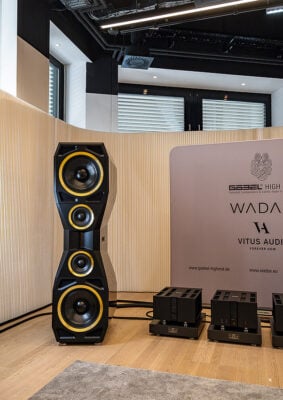
The €469k Göbel Divin Monarque is a huge, handsome, three-way, D’Appolito floorstander with twin glass-fiber/paper 15” woofers, twin bending-wave carbon/paper 8” midranges, and a central wave-guide-loaded AMT tweeter. Driven by Vitus Masterpiece Series MP M202 monoblocks and an MP L201 preamp and sourced by Wadax digital with Göbel cabling, this son of Fafner sounded wonderfully solid on winds, brasses, and plucked and bowed basses in Shostakovich’s puckish Symphony No. 1 with the LSO. The DM’s bass went very deep with just the slightest touch of room boom in the midbass. Massed strings were just as three-dimensionally solid as the winds, brass, and double basses, albeit with a little brightness on upper-octave tuttis. Overall, this was an extremely full and authoritative sound, slightly affected in the upper mids and low end by the room.
ESD Acoustic’s $1,048,571 Super Dragon multiway (11 drivers per side, counting its three cone outboard subs) features seven compression drivers equipped with field-coil magnetics and titanium or carbon-fiber membranes loaded into Chinese-lacquered, carbon-fiber spherical horns of various sizes, all driven by ESD electronics. Quite surprisingly, given its size, complexity, and widely separated free-standing drivers, the Super Dragon sounded intimate and of a piece on Rubinstein playing Chopin’s Valse Brillante, without the slightest trace of incoherence or horn coloration. Originally developed by the late Bruce Edgar, formerly Chief of Acoustics at NASA, and perfected and fabricated by ESD’s Chinese engineers, the Super Dragon is a unique creation with an excellent sound.
Speaking of horns, Audeum displayed a near-100-year-old two-way Western Electric (the engineering and manufacturing arm of Bell and AT&T) motion-picture-theater sound system, featuring WE’s famous 22B multicell exponentially flared horn driven by a WE 555 field-coil compression driver sitting atop WE’s huge TA-7395 baffle with 18” TA-4181 field-coil woofer, all from the mid-1930s. How did it sound a century on? “Unbelievably realistic” would be the words that came to (my) mind. On Glenn Morrison’s rendition of Liszt’s Grand Etudes, this antique produced electrifying dynamics, tone color, presence, and inner detail, resulting in one of the most lifelike reproductions of solo piano I’ve heard at a show (or anywhere else). Bass may not have been the deepest, and the horns definitely sounded forward with truncated depth of image, but the sheer density of color, touch, articulation, dynamic was astonishing. In daily life, much of Western Electric’s science was aimed at increasing the intelligibility of Bell’s nationwide telephone system. This ancient horn loudspeaker system is proof positive that its scientists knew what they were doing. A not-for-sale museum piece that in some ways has never been bettered.
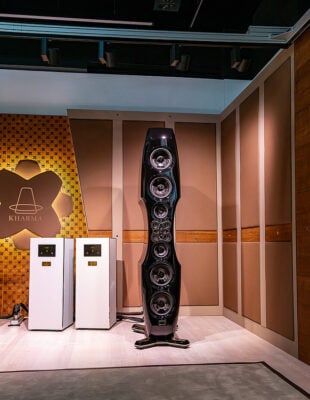
Priced at more than €1,000,000 a pair, Kharma’s flagship Enigma Veyron 1D four-way, 14-driver floorstander (with eight 1” and 2” diamond tweeters in a lotus configuration, two 7” iron-free Omega-F midrange drivers, and four 11” iron-free Omega-F woofers per speaker side housed in a beautifully finished, elaborately machined and structured Tankwood cabinet) was being driven by Goldmund electronics and sourced by Wadax. On a Paolo Fresu recording played back in the rather cramped room the EV-1D was being shown in, the sound was extremely spacious, open, neutral in balance, and seemingly boxless in staging but also a bit boomy and ill-defined in the midbass and slightly veiled in the midrange on trumpet. Since I’ve heard earlier versions of this world-class loudspeaker sound phenomenally realistic, the smallish room in Vienna was clearly limiting its performance.
Once again on the horn front, the €800k Cessaro Horn Acoustics’ Zeta five-way, 10-driver-per-side loudspeaker (four 18” powered cone subwoofers in outboard ported enclosures, two 11” spherical-horn-loaded cone midbass drivers with Alnico magnetics, one spherical-horn-loaded 2” TAD midrange compression driver, one spherical-horn-loaded 1” TAD compression-driver tweeter, and two spherical-horn-loaded TAD compression-driver super-tweeters) was being driven by Alieno electronics and sourced by a Döhmann turntable with SAT tonearm. The Zeta was simply superb on voice, guitar, drum kit, and bass from Dire Straits’ “Wild West End,” with much the same density of color, realistic presence, and standard-setting intelligibility of the Western Electric system and far superior bass and depth of image—proving that in some regards things have not stood still in a century of engineering. Thus far, Vienna was a great show for horns. Clearly, the Zeta was a Best of Show contender.
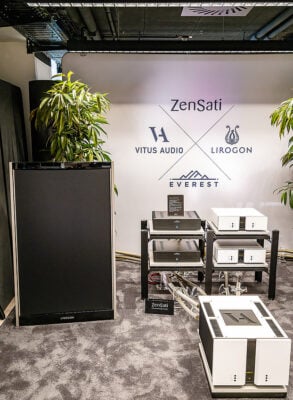
Now for another surprise. A new Polish company called Lirogon introduced a €120k full-range electrostat called the Origin. Based loosely on the legendary Koss Model 1, the Origin uses an ingenious, purely mechanical membrane-tensioning system to set (and adjust) the gap between its ultra-light diaphragm and the stators on either side of it, thus eliminating the need for any fixed spacers or crossovers. The stat panels and stators are housed in a sculpted aluminum frame open on both sides, with four panels tensioned to act as woofers and two others tensioned to handle the midrange and treble. Driven by Vitus Signature Series electronics, the Origin was an ear-opener. Like horns, electrostatic speakers use a technology that is almost as old as high fidelity and still hard to beat at what it does well, which (like horns) is generate sensational intelligibility coupled with extremely natural tone color, lifelike speed and presence (without horn forwardness or colorations), and, in this case (and at long last), superb low bass. On Markus Phillips’ bass on “Pink Panther” and Eric Clapton’s guitar, voice, and accompaniment on his acoustic cover of “Layla,” the Origin joined the Cessaro Zeta as a BOS contender.
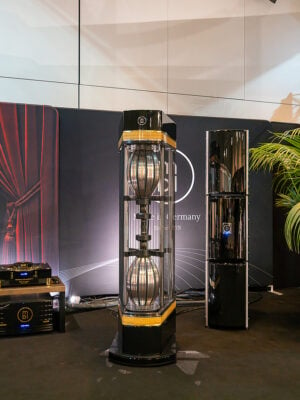
Speaking of which, the $400k MBL 101 X-Treme MKIII (called MKIII as the now-discontinued Class D amp built into the MKII’s woofer stack has been replaced by a newer model from the same company) was, as usual, being driven and sourced by MBL electronics, including a new Noble Line DAC/server/digital preamp, the N41. It came as no surprise to me that the sound was absolutely terrific on Peter Gabriel’s “Solsbury Hill” and Diana Krall’s “Peel Me A Grape.” This incomparably open, literally boxless, immensely powerful, three-dimensional-sounding loudspeaker does one thing that no other stereo speaker I’ve heard can do—it literally blends the acoustic of your room (no matter its size, which in Vienna was vast) with the acoustic of the room in which the recording was made. It is a magic trick that never grows old—and that brings the definition of the word “stereo” (from the Greek stereos, meaning “solid” or “three-dimensional”) to truest life. With terrific resolution, focus, color, dynamics, and rich purling bass, the X-Treme is a perennial BOS contender—this year maybe even more so than usual, in spite of the fact that the system was being played too loudly and its sub stacks were not ideally set up in level and timing (this is what happens when you don’t have old pros like Jürgen Reis, Jeremy Bryan, or Greg Beron on hand). Nonetheless…wotta loudspeaker!
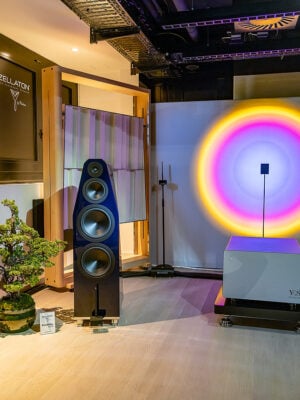
The $90k Zellaton Evo Plural, a four-way floorstander that uses a new sandwich of materials for its drivers’ diaphragms (thus the name “Evo”), was being driven by what may well be the largest amp I’ve ever seen, the YS 338 from Japan, and sourced by a Grado Epoch3 in a Reed Muse turntable with Reed 5T tonearm. Unlike Old School Zellaton drivers, the Evos have no trouble playing loudly—almost too loudly, actually. They sounded piercingly dynamic on Dean Martin’s voice from “I’m Confessing.” They were also considerably darker and less natural in tonal balance than the original Zellaton cones, which could sound fool-you realistic with the right recordings, despite any dynamic limits. The Evos never sounded realistic, though their tonal balance improved when the cartridge was changed from the Grado to a Reed optical with a Reed optical phonostage. Coming after the MBLs, the Evo’s staging seemed constricted, their presentation more “hi-fi” than natural, their dynamics supercharged, occasionally to the point of irritation. In sum, despite its limitations I much prefer Zellaton’s Klassik Series offerings.
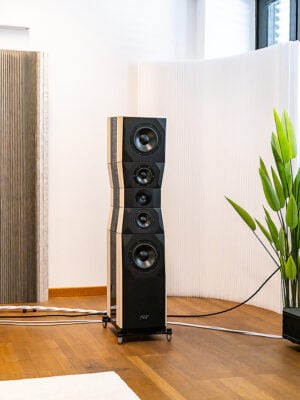
The $192k Peak Consult SunFyre, the newest model from Denmark’s Wilfried Ehrenholz, creator and previous owner of Dynaudio, is a five-driver three-way floorstander in a D’Appolito configuration, powered and sourced at the show by CH Precision. On Mahler’s Third Symphony, the SunFyre sounded impressively neutral, open, and boxless with great delicacy of detail on choral voices and orchestral choirs. It was every bit as natural-sounding on Maria Muldaur’s “Fever,” blessed with the colorlessness, resolution, and coherence of a planar. For the most part, I’ve liked Peak Consult’s loudspeakers in the past, and this year I really liked the new SunFyre. This was an impressive showing.
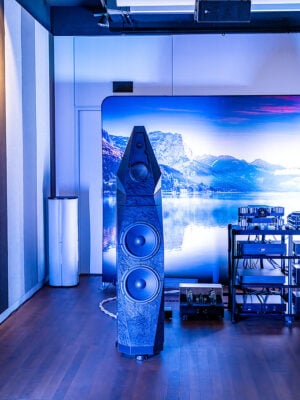
Which brings me to the latest iteration of a classic from another favorite brand, the $290k Avalon Acoustics Saga three-way, four-driver floorstander (one ¾” diamond-diaphragm tweeter, one 7” ceramic midrange, and two 13” composite woofers). Housed in Avalon’s unique, artfully angled cabinet, the Saga offered up the most neutral tonal balance yet on Ahmad Jamal’s “Autumn Leaves,” generating an extremely open, seemingly boxless soundfield peopled with unusually natural-sounding images of piano, double bass, and drumkit. Powered by Doshi’s marvelous tube electronics and sourced by my reference Kalista Dream Play DAC/server/preamp/player, the Saga system was the most realistic-sounding exhibit I’d yet heard. It instantly became one of the chief contenders for Best of Show, along with MBL, Cessaro, and Lirogon (each of which, though arguably less neutral and natural in the midrange, had its own salient virtues).
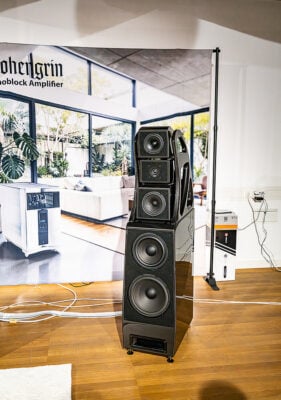
Wilson Audio’s multiway, five-driver (one 10½” and one 12½” hard-paper woofer, one 7” and one 5¾” doped-paper-pulp mid/woofer, and one 1” doped-silk-dome tweeter, each in its own enclosure mounted in a highly adjustable frame) Alexx V, driven (superbly) by VTL electronics including the new Lohengrin monoblocks and sourced by dCS, sounded much more neutral, bloomy, and natural than I’ve heard any Wilson sound in the past. As was the case with the Avalons, tubes made a crucial difference in tonal balance and realism, save for the bass, which, though more than respectably good, didn’t have all the low-end control of solid-state, but, then again, so what? As with the Saga, tonal neutrality is a key to realism, and this was a very neutral presentation. On a French rapper reciting a poem with Ahmad Jamal accompanying him on piano and on Berlioz’s Symphonie Fantastique, the Alexx V made the best (most natural) showing of a Wilson speaker I’ve heard. Obviously, another BOS contender.
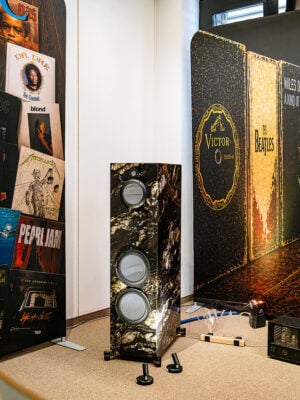
Sourced by an Aurender M30 server and driven by the Polish company Lampizator’s 211 and 300B tube electronics, the $75k Acora Acoustics SRC-5.2C granite-bodied three-way floorstander with Accuton ceramic woofer, midrange, and tweeter made a delightful showing. In Vienna, the 5.2C’s bass was very full and deep and a bit plummy in a small room, making for a darkish overall tonal balance. The speaker sounded quite lovely on the Carmen Suite with beautiful tone color on the “Habanera” and a notably wide and deep soundstage. Count Basie’s “Bluesville” was just as delightfully rich, spacious, and powerful. Though the sound was lovely, it was not as realistic as I heard these same Acoras sound in the much larger and more neutrally balanced ballroom at AXPONA. Still, for musicality-first listeners, it was an unalloyed treat.
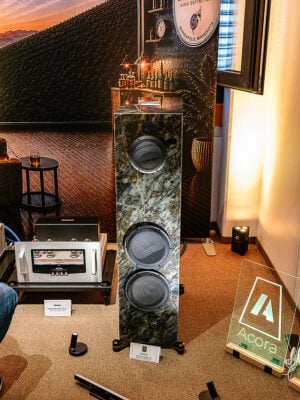
In the room next to the 5.2Cs, Acora Acoustics was demoing with the same musical playlist through its $95k SRC-5.2Dgranite-bodied three-way floorstander, equipped with the same Accuton ceramic woofer and midrange as the 5.2C but with an Accuton diamond tweeter instead of the ceramic one. Driven by the new, all-tube (no JFETs in the front end) ARC 80X stereo power amplifier and sourced once again by Aurender, the diamond-tweetered 5.2D made the “Habanera” from the Carmen Suite sound considerably airier and more neutrally balanced, thanks to the output, extension, and higher resolution of its diamond tweeter. This was much more like the Acoras I’d heard and liked in Chicago. Hans Theesink’s voice and guitars came across with more detail, timbrally and spatially, as did Count Basie’s big band on “Bluesville.” Thanks to its more neutral balance, even the 5.2D’s bass octaves sounded more resolved. (As with the addition of subwoofers, when you change the treble, you change everything.) Though not as dark and beauteous as the 5.2C, the 5.2D was far more realistic and faithful to sources, making for a little lesson in beauty versus truth.
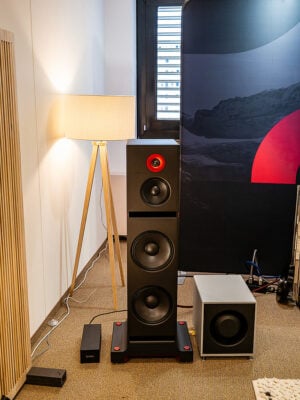
Stenheim showed its $105k three-way, four-driver (two 10” paper-cone woofers, one 6.5” paper-cone midrange, and one 1” soft-dome tweeter in a thin-walled, multi-chambered aluminum enclosure), Alumine 5SX bass-reflex floorstander, this time paired with the Swiss company’s new $18k Alumine S10 sub. Driven by Westend Audio tube electronics and sourced by a Master Fidelity DAC and a Thorens turntable, the 5SXes sounded rather bright in the treble and slightly overblown in the bass on “Badia” by Weather Report (the S10 subs may not have been ideally mated to the 5SXes). “Your Latest Trick” by Dire Straits had the same slight brightness in the upper mids and slightly amorphous low end, though Mark Knopfler’s voice was quite realistic-sounding. Capable of natural reproduction of voice, in this room and in this setup, the Stenheim’s mids were not matched elsewhere in the gamut by the same lifelike neutrality, definition, and resolution.
Voxativ showed its beauteous €80k Elektra equipped with a single AC-X2 field-coil wideband wooden driver in a proprietary back-horn-loaded enclosure (augmented below 60Hz by the separate Pi Bass2 dipolar subwoofer upon which the Elektra was perched). Powered and sourced by Voxativ tube electronics, the Elektra sounded very natural on voice on “Redemption Day” with Johnny Cash and Sheryl Crowe and “I Will Survive” by Ferruccio Spinetti and Petra Magoni, with marvelous instantaneous dynamic life on vocal transients. Though the slightest bit heavy, bass was also lively, terrific actually on “Fall in Love & Find Out” by Maddie and Tea. Like a planar, the single-driver Electra has a unique (for cones) sonic consistency from the midbass though the treble, though the very bottom octaves sound just the slightest bit tacked on (as they are), which is to say the Pi Bass2 makes for a very good but not entirely sonically seamless blend. As usual, the single-driver Voxativ offers a inimitably appealing and lifelike presentation for cones in a box.
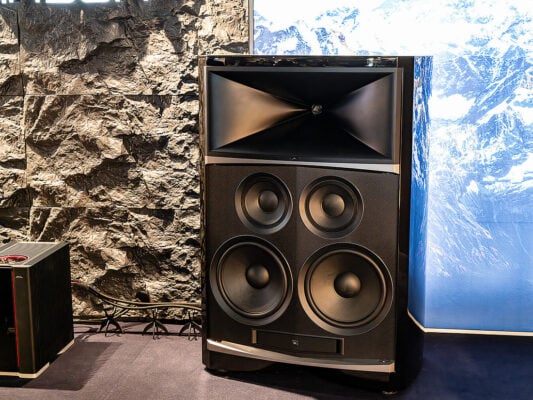
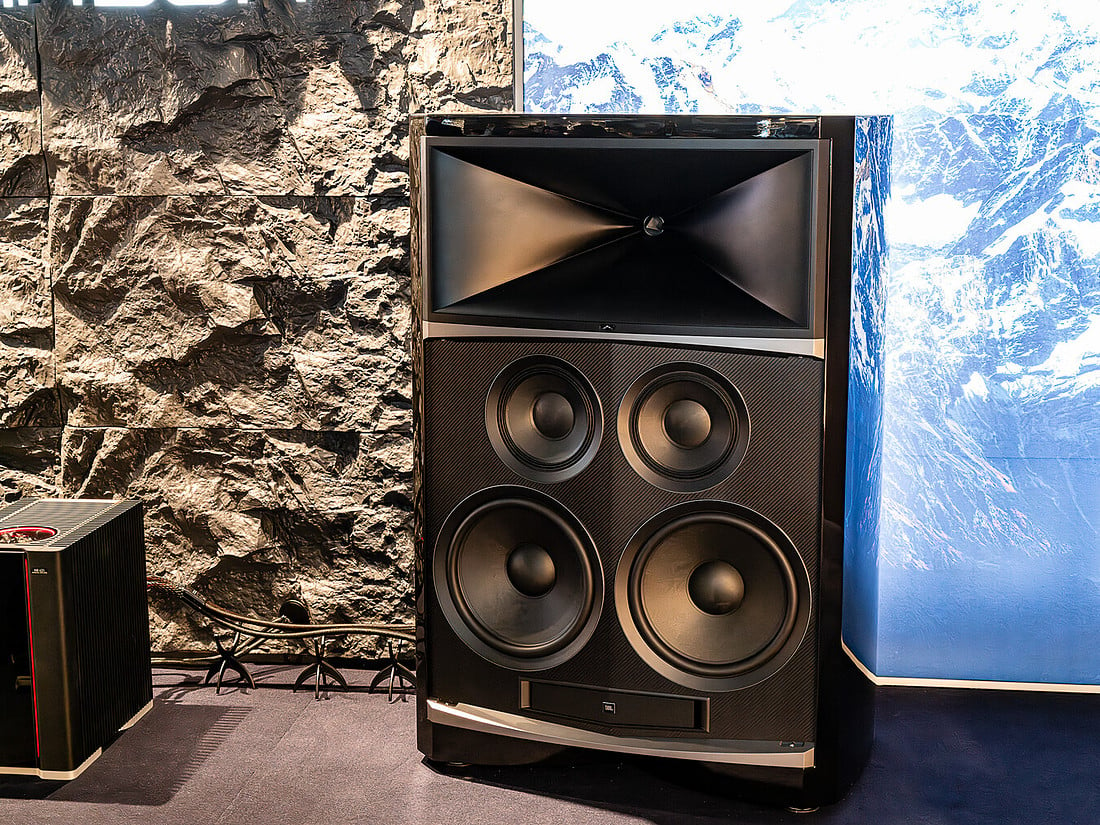
JBL’s giant $160k Summit Series Everest three-way, seven-driver floorstander (three 2” dual-diaphragm compression drivers mated to a Sonoglass HDI horn and augmented by two 10” mid/bass cone drivers and two 15” cone woofers) was being driven and sourced by Mark Levinson electronics. A big, powerful, dynamic, party animal of a loudspeaker, the Everest is not wholly a hi-fi offering. Nonetheless, it has its own appeal if you like your music loud, well-defined, and pacey. Bass was very well controlled, resolved, and powerful. A fun product.
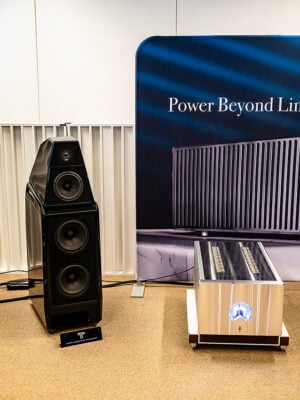
Wilson Audio’s $52k four-driver (two 10” paper-cone woofers, one 7” paper-cone midrange, and a 1” silk-dome tweeter in an artfully constructed ported enclosure), three-way Sasha V was being driven by Constellation’s gigantic new Statement monoblocks and sourced by dCS digital and an EAT turntable with a rebadged Graham tonearm and JOS 3cart. The sound of this formidable system was lovely, very slightly darkish in balance with a bit of room-induced bass boom on Mussorgsky’s Night on Bald Mountain. Dean’s “I’m Confessing” was also lovely in a darkish solid-state way—more suavely beautiful than lifelike. Belafonte at Carnegie Hall, however, was wonderfully well presented with super detail that was also well integrated into ensemble sonorities. Same on Rimsky-Korsakov’s Scheherazade. The slight tonal darkness and bass room issue notwithstanding, this was about as good as I’ve heard the Sasha Vs sound via solid-state.
The $85k YG Acoustics Hailey 3 three-way, three-driver floorstander (10¼” proprietary aluminum-cone woofer, 7¼” proprietary aluminum-cone midrange driver, 1” proprietary hybrid tweeter in a constrained-layer-damped aluminum enclosure) was driven and sourced by Boulder. The system sound was very detailed, densely colored, not overly dark, with some room influence in the bass but not much, making for an extremely attractive and fairly lifelike presentation on “St James Infirmary” with Angela Brown, with terrific attack and sustain on vocal and instrumental dynamics. A very good showing.
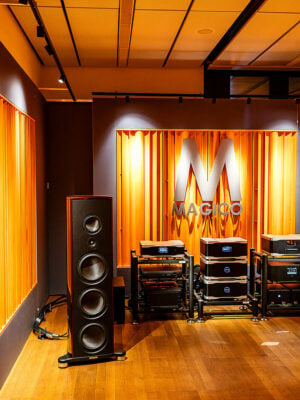
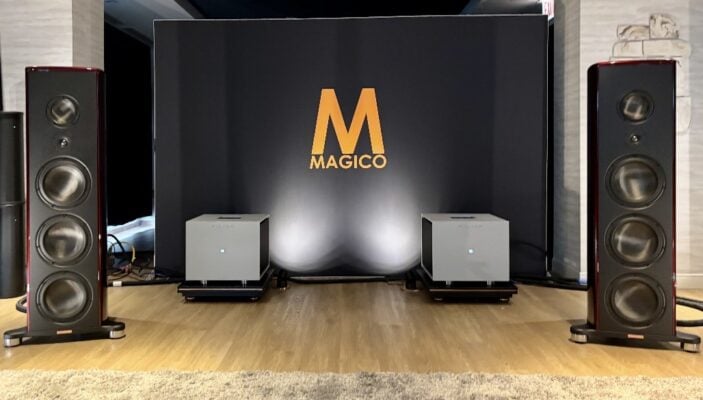
The $135k Magico S7 2026 three-way, five-driver floorstander (1¼” diamond-coated beryllium tweeter, 6” Nano-Tec Gen 8 midrange, and three 10” Nano-Tec Gen 8 woofers in a sealed, computer-optimized aluminum enclosure) was sourced by Wadax and powered by Pilium. The system produced a lush, full, dark sound with very deep bass and superb trailing-edge transients. The S7s were simply gorgeous sounding on Mark Knopfler’s “Sailing to Philadelphia,” with very dense tone color on voice, guitar, and bass and more than modicum of three-dimensionality. A Christian Jones recording was just as ravishingly beautiful on drum, piano, and bass. Though it was, perhaps, more beautiful than realistic, the S7 added a dollop of 3-D imaging and a taut deep-bass octave that made it stand out in a very narrow room.
The svelte, boat-tailed €120k Raidho TD3.10 three-way, five-driver floorstander (two diamond-coated 10” woofers, two 5¼” diamond-coated midrange drivers, and one planar-magnetic ribbon tweeter in a D’Appolito array) was being driven and sourced by EMM Labs. As I will be reviewing this speaker soon, I will only say that it is a considerably more neutral than previous iterations of large Raidho floorstanders, particularly improved in the midbass where earlier versions of these gorgeous speakers with ribbon tweeters and (now) diamond-coated woofers and midranges had a midbass hump that would have made Quasimodo’s back look straight as an arrow. A much improved transducer, the TD 3.10 has a more neutral and lifelike balance than its predecessors, with remarkably detailed 3-D textures and no sacrifice in speed, weight, or density of tone color.
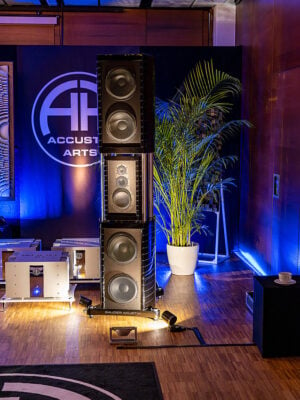
Although it was being played too loudly when I auditioned it, the $460k four-way Gauder Akustik Berlina RC15 driven by Accustic Arts electronics and sourced by dCS still had a neutral balance, albeit with a bit of hornlike shoutiness in the mids on female vocals (which disappeared on male voice), offset by a majestic low end that spread out beneath the midrange like an incoming tide. With a nice taste of three dimensionality on solo voice or instrument, it was overall quite a good showing for Dr. Gauder, who uses DRC to achieve perfect phase response and timing among drivers.
With its dust covers on, the statuesque $600k Goldmund Gaia active, eight-driver floorstander (one dome super-tweeter, one dome tweeter, two 4” upper-midrange drivers, two 6” lower-midrange drivers, and two 12” woofers) looks a bit like a stack of nondescript building blocks. Sourced by Goldmund digital, it proved to be very neutral in balance with a naturally bright presentation of voice and instrumentals that combined the immediacy of life with enough three-dimensional body to make central images sound realistically “there.” Jeff Buckley was particularly lifelike. This was a BOS contender.
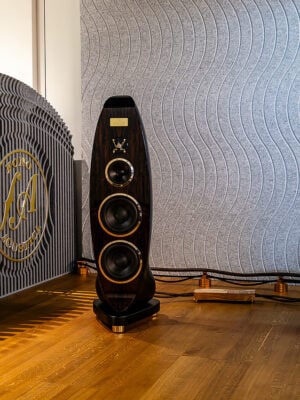
The $220k Avalos Ola Gold Edition three-way, four-driver floorstander (28mm magnesium-ceramic tweeter, 154mm Audio Technology midrange, two 250mm custom-made woofers), driven and sourced by Vitus Audio and wired by Fono Acoustica, served up a lovely, neutral presentation of oud, bass clarinet, bass guitar, and Darbuka and bendir percussion on Anour Brahem’s “Waking State.” Melody Gardot’s “March for Mingus” also sounded quite lifelike, particularly on double bass, and Hans Theessink’s voice and guitars were superb on “No Expectations.” Another BOS contender.
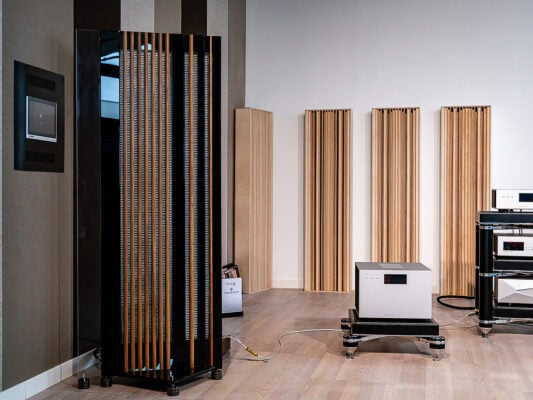
The $258k AlsyVox Caravaggio XX planar-magnetic/ribbon floorstander, driven and sourced by Soulution electronics (including its exceptionally ingenious new 787 turntable featuring linear tracking via a moving platter and a minimal excursion pivoted tonearm) was, in many ways, the most lifelike, highest-fidelity exhibit at the show. Fed by all this fabulous new-gen Soulution gear, the Caravaggio was a model of neutrality and highest resolution, where it played. Unfortunately, this single-panel planar/ribbon did not play everywhere with the same linearity and power. Like the Metaxas Emperor, which suffers more severely from this same problem, in the Vienna show room with these ancillaries the Caravaggio’s bass began to roll off somewhere around 60-80Hz. Though it was quite realistic sounding down to where it lost steam, it wasn’t able to summon up the full low-end power, extension, and color of something like “I Hear You Paint Houses” from Robbie Robertson’s Sinematic. In addition, its imaging and soundstaging, though prodigiously expansive, began well behind the speaker panels, as is often the case with dipoles. Though scarcely a demerit, this recession did require an adjustment after auditioning so many direct-radiating cone loudspeakers. Reservations notwithstanding, the Caravaggio XX did so many things superlatively well it was undoubtedly a Best of Show contender.
The $72k Marten Parker Quintet Diamond Edition two-and-a-halfway, nine-driver floorstander (one diamond tweeter, four 7.5” ceramic mid/bass drivers, and four 9” aluminum passive radiators on its rear panel), was driven and sourced by Lumin. On the bottom up side in tonal balance, the Quintet made Eric Clapton’s “Have You Ever Loved A Woman” a dark chocolate delight. Deep purling bass, lovely piano timbre without a trace of upper-octave brightness, full-bodied synth. An altogether delightful listen that may not have sounded real but nevertheless was beautiful and thrilling enough to greatly please any musicality-first listener.
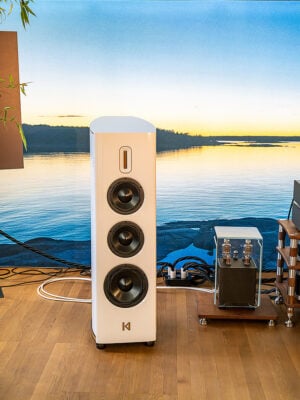
The $118k Kroma Callas three-way, five-driver floorstander (two AMT tweeters, two 8” anodized aluminum midrange drivers, one 10” anodized aluminum woofer), driven by Engstrom and sourced by Wadax and DS Audio, sounded fairly neutral in balance on Voya Con Dios’ “Something’s Got a Hold on Me,” reproducing the background singers with dimensionality, individuation, and lifelike timbre and dynamic, both as individuals and as a group. Cannonball Adderley’s “Autumn Leaves” came across with a wonderfully appealing golden glow on Nat Adderley’s cornet and sweet dark timbre on Cannonball’s alto sax. A very good showing.
The €69k Albedo Acclara Diamond SGS three-way, five-driver floorstander (1” diamond tweeter, 5” Accuton Cell Series ceramic midrange, and three 7” Accuton Cell Series woofers) was driven and sourced by Soul Note electronics and a Thorens turntable. On Jim Keltner and Ron Tutt’s “Amuseum,” these Italian speakers were very hard hitting on drumkit and well resolved on bass and synth. Their power was under control but not too tightly; their tonal balance was dark and attractive though not realistically neutral. A pleasant showing, nonetheless.
Best of Show (cost-notwithstanding)
Avalon Acoustics Saga, with the other contenders from MBL, AlsyVox, Liragon, Wilson, Goldmund, Avalos, Cessaro, etc. very close behind.
Best of Show (cost-considered)
Wilson Sasha V.
Best Soundstage
MBL 101 X-Treme MKIII. As noted, no other stereo speaker can turn your room into the space in which a recording was made like this all-encompassing omni.
Best Introduction
Soulution 787 linear-tracking record player.
Biggest Surprise
The rooms at the ACV (Austria Center Vienna). No one knew what to expect, as this was the first year of the Vienna show, but as it turned out, the listening rooms at the ACV were, in general, sonically superior to the rooms at the MOC in Munich.
Tags: SHOW REPORT LOUDSPEAKER HIGH-END VIENNA
Trending Articles
See all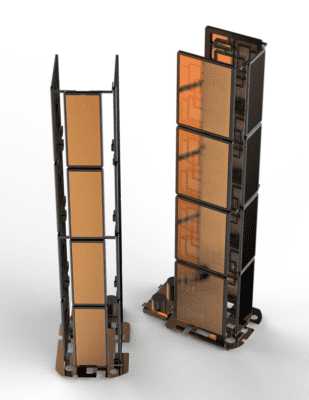
Metaxas & Sins Emperor Loudspeaker
- May 23, 2026
Gauder Akustik Elargo 200 Loudspeaker
- May 30, 2026
Building a Listening Room
- May 28, 2019


By Jonathan Valin
I’ve been a creative writer for most of life. Throughout the 80s and 90s, I wrote eleven novels and many stories—some of which were nominated for (and won) prizes, one of which was made into a not-very-good movie by Paramount, and all of which are still available hardbound and via download on Amazon. At the same time I taught creative writing at a couple of universities and worked brief stints in Hollywood. It looked as if teaching and writing more novels, stories, reviews, and scripts was going to be my life. Then HP called me up out of the blue, and everything changed. I’ve told this story several times, but it’s worth repeating because the second half of my life hinged on it. I’d been an audiophile since I was in my mid-teens, and did all the things a young audiophile did back then, buying what I could afford (mainly on the used market), hanging with audiophile friends almost exclusively, and poring over J. Gordon Holt’s Stereophile and Harry Pearson’s Absolute Sound. Come the early 90s, I took a year and a half off from writing my next novel and, music lover that I was, researched and wrote a book (now out of print) about my favorite classical records on the RCA label. Somehow Harry found out about that book (The RCA Bible), got my phone number (which was unlisted, so to this day I don’t know how he unearthed it), and called. Since I’d been reading him since I was a kid, I was shocked. “I feel like I’m talking to God,” I told him. “No,” said he, in that deep rumbling voice of his, “God is talking to you.” I laughed, of course. But in a way it worked out to be true, since from almost that moment forward I’ve devoted my life to writing about audio and music—first for Harry at TAS, then for Fi (the magazine I founded alongside Wayne Garcia), and in the new millennium at TAS again, when HP hired me back after Fi folded. It’s been an odd and, for the most part, serendipitous career, in which things have simply come my way, like Harry’s phone call, without me planning for them. For better and worse I’ve just gone with them on instinct and my talent to spin words, which is as close to being musical as I come.
More articles from this editor
Read Next From Show
See all
AXPONA 2026: New, Impressive and Good Value
- Jun 09, 2026
The 2026 AXPONA Show: Loudspeakers under $50,000
- Apr 21, 2026
The 2026 AXPONA Show: Analog & Digital Sources
- Apr 20, 2026
The 2026 AXPONA Show: Loudspeakers $50k and Up
- Apr 17, 2026

