

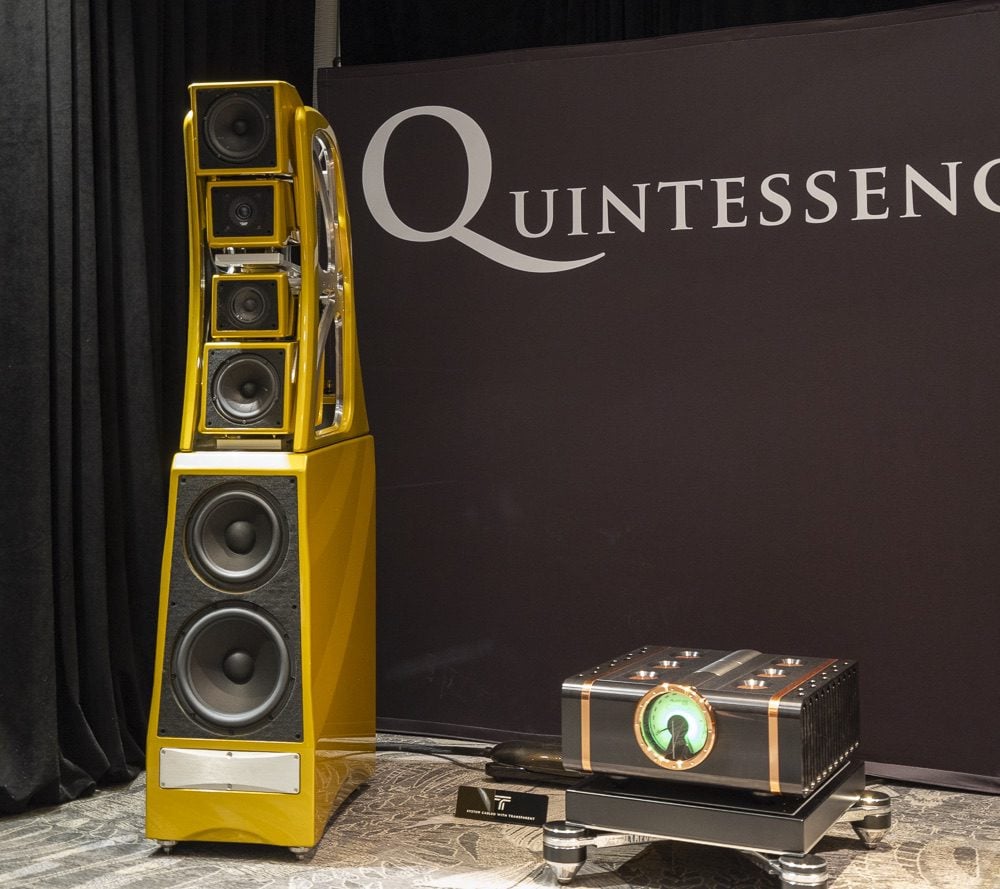
Like last year, the sound at AXPONA was quite pleasantly musical on the whole. While virtually every exhibit, whether in a huge ballroom or a small hotel bedroom, tended towards the dark, bottom-up side of neutral (just note how many times I use the word “dark” in sonic descriptions), it was still a good show for as-you-like-it listeners (which are, far and away, in the majority)—not so much for the absolute-sound or fidelity-to-sources crowds.
As always, I’ve tried my best to provide accurate and complete coverage, but at AXPONA 2026 there was a tremendous amount of ground to cover in my neck of the woods. I did my best, but I’m just one guy, and the field, as noted, was huge. My apologies in advance for any mistakes in nomenclature or pricing.—JV
The gorgeous, hourglass-shaped, $340,400 Estelon Extreme Mk II four-way with five drivers (including two ported 10**woofers) and user-operated, electronic, tweeter/midrange height adjustment was being driven by Vitus SM-103 MkII monoblocks and a Vitus SL-103 preamp, sourced by a Taiko Audio Olympus streamer/NAS drive, with Crystal Cable Infinite Dream wiring and Ortvik room treatments. In the past, I haven’t much cottoned to these tall, complex Estelons, which, despite their stunning good looks, have often sounded a bit dry, lean, and analytical in AXPONA ballrooms. But this time around was different. I don’t know if it was the combination of ancillary components, the room, or something about the speaker itself, but the sound was simply gorgeous, with well-defined, deep-reaching bass (albeit with a touch of room boom) on a Dominique Fils-Aimé ballad, the Buena Vista Social Club’s “Chan Chan,” and Diana Krall’s “Like Someone in Love.” This was an altogether more liquid, continuous, and lifelike presentation than last year’s demo.
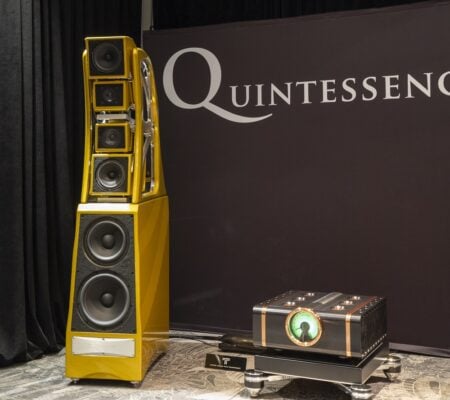
The mighty $464k Wilson Audio XVXes were being driven by ARC’s terrific $90k 330M monoblocks, $48k Ref 20linestage, and $53k Ref 10 phonostage, sourced by a $150k Dohmann Helix One Mk III turntable with a $60k Wilson Benesch Ti Graviton arm and $25k DS Audio Grand Master EX cart (with tubed DS Audio TB-100 EQ) and, on the digital side, the $354k dCS Varèse digital stack. The system had Wilson’s trademark presence, dynamic sock, and bottom-up balance combined with a welcome touch of ARC’s bloom, air, and light. It was a good match, quite attractively musical though never fool-you realistic.
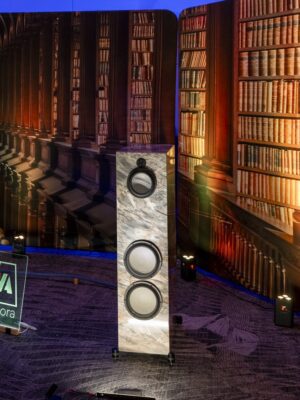
Among other notable items elsewhere at the show, Acora Acoustics was showing its new, granite-bodied, three-way $50k MRC 5.2 with ARC’s $48k Reference 20 preamp and new $23,000 80X stereo amp sourced by a $192k three-box Ideon Axiom digital stack with 16 parallel DACs for extremely low noise and distortion. In a tiny room, the Acora/ARC duo was bloomy and natural in the midrange and treble on a Murmuration cut. The bass, alas, was undone by the narrow space, sounding boomy and overblown.
Sonus faber’s Amati Supreme—a $78k, 4.5-way, five-driver floorstander (silk-dome super-tweeter, silk-dome tweeter, 165mm midrange with neodymium ring magnet, and two 220mm woofers in a sealed box)—was being driven by D’Agostino Momentum electronics, sourced by Clearaudio and dCS, wired by Transparent Audio, and seated on Critical Mass Systems racks. The Amatis had Sf’s typically gorgeous, velvety midrange and bottom-up tonal balance on Molly Tuttle’s cover of “White Rabbit.” Though the bass was just a bit vague in pitch definition, it was also naturally rich in color and quite winningly powerful. The system had terrific staging, imaging well outside the boundaries of the speakers on Geoff Catellucci’s cover of “Sixteen Tons.” All in all, a good showing.
Ø Audio’s $65k Ymir two-way with 76mm horn-loaded, carbon-diaphragm compression mid/tweet driver and 12” carbon-fiber-composite woofer (with three side-firing ports) was driven by a BRAMA integrated amplifier and sourced by a Clearaudio table with Diamond Jubilee cart and an Innuous Statement server with a Merason Audio DAC. On “Hallelujah,” the Ymir showed very rich mids with a slight forward projection of Jeff Buckley’s voice and very quick, articulate, and lively dynamics. It was equally lovely and energetic on Glenn Campbell’s “Wichita Lineman” and Polyphia’s “Playing God.” Another good showing.
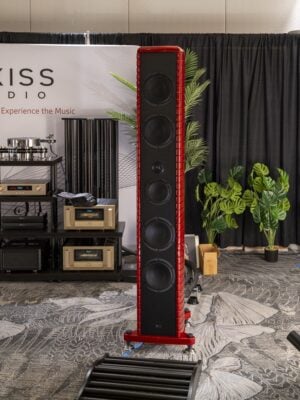
Gauder Akustik’s tall, handsome, $190k DARC-240 MK II four-way, seven-driver bass-reflex tower was driven and sourced by Accuphase with Transrotor/Koetsu analog and Tara Labs cables. On Sting’s “Shape of My Heart,” the DARC had a bottom-up tonal balance, excellent imaging on voice and backup instruments, and a notably wide soundstage. It sounded extremely good on Pete Cincotti’s “Miss Brown” with life-sized imaging of voice, sax, and bass, and superb repro of piano. The first contender for Best of Show.
TAD Labs showed its $86k CR1TX Compact Reference One three-way stand-mount with coincident tweeter/midrange and 8” woofer, driven by TAD’s A1000 integrated amplifier and digitally sourced by TAD’s DA1000TX DAC with Acoustic Signature analog. The hefty CR1TX sounded terrific on Hans Theessink’s “No Expectations”— dark, warm, lovely, with very good but not earthshaking bass. It was also superb on Sinatra’s “You Make Me Feel So Young” from Songs for Swingin’ Lovers vinyl on the AS table. Another BOS contender.
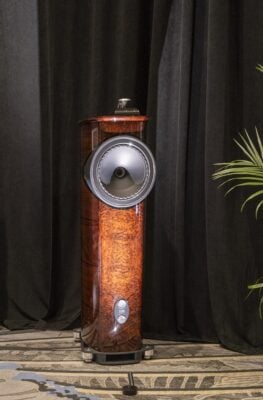
The $52k Fyne Audio F1-12S two-way—with two 12” dual-concentric drivers in a beautifully fashioned cabinet, augmented by a SuperTrax super-tweeter from 16kHz up to 60kHz—was driven by a Musical Fidelity 600 amp and sourced by a Berkeley Audio DAC and Aurender server. This was the first surprise of the show. Relatively new to me (though our Dick Olsher had extolled a smaller Fyne offering in our pages), the system was absolutely terrific-sounding on blues and rock, with the exciting speed and presence of London’s new Reference Type II cartridge and the lovely darkish tonal balance of a DS Audio optical. Resolution was superb, bass solid and powerful, with a little scintillating bite in the treble and a very continuous soundstage. At this point, the Fyne was only challenged by the less immediate but more expansive Gauder and the sterling, somewhat bass-limited TAD.
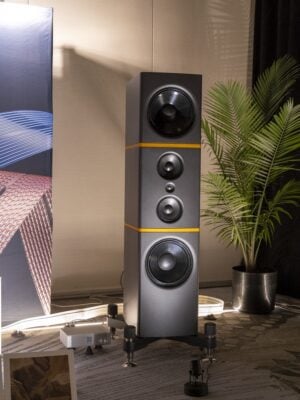
As in the past, Stenheim showed its superb five-driver (two 12” woofers, two 6.5” midranges, and a single 1” soft-dome tweeter in a ported D’Appolito array) $200k Reference Ultime Two SX floorstanders, driven this year by VTL’s brand-new 400W Lohengrin Reference monoblocks, TL-7.5 Series III linestage, and TP-6.5 Series II Signature phonostage, sourced by VPI and dCS, and wired with Nordost Odin Gold and Odin 2 Reference cabling. A DG LP (its first analog-tape recording in many years) of Chopin’s Preludes sounded closely miked and a bit clangorous in the mid-treble, though the bass was extremely good, and resolution, such as the reverberant decay coming off the piano’s sounding board, was outstanding. The system exhibited tremendous dynamic speed and power on the Chopin LP and on Rossini’s “Thieving Magpie” (an LP that our Andre Jennings lent Luke and Bea Manley for the duration of the show).
Raidho’s ultra-slim, sleek, €120,000, three-way, five-driver (two 10” diamond-coated woofers, two 5.25” tantalum-diamond midranges, and one ribbon tweeter) TD 3.10 floorstander was driven and digitally sourced by EMMLabs amps with a DS Audio Grand Master XTreme as the analog source (powered and EQ’d by EMM). There was none of the huge “Børresen bass bump” on very low-pitched synths and acoustic and electric bass in this new design. I thought the speakers might be a little too small for the huge room they were parked in, as image size and height were curtailed. Still, they did an excellent job with stereo spread. The sound, while quite respectably good, wasn’t quite BOS level, although on “Ring-a-Ding Ding” John Pizzarelli’s voice was notably realistic.
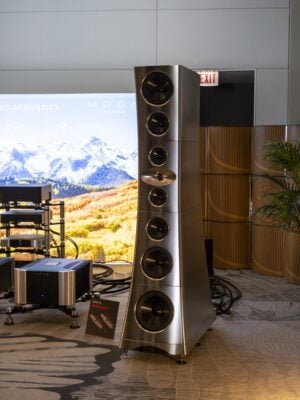
The $910k YG Titan five-way, eight-driver (D’Appolito tower in a tall, gorgeous, tapering, aluminum chassis with polished nickel finish were driven by four Moon by Simaudio 888 monoblocks and sourced by a Taiko Audio server and AMG turntable. I don’t know why, but in this huge room these statement speakers were on the tight, slightly dry, overdamped side, with somewhat constricted imaging and boomy low bass from the poorly integrated sub-bass driver.
This was so far removed from the YG sound I’ve enjoyed for decades (and especially of late) that I can only think that something went very wrong in this hotel ballroom exhibit. In a better room with sufficient electrical power, proper acoustic treatment, and more exacting setup, I’d bet the Titans sound as terrific as they look.
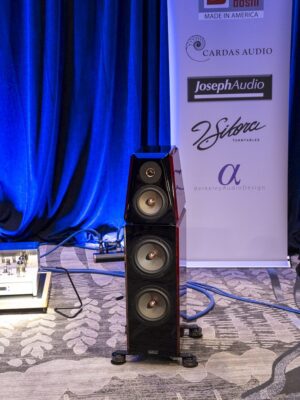
The venerable, four-driver, three-way, $51k Joseph Audio Pearl Graphene floorstander was driven by Doshi electronics and sourced by a J.Sikora table and arm and Berkeley DAC. About the same size as the Raidhos but warmer in balance on Mozart Piano Concerto No. 21 with Istomen, like the Raidho it reduced image height and size in the huge room it was parked in, though its staging was wide and its timbre lovely on “Trilobreta Solo 2” by Uakiti.
New Danish speaker-maker SV(Storgaard & Vestskov)–Audio showed its $82k flagship seven-driver Fenja (two 1.5” tweeters—one rear-facing—one 5” midrange, and four 7” woofers in a multi-ported, multi-chambered trapezoidal cabinet), driven and sourced by McIntosh. The Fenja had very, very powerful low end on “Jazz Variants” by the O-Zone Percussion group and reproduced lifelike vocals on “God’s Problem Child” with Tony Joe White, Leon Russell, Willie Nelson, et al. The surprisingly good, rich, organic sound from this Danish newcomer may signal the advent of a significant new player in the high end. We will see.
The three-way, three-driver $58k Acora MRC 5.2D floorstander with an Accuton diamond tweeter (a first for Acora) and two Accuton ceramic mid/woofs in a granite enclosure that is, well, solid as a rock, was being driven (sensationally well) by top-of-the-line VAC electronics (Statement Line, Statement Phono, and Statement 455 IQ Musicbloc™ dual-mono amplifiers) and sourced by a simply wonderful-sounding SAT CD1 turntable with Lyra Atlas Lambda cart. The sound was breathtaking on Nat King Cole’s “When I Fall In Love”—and on everything else that was played in the large AXPONA ballroom. This was the best exhibit of the show thus far, combining musicality, accuracy, and lifelike timbre in equal measures for a truly entrancing listening experience.
Aequo Audio’s $50k Ensium three-way floorstander with powered bass in a nanotechnology metal-matrix-composite cabinet was driven by hybrid Trilogy electronics and sourced on the analog side by a VPI Avenger/Fatboy record player with VPI Shyla cart and on the digital one by an Ideon Absolute DAC. I was sitting rather close in Aequo’s small room; nonetheless, the Ensium had a very attractive darkish tonal balance with good ambient recovery and just a slight touch of brightness in the upper mids on a Patricia Barber recording. A good showing.
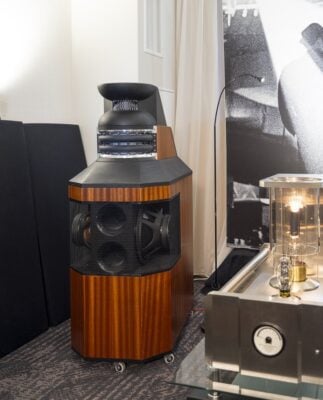
The $150k Western Electric A2 three-way with radial air-motion-transformer tweeter and midrange (said to provide 180° dispersion) coupled to dipole 12” woofers was being driven by $150k 160W WE 100E SET monoblocks, $80k WE91e pre, and $12k WE 203C CD player. The sound was rather lovely, even very closeup in a tiny room. Darkish in timbre, expansive in staging, a little forward in imaging at center, but altogether pleasing in presentation, this was a fascinating intro to a product that was unusual and interesting enough to pique my interest in a review.
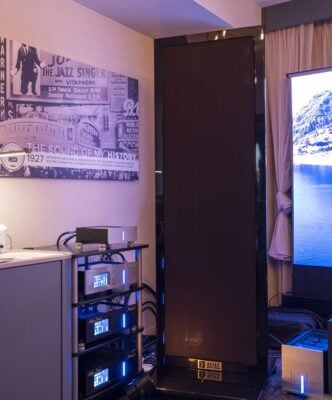
Speaking of unusual and interesting, the $119k Altec Lansing Ribbonacci Reference bipolar three-way planar was being driven and sourced by Infigo electronics. Parking big planars in a small room is not usually a recipe for success, but the Ribbonacci References proved quite musical sounding on small jazz combo with excellent reproduction of piano, bass, trumpet, drum kit, and vocals. Potentially BOS contenders in a larger space, they had remarkable single-driver coherence top to bottom without a trace of boxiness (perhaps because they had no boxes).
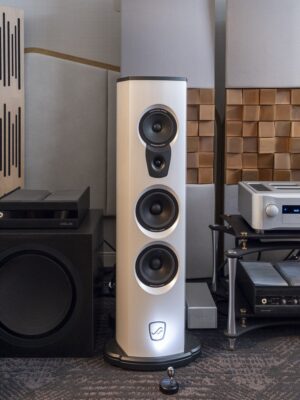
The $60k Audio Soulutions Virtuosa four-driver three-way floorstander driven and sourced by Esoteric, was sited in another small room but managed a well-balanced sound with very solid bass and dark lovely vocals on a Daft Punk recording. A good showing despite room limits.
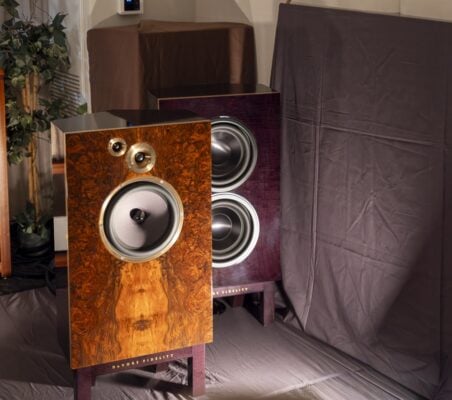
The $89k Devore O/Reference four-box, semi-horn-loaded stand-mount system with separate subs was set up in another small room, and once again it overcame the room’s limitations, producing a very lively, detailed, darkish sound with excellent repro of strings and winds on “A Midsummer Night’s Dream” (Maag). Although it grew a little bright on fortes due to the room, it was otherwise quite impressive, sounding superbly lifelike on a Juilliard Quartet rendition of Beethoven. An excellent showing given the room constraints.
The $65k Cessaro Opus SE Limited horn loudspeaker was driven by Alieno SE amp and Ferraro F9 preamp and sourced by a Raven LS-3 Copper turntable with Fuuga cart. The sound was very lively, of course, with the horn-loaded tweet, but overall timbre was rich and darkish, and the bass though very slightly boomy, was deep going.
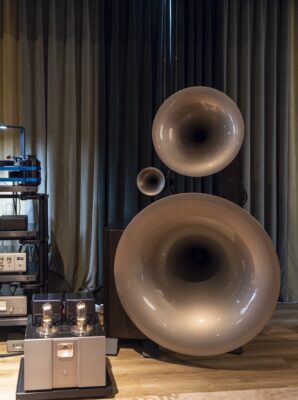
The $200k Avantgarde Trios spherical horn loudspeakers with new TwinSubs were driven by Air Tight’s fabulous tube electronics. The new subs provided extremely deep, well-defined, nuanced bass on synth with a good blend to the Trios on Recondite’s “Compel.” The system generated a deep, wide, encompassing soundstage on Askvik’s “Liberty” and offered tremendous repro of all instruments and vocals on “Walk on the Wild Side” from Lou Reed’s Transformer. Another BOS contender.
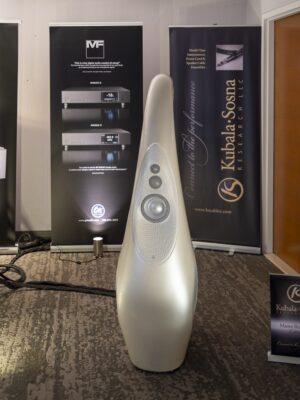
The $95k Vivid Audio Goya G1 Spirit CU driven by Audionet had extremely deep bass on Geoff Castellucci’s cover of “Sounds of Silence.” Darkish in balance, relatively open and spacious in staging, with good individuation of instruments, it only lacked for a little harmonic complexity on my Hans Theessink recording to make the BOS grade. Still, very enjoyably listenable.
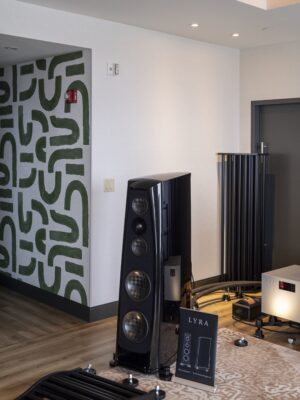
Rockport’s three-way, five-driver, $225k flagship Lyra (first demo at a North American trade show) was driven by Soulution’s fabulous Series 7 electronics (717 amp, 757 phonostage, 727 linestage) and sourced by a Reed turntable and a Metaxas & Sins Tourbillon tape deck. Jeff Buckley’s “Hallelujah” was very dynamic, neutral, and natural on voice and guitar. Indeed, everything played was neutral and natural with a harmonic delicacy and completeness that were simply absent from even the worthiest competition. It goes without saying that the Lyras instantly became a top contender for Best of Show.
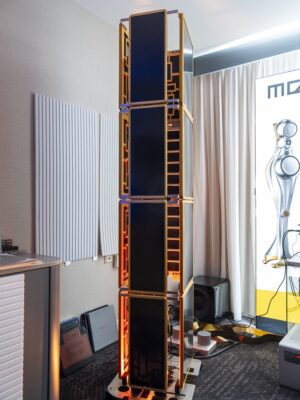
The MBL 101 E MKII Radialstrahlers driven and sourced by MBL’s own electronics made a very welcome appearance at AXPONA—and sounded great doing so. After a period of uncertainty, the brand is back in business under new (and considerably wealthier) ownership. All products will continue to be handmade by MBL’s highly trained staff in its German factory outside of Berlin, and products will now be shipped from Germany directly to MBL’s large network of dealers worldwide. Given that this one of the world’s greatest high-end marques, it is a pleasure to report that all is well again.
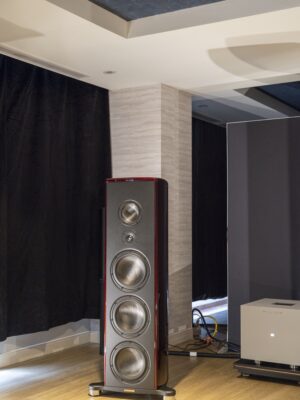
Magico’s $135k, three-way, five-driver (1.1” diamond-coated beryllium tweeter, 6” Nano-Tec Gen 8 midrange, and three 10” Nano-Tec Gen 8 woofers in an artfully curved and damped aluminum enclosure) S7 2026 was being driven by Piliumelectronics and sourced by a dCS stack. A little bright in the upper mids (perhaps a room effect) but otherwise exemplary, the new S7s showed tremendous power, extension, and articulation in the bottom octaves. Though they didn’t have quite the same midband harmonic delicacy, neutrality, and sweetness of the Rockport Lyras powered by Soulution, the S7 2026/Pilium combo did have tremendous dynamic authority coupled with enough very-low-level resolution to make them BOS contenders. I would have to hear them in my digs to find out whether that touch of upper-midrange brightness was a room effect.
The $90k Master Artist Audio Masterpiece Statement—an MTM tower floorstander with a Raal ribbon tweeter flanked by Accuton cell mid/bass drivers on its front panel and dual 8” woofers on its side—was driven and sourced by new Burmester 259 monoblocks, a Burmester 808 preamp, Burmester 111 streamer, and Burmester 175 turntable. The narrow confines of the smallish room limited stage width, but Leonard Cohen’s “My Secret Life” and Janis Ian’s “Jesse” still had lovely natural timbre and tight imaging on voice and guitar. A nice showing.
Franco Serblin’s $60k Unica three-way four-driver floorstander driven by Bel Canto and sourced by a Transrotor Dark Star turntable with Koetsu Rosewood Signature cart sounded swell on Willie Nelson “Georgia,” capturing the darkish timbre of his voice with clear repro of the added echo and nice bottom-up reproduction of piano, guitar, harmonica, strings, and Hammond organ.
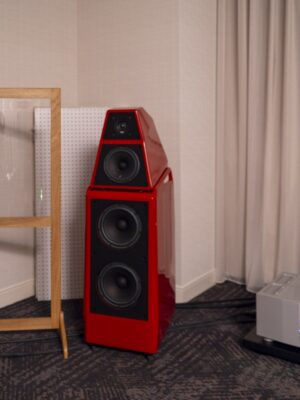
The three-way, four-driver, $54,600 Wilson Sasha Vs driven by Ypsilon Orion monoblocks, an Ypsilon PST100 MK2 SE Anniversary preamplifier, an Ypsilon VPS 100 MK2 phonostage, and sourced by a TechDAS Air Force 3 Premium S turntable with TechDAS Air Force 10 tonearm and Dia cartridge and an Ypsilon DAC/streamer sounded quite good on a stream of Sara K’s “Can’t Stand the Rain,” with very nice repro of instrumental textures, darkish timbre, and fine resolution of performance detail. But it was “Moonlight in Vermont” from Cornelius Ballin’s Mastercut lacquer of Ella and Louis that took my breath away. This was analog playback taken to an entirely new (and greatly elevated) level of sonic excellence. For that experience alone, Maier Shadi’s Sasha V/Ypsilon room deserved a BOS nomination, though to be honest the Sasha Vs are better suited to “musicality-first” listeners than the “fidelity-to-sources” or “absolute-sound” crowds.
To my delight, the $150k Metaxas and Sins’ Emperor omnidirectional electrostats, coupled in Chicago with a pair of SVS subs (crossed at 60Hz) and driven by Soulution 5 Series electronics, made a surprise appearance at AXPONA. Though I was sitting too close at first to music being played back at too loud a level, the sound improved enormously at more reasonable volumes, verging on BOS excellence on my Hans Theessink and Mary McAvoy cuts, with superb delineation of instrumental detail, lifelike timbre, and, of course, no cabinet fog. Coupled with a sub, these stats are contenders.
The $230k Avelos Ola three-way four-driver floorstander driven by Karan Acoustics Class A electronics sourced by a Thiele TT-01 table with Ortofon Verissimo cart and a Kalista DreamPlay XC DAC/player/server, sounded quite lovely on Bach’s Chaconne in D Minor. Sam McClain also sounded superb as did the drumkit, Hammond organ, bass, harmonica, and guitar backing him up, with good performance and instrumental detail and a fair measure of Class A warmth, solidity, and liquidity, making for a good showing in a very large room.
JV’s Best of Show
Best Sound at AXPONA 2026 (cost-no-object)
In a show where virtually everything leaned toward the dark, bottom-up side of neutral, sounding uniformly and pleasantly musical but rarely like the real thing, there was one exception: Rockport’s $225k flagship Lyra floorstander (which, oddly enough, had never before been demoed at a North American trade show). Driven by Soulution’s new ne plus ultra Series 7 Class A electronics, which themselves redefine neutrality and completeness in solid-state gear, the Lyra/Soulution combo consistently came closest to sounding like the real deal. A wonderful showing.
Best Sound at AXPONA 2026 (cost considered)
The Rockport Lyra’s chief rival in lifelike presentation, at one-fifth the price, was Acora Acoustics’ fabulous new $58kMRC 5.2D three-way, granite-enclosed floorstander (the first Acora to use an Accuton diamond tweeter), driven sensationally well by top-line VAC electronics and sourced by a superb SAT turntable. Perhaps not quite as neutral in tonal balance and complete in duration as the Rockport/Soulution combo, the Acora/VAC room sounded so beguilingly lifelike on Nat King Cole and other cuts that the difference was vanishingly slim. This was the best introduction of a new product at AXPONA 2026 and one of the two most realistic-sounding exhibits.
Best Sources at AXPONA 2026
As noted, Maier Shadi’s Wilson/Ypsilon/TechDAS room was unforgettable because it introduced me to Austria’s Mastercut Records (which specializes in transfers made from original mastertapes directly to lacquers). The Mastercut version of “Moonlight in Vermont” from Ella and Louis was like listening to an entirely new and superior performance. Also breathtaking was the sound of Enescu’s Romanian Rhapsody No. 1 from RCA’s Stokowski Rhapsodies album (dubbed from a mastertape to 15ips R2R tape by Analogue Productions) on Alon Wolf’s Studer/ReVox pro tape deck with Doshi head amp. Wolf’s was one of the small handful of rooms offering R2R playback, and the source served his S7 2026/Pilium system superbly well.
Best Introductions
Here the list is longer. Not counting the Acora MRC 5.2D, I was intrigued by any number of novel new offerings, including Fyne Audio’s F1-12S coincident-driver floorstander, Altec Lansing’s Ribbonacci Reference bipolar planar, Western Electric’s quasi-omni A2, SV-Audio’s Fenja floorstander, and Devore’s quasi-horn-loaded O/Reference.
Best News
MBL is under new ownership but will still be designed and handmade in Germany by the company’s highly trained technicians. Great news for any high-end audiophile.
Tags: SHOW LOUDSPEAKER AXPONA
Trending Articles
See all

By Jonathan Valin
I’ve been a creative writer for most of life. Throughout the 80s and 90s, I wrote eleven novels and many stories—some of which were nominated for (and won) prizes, one of which was made into a not-very-good movie by Paramount, and all of which are still available hardbound and via download on Amazon. At the same time I taught creative writing at a couple of universities and worked brief stints in Hollywood. It looked as if teaching and writing more novels, stories, reviews, and scripts was going to be my life. Then HP called me up out of the blue, and everything changed. I’ve told this story several times, but it’s worth repeating because the second half of my life hinged on it. I’d been an audiophile since I was in my mid-teens, and did all the things a young audiophile did back then, buying what I could afford (mainly on the used market), hanging with audiophile friends almost exclusively, and poring over J. Gordon Holt’s Stereophile and Harry Pearson’s Absolute Sound. Come the early 90s, I took a year and a half off from writing my next novel and, music lover that I was, researched and wrote a book (now out of print) about my favorite classical records on the RCA label. Somehow Harry found out about that book (The RCA Bible), got my phone number (which was unlisted, so to this day I don’t know how he unearthed it), and called. Since I’d been reading him since I was a kid, I was shocked. “I feel like I’m talking to God,” I told him. “No,” said he, in that deep rumbling voice of his, “God is talking to you.” I laughed, of course. But in a way it worked out to be true, since from almost that moment forward I’ve devoted my life to writing about audio and music—first for Harry at TAS, then for Fi (the magazine I founded alongside Wayne Garcia), and in the new millennium at TAS again, when HP hired me back after Fi folded. It’s been an odd and, for the most part, serendipitous career, in which things have simply come my way, like Harry’s phone call, without me planning for them. For better and worse I’ve just gone with them on instinct and my talent to spin words, which is as close to being musical as I come.
More articles from this editor
Read Next From Show
See all
Whole Lotta Analog at High End Vienna 2026
- Jun 22, 2026
High End Vienna 2026: Loudspeakers Under $50k
- Jun 17, 2026
Vienna Show Highlights | Tom Martin reports
- Jun 13, 2026

