

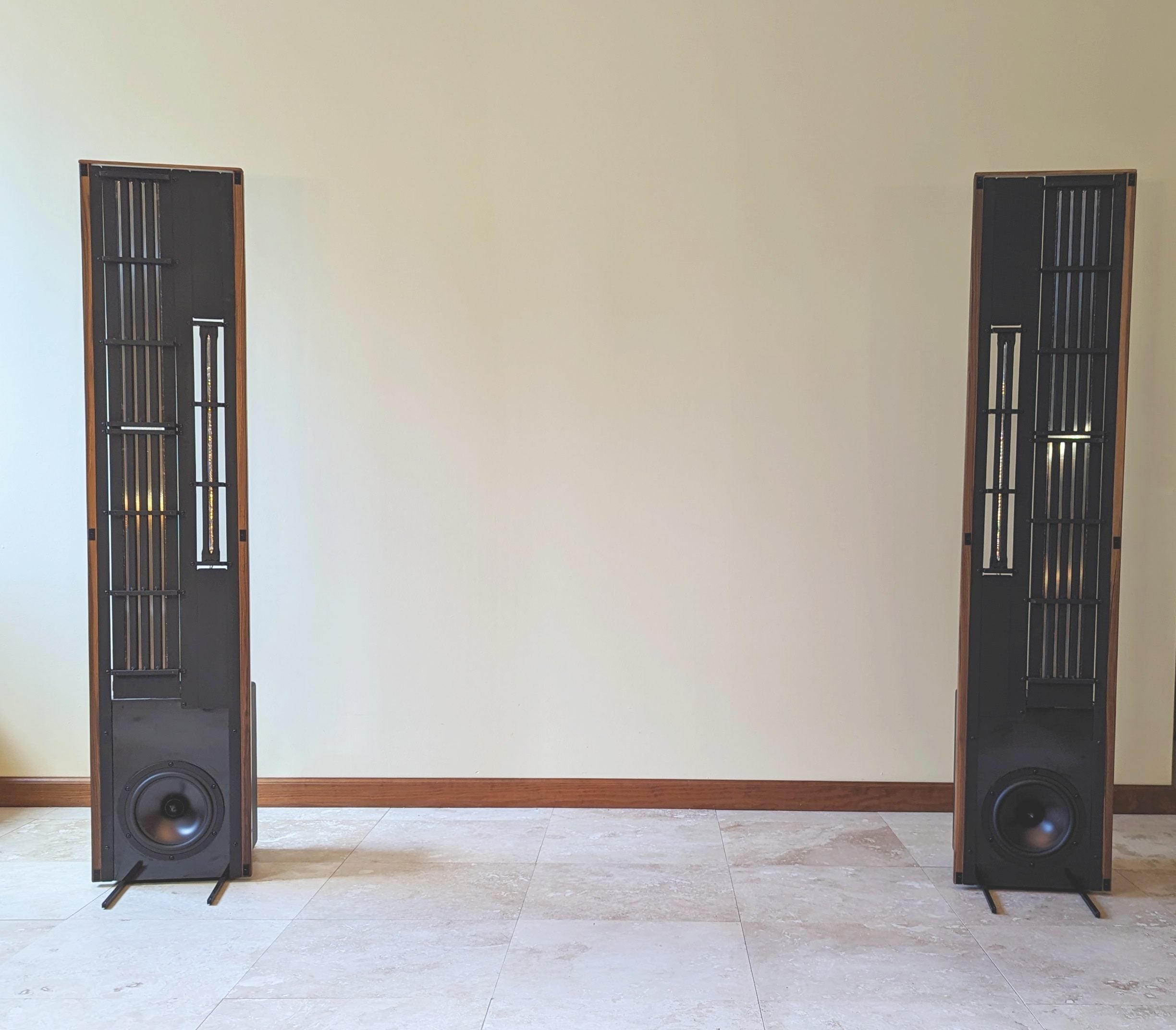
Somewhere in the midst of reviewing the new Eminent Technology LFT-8c’s, I took it into my head to listen to Marc Aubort’s recording of the Ravel String Quartet, played by the original Cleveland Quartet (Telarc CD). This was Aubort’s personal favorite among all his many recordings over a long and distinguished career, and one expects it to sound good. But listening to the LFT-8c’s, it occurred to me that it did not just sound good as audio goes; it also had a beauty of sound comparable to live music. It was not that it sounded exactly like the live experience—how would one know?—but that the musical gestalt was presented in such a way that one could, and ought to, listen to it in the same spirit of enchantment that one finds in live performances under favorable circumstances. I made a quick mental note that I would have to try to explain how this feeling arose, and then I went back to listening to the Ravel with total absorption.
If you, like me, regard such semi-mystical experiences as the only real reason to be interested in serious audio, you could almost stop right here. If the 8c’s worked for this, they would likely work for lots of recordings—as, indeed, turned out to be the case—and such enchantment is what we are all after, isn’t it?
But there is a difficulty in such a style of audio reviewing. One person’s enchantment might be another person’s cold baloney. So, audio reviewing has developed a large vocabulary and conceptual framework to try to give something resembling transferable information on how audio equipment works. And a reviewer is stuck with having to justify his ecstatic reactions in supposedly “objective” transferable terms.
I suppose most of my past readers tend to think of me as someone who goes towards such “objective” descriptions naturally, by preference. But part of me is in fact a sort of crazed romantic—I once seriously considered buying some speakers that were far outside my budget on the sole basis of the way they made Arthur Grumiaux sound so beautiful on one single record (To My Friends, on Philips), as he did sound in reality. I have always regretted that the cooler heads of my friends talked me out of this. I can hear that sound now in my mind’s ear.
This LFT-8c experience was something like that—once heard, never forgotten.
All speakers involve compromises, and I shall have to add some caveats as I go along, at the same time as I am going to explain where the beauty came from. But keep in mind all along that the beauty is there. “One crowded hour of glorious life is worth an age without a name.” I mean, it is the essence of romanticism, isn’t it?
And when one considers that the LFT-8c’s cost a moderate amount of money, one is beginning to talk of irresistibility.
The Physical Nature of the Speaker
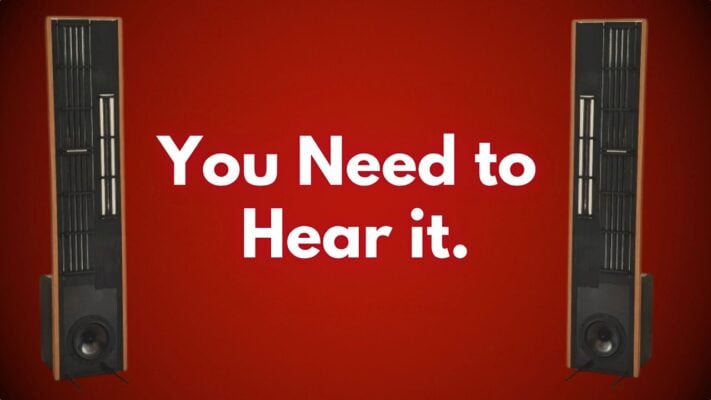
The LFT-8c’s are similar in general terms to the 8b’s, which I reviewed previously (Eminent Technology LFT-8b Loudspeaker, The Absolute Sound). Like the 8b’s, the 8c’s have a box bass unit on the floor with a mid/treble panel attached to the front of the box. The mid/treble unit contains two planar-magnetic drivers, driven from both sides (which reduces distortion a lot compared to single-sided drive), both much taller than they are wide and operated as dipoles. So, the whole speaker above the bass operates in effect as a line-source dipole or strictly speaking a partial line source. (A true line source has to run from floor to ceiling, but when the height of the source is large compared to wavelength and the width small, a good approximation of a line source is obtained.) But there are major differences between the 8c and the earlier 8b. There is a new tweeter. And in a truly major change, the bass unit in the 8c has a rear-firing reverse-polarity driver added to the front-firing woofer so that the lower frequencies come close to dipole behavior. And there is DSP processing, which delays the mid/tweeter unit’s signal to make it aligned in time with the bass. The mid/tweeter unit uses first-order crossovers so that the speaker is phase linear above the bass. It will reproduce square waves at, say, 1kHz quite nicely! You can find further generalities about the upper-frequency two-way unit in my 8b review linked to above, but the bass operation is new. And it works extremely well. Details will be discussed later.
Altogether, the 8c falls into the category of essential uniqueness. There are other bass-unit/panel hybrids, but there is nothing else quite like the 8c, with its new and unusual woofers. Incidentally, you can change the bass to operate as a monopole by rewiring via a jumper shift (easy to do), but I doubt that you will want to since the quasi-dipole operation gives the 8c a completely coherent uniform sound arising from the essentially constant radiation pattern throughout the transition to the mid/tweeter unit.
What Makes the 8c Sound So Good: Part 1, Low Distortion
Low levels of distortion, of deviation from linear behavior, are of course one of the most standard audio criteria. Oddly enough, the concept has been muddied in recent years by confusing “linearity” with flatness of frequency response. What linearity really means is that the output from the sum of two inputs is the sum of the outputs from the two inputs applied separately. The deviation from this can be measured in various ways. Harmonic distortion is the most familiar: It is the percentage of the output from a sine wave input that is not a sine wave of the same frequency. The response to a sine wave input is typically a sine wave of the same frequency plus some “harmonics”—sine waves of frequencies that are a whole-number multiple of the input frequency, twice that, or three times that, etc. The percentage energy that these spurious harmonics have compared to the output at the fundamental input frequency is the measure of “harmonic distortion.” This has nothing to do with frequency response. But it has a lot to do with linearity in the true sense (of Output from A + B = Output from A + Output from B), although what harmonic distortion percentage has to do with linearity is a mathematical matter which is beyond the scope of this review to explain. (Surprising, is it not, how words get tossed around in audio without clear concepts in sight of what they actually mean.)
In any case, low distortion in the technical sense is connected to what is perceived in listening terms as purity of the sound. And the point here is that the LFT-8c’s have extremely low distortion. People have long noticed that electrostatics have exceptional sonic purity (and low measured distortion, too), but the 8c’s are equal or, I think, even better. Indeed, the 8c’s have the lowest perceived distortion of any extant speaker that I am aware of. (The “extant” is to rule out the legendary and impractical cold plasma Tolteque speaker, which never became a real-world product. There is no diaphragm like no diaphragm.) It is really startling to hear a pure-voiced soprano on the 8c’s. The voice has the purity of real life. Montserrat Caballé, say in Turandot on Decca, has the almost divine purity of sound that she had live, for instance.
Audio people are often a little strange about distortion, worrying about extremely small amounts in electronics while ignoring the much higher levels common in speakers. In days gone by, this made a little sense because speakers have little high-order harmonic distortion, while sometimes electronics have distortion in the higher-order harmonics, and that kind of distortion is more annoying. But today distortion in electronics is way down in level for all the harmonics, whereas speakers often have substantial amounts comparatively. But with the 8c’s distortion is way down in level, and one really hears this as sonic purity.
What Makes Them Sound So Good: Part II, Phase Linearity
The 8c’s are phase linear above around 300Hz. As noted, they will reproduce 1kHz square waves, a test where most speakers make an utter hash of the wave form in literal terms. Historically, when changing phase without altering amplitude response was difficult, it used to be believed that this did not matter. Indeed, there is another “Ohm’s Law” (not the V/R=I one) that says the ear cannot hear phase, only amplitude. But in modern times, when it became easy via DSP to alter phase without changing amplitude response, it was found that the phase behavior was audible. Maybe it does not seem huge to some people, but audible it is, on transient sounds in particular and in resolution of complex material. And here in the 8c you have it.
Now to hear this properly, you have to sit in the right spot, so that the distance from the mid-driver matches correctly the distance to the tweeter, but you need that anyway to get the frequency response right (more on sensitivity to listening position later). The 8c really gets attacks right—not by over-emphasizing them but by lining the frequencies up right in time. Pianos really sound like pianos, for instance. To some extent, any speaker that runs a single driver over the whole range from say 200Hz to 3kHz will get some of this (forget about speakers with crossovers at, say, 600Hz of higher order). But getting phase linearity all the way up is an even better idea.
The mid-fi people will tell you not to worry about this, but in a world where people are worried about the phase shifts from roll-off of electronics way on up and in filters for digital and so on, it makes sense to me to get phase-linear speakers. (You should know that 24dB-per-octave Linkwitz-Riley crossovers kick phase all over the place in the vicinity of the crossover frequency. The claim that those crossovers are phase correct means at best that the drivers are in phase at the crossover frequency, but the summed response, what you hear, is flopping around like crazy near but not right at the crossover frequency.) For phase linearity without DSP, you need first-order crossovers, and that is what you have in the 8c between mid and tweeter.
What Makes Them Sound So Good: Part III, Coherence
The LFT-8c’s speak with one voice in a way that is unusual among speakers and essentially impossible with dynamic speakers in boxes. A forward-radiating box speaker is not forward-radiating from bottom to top. At the bottom, it starts out omni, and then at a certain point, as frequency rises, it switches over to being more or less literally forward-radiating. This is the “baffle step,” which occurs when the wavelength gets short enough that the size of the front of the speaker blocks the sound from going around behind. In a typical narrow-front floorstander this happens around 500Hz. Now, it can be arranged that this happens relatively gradually, but happen it must. A forward-radiating box at 1kHz is doing something quite different from what it does at 100Hz. It helps to have a wide baffle so the transition happens lower down, but a transition is always there. This does not happen in the 8c’s.
In the 8c’s, the pattern of the radiation remains uniform over a very wide range. There is no “baffle step,” no sense of changing sonic nature as one goes up from say 100Hz, and even the bass seems very much of a piece with the rest to the extent that is possible in the context in which bass in a room inevitably involves room modes. But the room modes are much better controlled, too, than with an ordinary box speaker because of the dipole-like character of the bass unit, with its reverse-polarity back driver.
Incidentally, you can rewire the jumper on the speaker to make the back bass driver have positive polarity relative to the front one. This makes the bass omni and makes there seem to be more of it. But the bass level overall is adjustable in any case, so one can get the balance as desired with the reverse-polarity wiring. So, the only advantage of the omni configuration would be greater dynamic range, perhaps useful for a very large room. Otherwise, it is better to leave the semi-dipole bass operation in place. This makes the speaker extra-coherent and gives very precise and defined bass.
This coherence is aided by the fact that the midrange driver operates over a very wide range. The 8c’s are nearly a one-driver speaker, with the bass unit and the tweeter filling in the frequency extremes. This gets rid of the trichotomy commonly observed in three-way speakers of bass-mid-treble. where each has its own character, an effect which is definitely not consistent with live musical sound.
Here, by contrast, as one listens through the 8c to, say, a passage running from the bottom of a piano to the top, one hears no change of character except that of the instrument itself. (You can hear this vividly in Rachmaninov’s transcription of Kreisler’s Liebesleid, played by Freddy Kempf on BIS, for example. The piano sound changes only because the real sound changed—the speakers add no extra change of character themselves.)
What Makes Them Sound So Good: Part IV, Getting The Room Out
Back in the 1990s, the Archimedes/Eureka project, one of the few scientific, controlled investigations of speaker sound in rooms, determined that the main effect of room reflections on speaker sound came from the floor (see https://backend.orbit.dtu.dk/ws/portalfiles/portal/5317430/Bech.pdf). Early sidewall reflections were much less audible. In spite of this fact, perhaps for lack of knowing what to do about it, speaker designers largely went right on making speakers that did not address the floor issue at all. You can see the unfortunate results in published measurements of in-room response.
There was and still is a conspicuous exception to this ignoring of the floor issue: line-source speakers or quasi-line source ones. A speaker like the 8c all but ignores the floor entirely. The bass unit is on the floor, so the floor reflection and the direct sound are unified. And the partial line-source midrange and tweeter drivers have so much vertical directivity that they bounce almost no sound off the floor. Moreover, the dipole operation of the mid and tweeter minimizes early sidewall reflections. If you put the speakers far from the wall behind—I did, about seven feet—almost nothing arrives except direct sound for well over ten milliseconds. In effect, you have an RFZ (reflection-free zone ) sound without having to build an RFZ room.
The effect of this is a remarkable lack of coloration by reflected sound. In general, the sound of a speaker is a combination of the direct sound, the early reflected sound, and the total sound in the room. With the LFT-8c’s, the second one of these is largely missing, and the overall room sound is itself much like the direct sound because of the nearly constant directional pattern. So, one is hearing a sound that is all one thing, in effect.
The near-absence of early reflections and the line-source nature have two more remarkable consequences. One is that the images are not attached to a particular height in the way typical of point-source speakers, which tend to present images at the constant height of the tweeter. (Someone once remarked of the virtual point-source Quad ESL 63 that it was an open window, but the window was open only an inch vertically.) This was the motivation for Dolby Atmos in effect, but in the 8c’s it happens as part of the speaker design itself.
Second, the position of images back to front is less attached to the plane of the speakers than usual. The way most speakers position the front of the “soundstage “ in the plane of the speakers was described long ago by Gunther Theile as a basic failing of stereo as usually executed. In theoretical stereo, the front-to-back position of images is not related to how far away the speakers are. And in Theile’s view, the dependence on speaker position shows that at some level the ear/brain is actually determining where the speakers are. But this determination is related to the sensing of early reflections, and when those are minimized, the ear/brain senses the front-to-back location of the speakers less aggressively. Then the imaging becomes more what is actually recorded, not an artifact of playback.
Now all this might seem, at best, a theoretical matter. But it has important meaning for listening to music. The idea of stereo, or at least my idea, is that it is supposed to transport one to the original venue. This effect is dissipated a lot if images are attached to the front-to-back position of the speaker, whether they are somewhat behind the plane of the speakers or not. If you really want to hear the original venue, you need not to hear the speakers separately laterally (on which everyone agrees) but also not front to back. And with the right recordings, the 8c’s really do a remarkable job of letting one listen into the original hall acoustics.
There is a school of thought that says one should use the early reflections to create a soundstage. But this is by nature a fake that is going to produce a “soundstage” for every recording which will inevitably be too much the same from recording to recording, because the “spaciousness” is being generated by the speakers and their reflections, not by the recorded sound. I cannot say you won’t like this, but personally I find it to be a sort of annoying sound effect, and not nearly so pleasing as the real reproduction of space as it is recorded.
One of the effects of the suppression of early reflections is that with highly reverberant recordings, you really hear the reverberation as hall sound, not as a sort of undifferentiated after-ringing. For an example, listen on the Ravel/Bizet Telarc CD to the Carmen Suite track that begins with an off-stage trumpet, followed by an onstage one (Track 11 of Telarc CD 80703).
Frequency Response: The Moving Target
So far, the description of the 8c’s has been essentially all positive. But all speakers involve compromises, if only because there is no universal agreement as to what speakers ought to do. One of the compromises is in the simplest feature of how a speaker sounds: its perceived frequency response. Perhaps this should be thought of not as a compromise as such but simply as a choice. Now, the overall balance of the 8c’s was chosen, according to designer Bruce Thigpen, by the most basic and incontrovertible of methods: direct comparison to live sound. He arranged permission to record in the rehearsal and concert rooms of the Florida State University. And he used these recordings to set overall balance. (By coincidence, my late uncle Karl Kuersteiner was the dean of the music school there, and as it happens, Bruce T. was a neighbor of his and his family as a boy: He knew and still knows some of my cousins. And some of the recordings involved here were made in the building now named after my uncle Karl. Small world!)
Not surprisingly, the overall balance thus tuned turned out to be very natural. But rooms alter things, even for speakers that resist room influence as much as possible. And to accommodate this, the 8c’s have a lot of possible adjustments.
For a start, the bass level is adjustable as is necessary to match not just the room but the bass level compared to the gain level of your own amplifier. The 8c’s have a built-in bass amplifier, but the mid/tweeter array is driven by a user-supplied amplifier, so there must be some user-adjustable matching possible. In operation, the signal from the preamp drives the speaker; an internal DSP unit digitizes the sound, converts it back to analog, and sends an analog line-level time-delayed output to the amp for the mid/tweeter panel (and an internal signal to the built-in bass amp).
You can also drive the mid/tweeter panel by directly connecting your preamp to your amp and then to the mid/tweeter unit, with a separate connection from preamp to the LFT-8c’s bass unit. This avoids A-to-D processing of the input above the bass, but it also means you lose the time coordination of the bass and mid/tweeter. Moreover, the mid is then operated without high-pass filtering, which in principle potentially loses some dynamic range since the full bass energy goes into the mid, though it won’t be reproduced at full level, the mid unit having a natural roll-off. Unless you are paranoid about A-to-D conversion, sticking with the DSP on the whole signal seems to me the way to go.
But in addition to the bass level adjustment—and the possibility already mentioned of running the bass as omni, not quasi-dipole—you can also adjust the tweeter level via a jumper on the back. A panel speaker needs a high-frequency roll-off to sound naturally balanced. This is the panel analog of a box speaker needing increasing directivity at the top end. A panel has more “room reach” than a dome tweeter, say, so if it is anechoically flat at 1m, it will produce at the listener’s ears more top end than usual (something no one needs with recordings as they are made). The 8c do this roll-off, but the adjustment determines how much of it they do. My experience was that the “high” position gave too much energy around 6–7kHz, and the lower position was preferable with, if one desired, a push up of the top octave by EQ. Alternatively, you could use the high position and take out a little by EQ to get the 6–7kHz region right.
Now in addition to all these adjustments offered on the speaker, there is also the fact that the balance of the speaker is quite sensitive to the position of the listener relative to the speaker and to the angling (“toe in”) of the speaker—sensitive not just to the lateral position but also to the distance of the listener. The ideal position will be not only precise as to side-to-side position of the speaker and the angling of the speaker, but as to how far away from the speaker you are. This is because of the behavior of partial line sources.
A line source has output that falls off, not as 1/distance squared (as a point source does) but as 1/distance. Line sources drop with distance a lot less than point sources. Now partial line sources, lines of finite length, are more like point sources in the low frequencies and more like line sources further up. So, their perceived (and indeed their literal) tonal balance depends on distance! I guess it is becoming clear why the subtitle of this section is “moving target.”
People who want speakers to be like appliances, like say a dishwasher where you fasten it up and forget it, find this sort of thing really disturbing, but people with a high-end mentality see this kind of variation as an opportunity. You can get things to work as you want them to. You must, however, live with the fact that the ideal position for listening will be essentially one point. The 8c’s are not party-time speakers where everyone anywhere near them will hear the nearly perfect sound one can get at the ideal position. Compromise is inevitable—and here is one.
While we are on the subject of frequency response, we need to talk about an even deeper level of possible adjustment, A membrane driver, a flexible diaphragm driven over its whole surface, whether electrostatic or planar-magnetic, does not move as a unit. While the overall motion is well controlled and low in distortion, the detailed motion involves parts of the diaphragm moving one way, other parts other ways with ripples running around and even chaotic motion in the mathematical sense of the word chaos. There are micro-resonances that average out, mostly. But sometimes they don’t average out completely. And this can result in resonances and, if driven hard, distortion. But this all depends on membrane tension and the configuration of the structure and particularly the position of what the manual calls “cam spacers.”
And these are user adjustable! I did not think it was appropriate to experiment with them on a review sample. But the manual suggests how to fine-tune the whole business and says that if you hit difficulties, you can consult the company for suggestions. It is a tweaker’s paradise, although I suppose from the POV of the “speakers as appliances” people it is unfortunate.
Limitations
While the basic balance of the speaker was agreeable, I did find that subtle but definite improvements could be made by judicious equalization. This is, in fact, true of almost all speakers in my experience. Occasionally, a rare combination of room and speaker turns up that does not really need any change, but rare is the operative word. However, there is something special about the LFT-8c’s in this regard: You can correct them in a way you cannot do to speakers that interact with the room less well.
DSP can at one point correct anything. But if you take a speaker with irregular response generated by large early room reflections and push it by DSP into smoothness at one point, the result is likely to be perceived as more in the direction of a speaker with a weird response modified by the room that accidentally measures smooth and flat rather than sounding like a smooth flat speaker without need for modification to correct room effects.
In the bass and in broadband terms, you can help out, say, the “usual floor dip” that tends to occur between 100Hz and 300Hz. This can help. But it works better if you do not have to do much.
In the LFT-8c’s, care has been taken to make the room interaction as unproblematic as possible. And this has been very successfully done. As a result, when you correct by equalization what needs to be corrected, the result is real neutrality. In my case, for instance, I pulled down a perceived peak at 1.4kHz. This solved the issue without introducing any feeling at all of fighting with the room. Further down in frequency a few things, not terribly large as speaker/room errors go, also could be corrected successfully. (I was working this time with analog EQ.) When it was all done, the sound was heard as effortlessly neutral, not pushed into artificially forced measured neutrality.
Now, as noted, speaker design is a matter of compromise. And I would not want to claim that if one restricted attention to the upper midrange frequencies only, I could quite get the LFT-8c’s to be as smooth and flat as speakers optimized for this primarily. My Harbeth Compact 7 XDs, which have become a de facto reference after the destruction by fire of my long-term reference, the original Harbeth M40s, have a kind of almost completely smooth and non-resonant behavior that is hard to get from a membrane-driven speaker, for the reasons discussed above. But the LFT-8c’s were close enough that their virtues, in terms of differentiation against the floor, phase linearity, uniformity of radiation pattern, and so on, will for most people seem more than adequate compensation for a not quite as perfectly non-resonant midband.
One more limitation needs to be mentioned: While they will play reasonably loudly (surely loudly enough for me), the 8c’s are not the speakers for rock music at rock concert levels (does anyone listen like that at home?) nor for close-up ultra-loud Romantic orchestral music. Conductor levels of, say, Scriabin orchestral works like the Poem of Fire are not going to really be on the docket. Because the LFT-8c’s are so clear at moderate levels, one does not feel the need to crank them up. Or at least I did not. But if for some reason, deafening levels are your goal, the 8c’s are probably not for you. Also, they are quite insensitive, so be prepared to supply adequate power—no SETs need apply.
The Big Picture
In the early decades of high end, when TAS was new, it was almost taken for granted with very few exceptions that the best approach to reproducing the sound of “real music in real space” was via panel speakers. Few boxes were taken seriously in trying for the best possible reproduction. But times have changed, and forward-radiating floorstanders have become if not canonical, surely the most frequently considered possibility. One often hears this explained on the basis that box speakers have improved. To a small extent, this is true, but I think the main reasons for the rise of the floorstanding forward-radiating box lie elsewhere.
The real reasons, as I see them, are first, much of high end has become addicted to loud, and panel speakers typically do not take well to extremely high levels. Second, people seem to have decided they want speakers to fit ordinary room décor. This is harder with panels because they need to be out into the room, quite a long way, ideally. And finally, there is a peculiar idea that has arisen from preference testing without comparison tests with real sound and surely not with real space, that box speakers are somehow “better” in some sense that is supposed to be scientific. Strangely enough, the advocates of this peculiar stuff admit that their criteria, the “Harman score,” for example, are not relevant for panel speakers, an admission which, while true, is accompanied by the unspoken implication that the reason is that panel speakers are not really any good. The details of this are beyond the scope of this review. But you can’t say I did not warn you. In Issue 62, 1989, more than 35 years ago, I was already sounding the alarm. In my view, the methodology that led eventually to the Harman score was in effect going to be anti-high end (HP dubbed the exchange “The End of High End?”).
But if forward-radiating boxes for these various reasons are dominating the market, we might well paraphrase Galileo to the Inquisition on the Earth (“And yet it does move”) and say about panel speakers: “And yet they do sound like music.” Panels live on, and vigorously so.
I do not mean to suggest that I am not an admirer of box speakers. As indicated, I used the Harbeth M40s for years as a primary reference. But it is obfuscating the real situation not to admit that dipole line sources do things that other speakers cannot. And these things are important to many people, including as it happens, me.
I cannot tell you what you ought to like. In the words of the aged wise man in Joseph Kessel’s The Horsemen, “Each man has the right and the duty to make up his own mind. But a man must thoroughly understand what he means to judge.”
This surely applies to audio, since music is a deeply personal thing, and how you want reproduced music to sound is a choice, given that it is not going to sound exactly like the actual event—even if one assumes that sounding like the actual event is what you want. But everyone has, I think, a sort of internal paradigm of what “sounds like music” amounts to—for them. Of course, getting natural timbre is a good start, something that almost everyone responds to. But beyond that, there are considerations of how the music presents itself spatially, for lack of a better word for the distinction between a mono source and the sound of a real musical event. With everything adjusted just so, the Eminent Technology LFT-8c’s do well in the timbre department and to my view they are absolutely top-drawer in making music sound spatially natural. This is something that is a real rarity for speakers and is almost unknown among forward-radiating floorstanders, which at some level attach the sound to the speakers almost always.
As I write this, I have just finished listening to Ofra Harnoy playing the middle movement of the Lalo Cello Concerto. The feeling of hearing the real event was hypnotic—not that the sound was literally like reality (which no speaker can do, actually) but in presenting the feel of an actual cello plus orchestra, the gestalt for lack of any other word, and in particular the musical beauty that such a performance would have, was just entrancing.
This is a personal view of course. But I think that it is likely to be shared by many people. I tried to explain why in this review. But in the end, the gestalt is either there for you or not. I think it is very likely that it will be, and one cannot really expect any more from a speaker than that.
Specs & Pricing
Type: Three-way speaker, dipole planar-magnetic midrange and tweeter, powered box woofer with two drivers in opposite polarity, DSP processing to time-align bass and upper frequencies. Powered woofer section, passive midrange/tweeter section
Frequency response: 25Hz–50kHz ±4dB (typical in-room)
Impedance: 8 ohms nominal
Sensitivity: 83dB
Power requirements: 75W minimum
Crossovers: 180Hz and 7kHz, mid-to-tweeter first-order, woofer-to-mid 24dB-per-octave low pass, midrange high-passed at 50Hz when DSP unit is used (output falling acoustically below 150Hz)
Maximum SPL: 105dB at 1m
Finishes: Oak, walnut, gloss black, cherry
Warranty: Three years parts
Dimensions: 13″ x 61″, midrange-treble panel 1″ thickness
Weight 65 lbs. each (shipping)
Price $5400/pr.
Eminent Technology Inc.
225 E. Palmer St.
Tallahassee, FL 32301
(805) 575-5655
[email protected]
eminent-tech.com
Tags: FLOORSTANDING EMINENT LOUDSPEAKER
Trending Articles
See all
High End Vienna 2026: Loudspeakers Under $50k
- Jun 17, 2026
High End Vienna 2026: Loudspeakers $50,000 and Up
- Jun 10, 2026
Building a Listening Room
- May 28, 2019



By Robert E. Greene
More articles from this editor

Read Next From Review
See all
B.audio B.dpr Preamplifier and B.amp Amplifier
- Jun 30, 2026
Editors’ Choice: Crystal Cable Art Series Da Vinci
- Jun 30, 2026
Editors’ Choice: Moon 681 DAC
- Jun 27, 2026

