

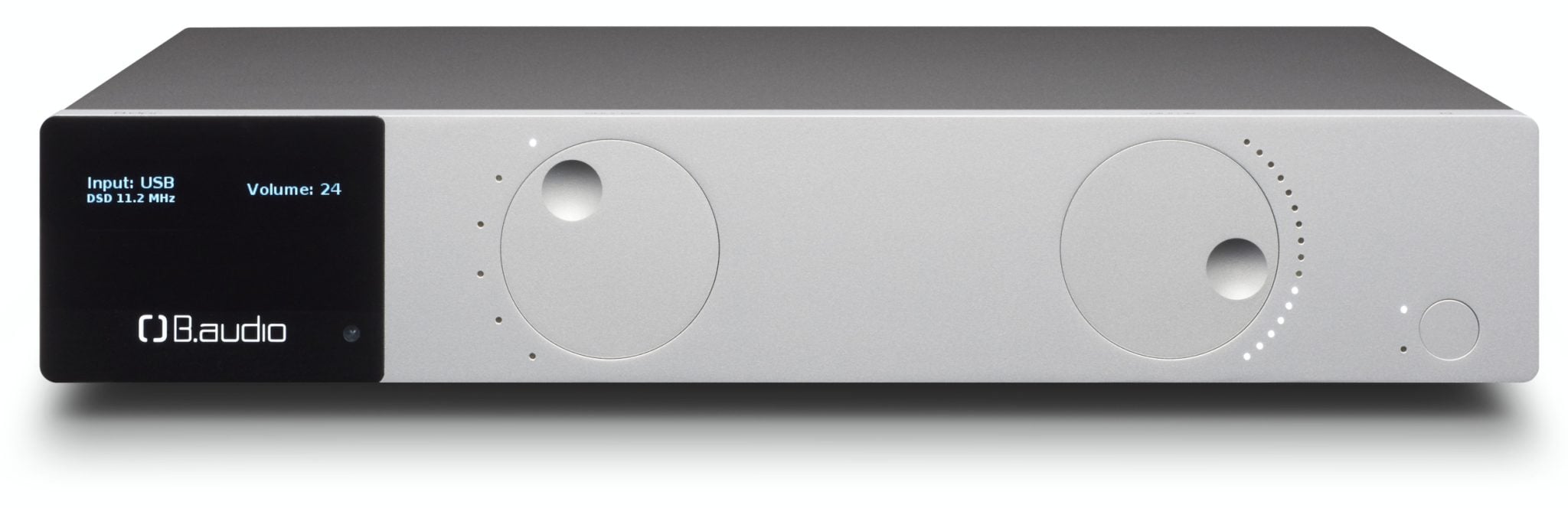
In 2024, I reviewed the B.audio Alpha One integrated amplifier with streaming network DAC. The review marked the first appearance in TAS for this boutique French electronics company. At the time, I added that if the performance I observed in Alpha One was any guide, TAS readers would be hearing a lot more from B.audio, and soon. Well, that moment has arrived in the form of a pair of separates from B.audio’s Reference line, namely the B.dpr EX, its DAC/preamp, and the B.amp, a stereo amplifier.
A quick refresher: B.audio is a relative newcomer on the North American high-end scene. It was founded in 2016 by brothers Cédric and Sébastien Bermann. Prior to B.audio, they’d had wide-ranging experience in the fields of electronics and signal processing, precision measuring equipment for electrical networks, and R&D projects at Mercedes Benz, thus laying the groundwork that informs their designs, both technologically and aesthetically. The company is based in Saint-Hippolyte, a small town in eastern France near the German border, about 30 miles from Strasbourg.
B.audio develops its hardware and software in-house. Subassemblies like circuit boards and metalwork are also in-house-designed but manufactured by carefully chosen subcontractors, most of whom work with larger companies and are adept at strict quality control and pre-testing. Once the pieces arrive at the factory, they’re tested again, assembled into finished products, tested as whole units, burned in, tested again, and shipped.
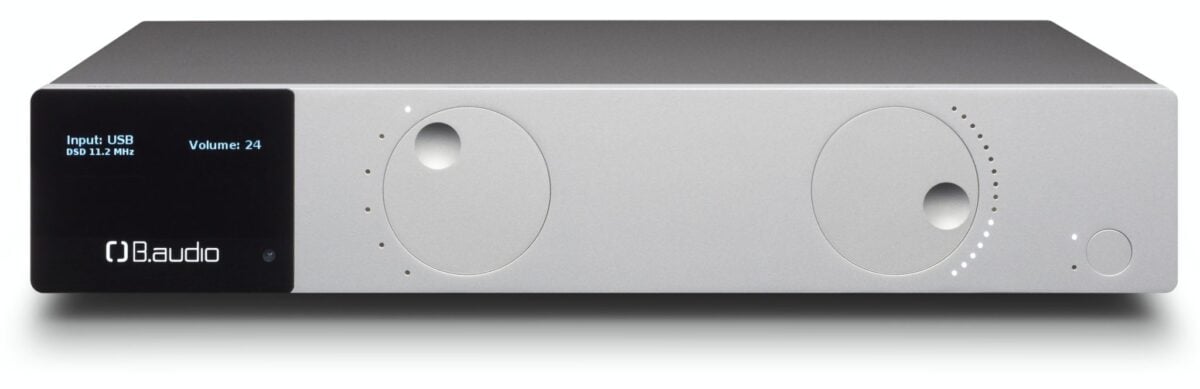
Visually, B.audio gear is elegant, low-profile minimalism. Materials and quality control appear top-notch. Dimensions are standardized throughout the One Series and Reference Series lines. The front panel of the B.dpr EX is smooth, thick aluminum plate, with a gloss black LED display offset to the left. A pair of flush, ball-bearing-mounted rotary wheels individually select volume and input. B.amp’s front panel takes minimalism a step further with only a single small on/off button and a status light.
The B.dpr is based on the stand-alone B.dac EX, joined to an additional analog preamplification stage. It runs in 100% balanced mode and is distinguished by the absence of coupling capacitors. The preamplification stages take advantage of the loop inductance reduction provided by surface-mounted components, while the fully balanced topology maintains a noise-free environment for the analog signal. Thanks to the analog volume control, which operates via a 64-step, relay-driven resistor network, analog input signals remain in the analog domain. The B.dpr EX can be optionally fitted with a full-function phonostage that supports both moving-magnet (mm) and moving-coil (mc) cartridges. Included is a full-function, custom-made aluminum remote control.
The B.dpr EX’s outward simplicity belies a wealth of menu-driven settings and a plethora of configuration features. Among them a handy mode that allows automatic source-detection scanning, as well as streamer-module activation and configuration, standby delay, direct mode (volume control bypass). balance, subsonic filter, and the EX acoustic-correction suite.
The back-panel real estate is uncluttered and intelligently laid out. It includes a pair of RCA analog inputs, plus an XLR analog input. Digital inputs include USB Data for a thumb drive, AES-EBU, TosLink, and SPDIF. The unit has XLR outputs.
The DAC incorporates B.audio’s patented SJR “Source Jitter Removal” technology, which provides the best possible D/A conversion from every source by reportedly eliminating all input jitter without the need of an external clock. In terms of network functionalities, it can access popular streaming services (Qobuz, Tidal, Spotify) via compatible iOS and Android applications. It is also compatible with most protocols including UPnP, Roon, AirPlay, and Spotify, and supports playback of most formats (PCM up to 384kHz/DXD/DoP/native DSD up to DSD256). An integrated UPnP server makes data stored on USB media accessible over the network.
The optional “EX” models include DSP-based parametric speaker and room correction based on a 64-bit architecture. The equalizer is equipped with independently configurable filters: high- and low-shelf, peak, notch, bandpass, high- and low-pass. Each filter can be activated or deactivated. However, to carry out the room measurements, a computer and USB microphone are required. Measurements are conducted via a signal sweep of audible frequencies and are sent to your computer. Based on those measurements, the user then selects and fine-tunes the appropriate filter in the amp’s menu settings. A simpler alternative is to use the response curve of your loudspeakers as a good starting point for defining the corrections to be used and further refine from there.
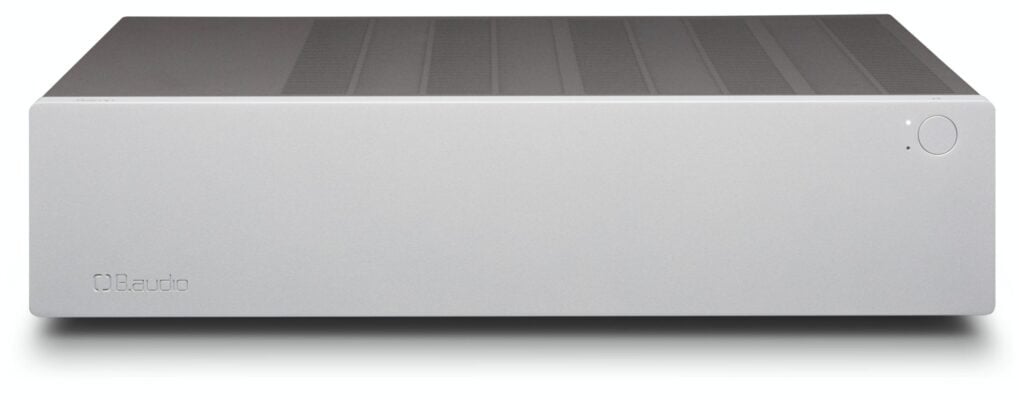
Turning to the amplifier, the B.amp is a solid-state, Class AB power amplifier that outputs 120Wpc into 8 ohms (200Wpc into 4 ohms). The amp can also be configured to operate in bridged mono mode, which increases output to 300W into 8 ohms (500W into 4 ohms).
It’s a full dual-mono design with independent power supplies for each channel and ultra-low-magnetic-radiation toroidal transformers. Its oversized current reserve makes it an easy fit for loudspeakers that present a difficult load. Its output stage sports four pairs of high-current bipolar transistors per channel. Along the back panel of the B.amp are RCA and XLR analog inputs, top-drawer WBT speaker connectors, and a trio of switches to select input type, auto on/off, and mono/stereo modes.
B.audio employs its own in-house engineered Intelligent Drive Stage (IOD)—a Class A push-pull design fitted with six transistors and placed between the voltage gain stages and the output transistors. In B.audio speak, “it creates a local feedback loop around the output stage which stops back-EMF currents from reaching the gain stage, an approach that produces strong linearity…This topology emulates Class A output stages (without the heat) by eliminating typical Class AB crossover distortion, all the while efficiently keeping power consumption under control. In combination with an extremely low output impedance due to the oversized output stage, it ensures optimal operation with any load.”
In sonic performance the word that instantly came to my mind was refinement. Refinement in the way low-level information locked into place, fully focused during attacks, slow harmonic developments, and reverberant decays, bespeaking refinement in capturing timbral cues and textural details. I’m thinking of when Norah Jones sings “The Nearness of You”; the tasteful piano was beautifully articulated, as was the final radiating sustain of the deep low C that closes the song out. Similarly, there were the singing high-pitch octave strings of a 12-string guitar during the closing verse of k.d. Lang’s “Love is Everything,” which sounded clean, extended, and resolved. This refinement was anchored by a broad macro- and micro-dynamic envelope, an open effortless midrange, and a grain-free top end. Brass fared especially well, with speed and bell-like transients and bloom.
My immediate impression was of a pair of electronics that were very exacting and well-ordered in reproducing a musical source. Almost tool-like in their precision, time and again the combo demonstrated its skill reproducing large-scale symphonic music (Beethoven’s Ninth, for example, with full chorale and soloists [Chicago/Solti: Decca]). Each image element and orchestral section—string, winds, and brass—were comfortably fixed in place and spaciously layered to the back of the hall. And in the case of the large assembly of choral voices, even the presence of vertical height cues made themselves known in the vast acoustic of the symphony hall.
Bass reproduction was purposeful and complex. Complex in the way it accurately captured pitch and trailing resonances and often as not, the physical scale of cascading kettle drums or tam-tam. On Renaud Garcia-Fons’ acoustic bass from the mysterious and elegiac “Palermo Notturno,” the B.audio’s performance involved much more than mere extension; it was lively, well-articulated, and richly, romantically musical.
I usually try to characterize the “personality” of amplification. But B.audio gear had me a little flummoxed. It was neither overtly warm and tube-like nor clinically cold in an early solid-state fashion. It was more chameleon-like, warming or cooling to the material it was reproducing—nonjudgmental, more like a benign “pass-through” for the signal. Images were spotlessly clean and nicely drawn, rock-steady across the width and depth of an orchestra. I enjoyed a wonderful contrast of light-to-dark during guitarist Pat Metheny’s rendition of Jimmy Webb’s “The Moon is a Harsh Mistress.” Joined by bassist Charlie Haden, and even without the poetic lyrics, the atmosphere and expressive underpinnings and soulfulness that the players bring to this track even rivaled the vocal versions by Linda Ronstadt and Judy Collins [Beyond the Missouri Sky].
Singling out DAC performance for a moment, it was excellent over most criteria, but I thought it was worth making a brief comparison to another top-notch DAC I had on hand in the dCS Bartók Apex DAC. A daunting task being pitted against the dCS, but the B.dpr held its head high throughout. In one area it came up a just a little short, grappling with dimensional space and reverberation during the wildly immersive “Tea in the Sahara” by The Police. The depth component was a little shallower compared with the Apex, and tonally it was overall a little leaner with less of the Technicolor-like color density and micro-dynamic contrasts that the Bartók Apex brings to the table, albeit at a much higher price.
A word on the B. amp. It’s uncommon for me to review separates. My beat is typically integrated amplification. However, since Monarch System distributes both B.audio lines as well as Audio Physic loudspeakers, and I was at the time reviewing the new Audio Physic Tempo loudspeaker, Monarch afforded me the opportunity to listen to both the Alpha One integrated/DAC and B.dpr/B.amp separates. Overall, the Alpha One more than held its own, but I felt the Audio Physic Tempo was asking for more. Turned out, it was asking for the B.amp. This amp seemed to grab the Tempo by its sonic lapels. Bass extension was tighter and dynamics began to pop. There was more snap to the music’s transients. It was as if the Tempo was breathing through a bigger set of lungs. Chalk it up to the larger power supplies and other discrete circuitry that the added chassis-space confers. In other words, the B.amp offered an upgraded caliber of wattage—more color, impact, and grunt, proving again that even within the same company stable there are watts and there are watts! The B.amp was a real standout.
To me, the B.audio B.dpr EX and B.amp are Exhibits A and B for what audiophiles should expect from mature, top-tier amplification in 2026. They celebrate resolution and transparency. Electronics that don’t need to shout but silently stand at the ready with a soft touch and a firm grip to allow the full musicality of a fine component system to shine. This was my second dance with B.audio, and I’m even more impressed by this go-round. The B.amp and B.dpr EX fully live up to their reference designation. In other words, without reservation, highly recommended.
Specs & Pricing
B.dpr EX
Type: Preamplifier/DAC
Inputs: Two RCA, one configurable as bypass; one XLR (balanced)
Digital inputs: 2x SPDIF, 2x TosLink, 1x AES/EBU, 1x USB (Type B)
Outputs: RCA and XLR pre-out
D/A conversion: Multibit sigma-delta
Formats: PCM up to 384kHz/DXD/DoP/ native DSD up to DSD256
USB supported formats: PCM (incl. DXD), DSD, DSD over PCM (DoP)
Sample rate: (PCM) 44.1kHz, 48kHz, 88.2kHz, 96kHz, 176.4kHz, 192kHz, 352.8kHz (DXD), 384kHz
SPDIF/AES: PCM, 44.1kHz, 48kHz, 88.2kHz, 96kHz, 176.4kHz, 192kHz
Acoustic correction: 64-bit DSP, 8x parametric filters with automatic gain adjustment
Dimensions: 17.72″ x 3.58″ x 14.76″
Weight: 16.3 lbs
Price: $22,700, silver or black (custom colors available at extra cost)
B.amp
Type: Class AB stereo
Power: 120Wpc into 8 ohms, (200Wpc into 4 ohms)
Input: One pair RCA, one pair XLR WBT connectors
Dimensions: 17.72″ x 4.41″ x 15.16″
Weight: 44 lbs
Price: $22,200
MONARCH SYSTEMS DISTRIBUTION
7335 East Orchard Rd.
Greenwood Village, CO 80111
(720) 399-0072
[email protected]
b-audio.com
Tags: AMPLIFIER B.AUDIO PREAMPLIFIER
Trending Articles
See all
T+A Elektroakustik DAC 200 Review
- Jun 23, 2026

Master Artist Fresco Loudspeaker Review
- Jun 27, 2026
Esoteric’s Grandioso Full System Review
- Jun 20, 2026



By Neil Gader
My love of music largely predates my enthusiasm for audio. I grew up Los Angeles in a house where music was constantly playing on the stereo (Altecs, if you’re interested). It ranged from my mom listening to hit Broadway musicals to my sister’s early Bob Dylan, Joan Baez, Beatles, and Stones LPs, and dad’s constant companions, Frank Sinatra and Tony Bennett. With the British Invasion, I immediately picked up a guitar and took piano lessons and have been playing ever since. Following graduation from UCLA I became a writing member of the Lehman Engel’s BMI Musical Theater Workshops in New York–working in advertising to pay the bills. I’ve co-written bunches of songs, some published, some recorded. In 1995 I co-produced an award-winning short fiction movie that did well on the international film-festival circuit. I was introduced to Harry Pearson in the early 70s by a mutual friend. At that time Harry was still working full-time for Long Island’s Newsday even as he was writing Issue 1 of TAS during his off hours. We struck up a decades-long friendship that ultimately turned into a writing gig that has proved both stimulating and rewarding. In terms of music reproduction, I find myself listening more than ever for the “little” things. Low-level resolving power, dynamic gradients, shadings, timbral color and contrasts. Listening to a lot of vocals and solo piano has always helped me recalibrate and nail down what I’m hearing. Tonal neutrality and presence are important to me but small deviations are not disqualifying. But I am quite sensitive to treble over-reach, and find dry, hyper-detailed systems intriguing but inauthentic compared with the concert-going experience. For me, true musicality conveys the cozy warmth of a room with a fireplace not the icy cold of an igloo. Currently I split my time between Santa Fe, New Mexico and Studio City, California with my wife Judi Dickerson, an acting, voice, and dialect coach, along with border collies Ivy and Alfie.
More articles from this editor

Read Next From Review
See all
Editors’ Choice: Crystal Cable Art Series Da Vinci
- Jun 30, 2026
Editors’ Choice: Moon 681 DAC
- Jun 27, 2026
Master Artist Fresco Loudspeaker Review
- Jun 27, 2026

