


The Great Proliferation: How High-End Audio Grew as a Global Industry
- BLOG
- by Tom Martin
- Jun 26, 2026
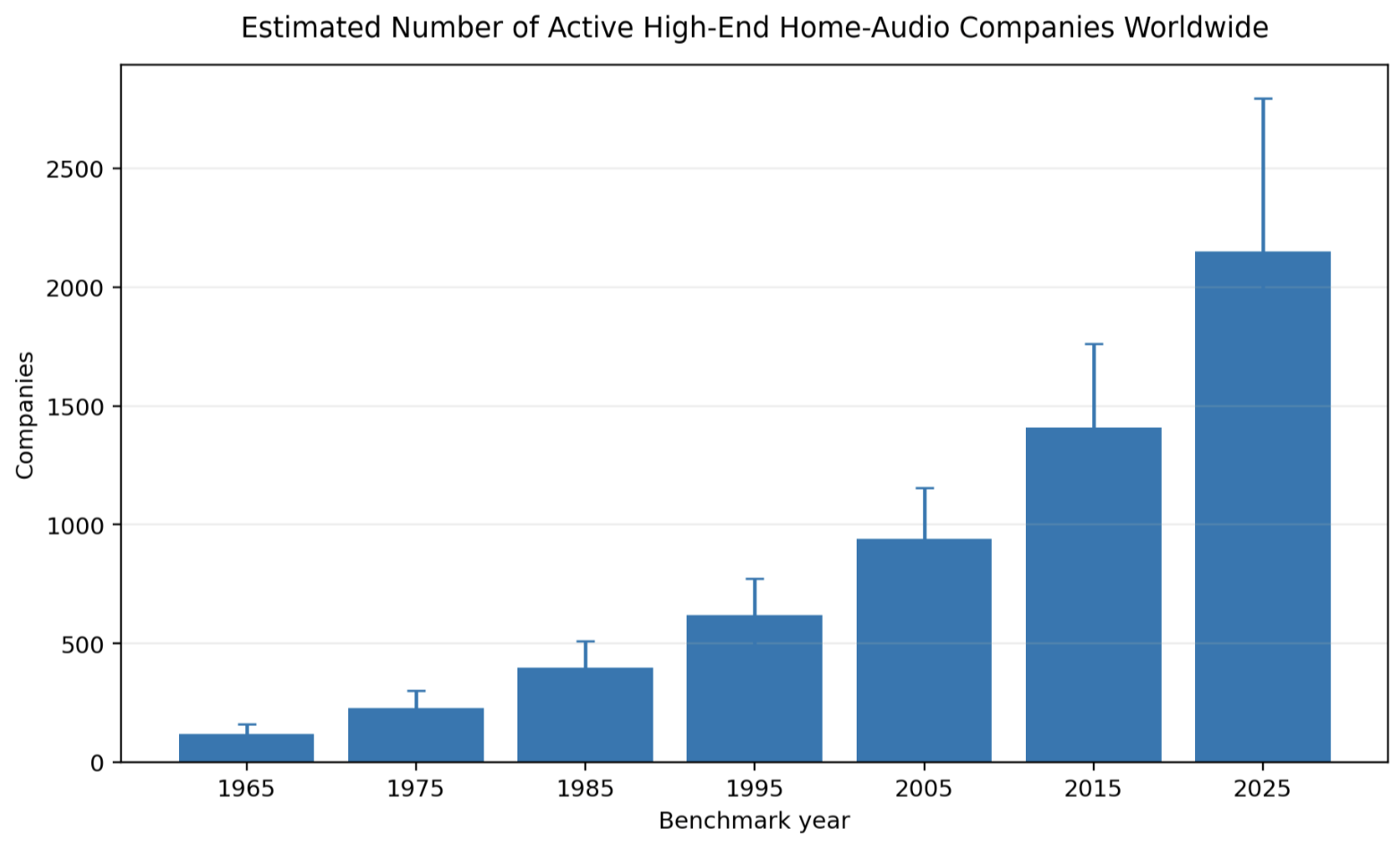
Estimated worldwide manufacturer population, 1965-2025
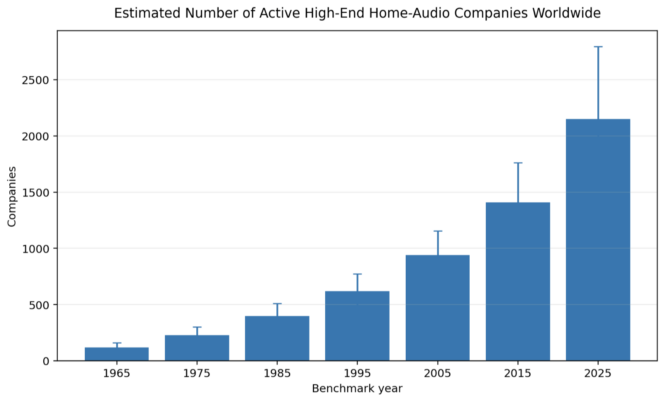
Figure 1. Midpoint estimates with broad uncertainty ranges reflecting incomplete historical coverage and differences between companies, brands, and exhibitors.
Consumers often express concern that “audio is dying” or something similar. This article looks at this issue and finds quite the opposite. It uses manufacturer counts as an indicator of industry growth because the underlying concern of consumers is not about the industry per se, but about whether high quality products will continue to be developed. We argue that this seems highly likely based on long-term history.
The Punchline
A reasonable analysis of the data suggests that the worldwide population of active high-end home-audio manufacturers increased from roughly 120 in 1965 to approximately 2,150 in 2025. Because no complete historical registry exists, the precise numbers cannot be known. A plausible range for 2025 is approximately 1,700 to 2,800 companies. However, the higher estimate seems more plausible given that The Absolute Sound does brand power surveys each year, and consumers are able to identify over 2000 manufacturers on an unaided basis. In professional marketing and consulting, unaided awareness is known to underestimate total brand counts.
Even the lower figure indicates that the field is many times larger and more diverse than it was during the supposed “golden age” of stereo.
This does not necessarily mean that high-end audio sells proportionately many times as many units, earns proportionately more money, or reaches a larger percentage of households. It means something more specific: the industry has grown enough to support far more individual makers, brands, and product specializations.
Estimated worldwide manufacturer population
| Benchmark year | Midpoint estimate | Plausible range |
| 1965 | 120 | 84-162 |
| 1975 | 230 | 166-304 |
| 1985 | 400 | 300-512 |
| 1995 | 620 | 484-775 |
| 2005 | 940 | 752-1,156 |
| 2015 | 1,410 | 1,128-1,762 |
| 2025 | 2,150 | 1,677-2,795 |
Method and definition
There is no authoritative census of high-end-audio manufacturers covering the period from 1965 to 2025. The figures in this report are therefore estimates constructed from historical manufacturer directories, magazine coverage, trade-show exhibitor lists, and contemporary brand databases. Trade-show counts are used as calibration points rather than treated as direct worldwide totals, because they mix manufacturers, brands, distributors, and service companies.
For this analysis, a manufacturer qualifies when it offers at least one product intended primarily for high-quality music reproduction in the home with a retail price above $500 in 2026 dollars. Adjusting the threshold for inflation is essential: the test is meant to distinguish specialist and premium products from ordinary mass-market electronics, not to declare that products below the threshold are incapable of high performance.
The count includes loudspeakers, amplifiers, preamplifiers, integrated amplifiers, DACs, streamers, disc players, turntables, tonearms, cartridges, cables, power products, equipment racks, isolation devices, and room-acoustic treatments. Importers, dealers, recording labels, software-only services, professional-sound firms, automotive-only suppliers, and headphone-only brands are excluded. Each independently marketed manufacturer brand is counted once and assigned to its principal product category.
The estimated growth
The midpoint growth estimated here is about 20X over 60 years, or a bit over 5% per year.
The shape of the curve is more informative than any individual number. The industry did not simply enjoy one great expansion during the stereo boom and then decline. The number of manufacturers appears to have continued rising through the transition from vinyl to compact disc, through the home-theater boom, through the collapse of the traditional record business, and into the streaming era.
The estimated manufacturer population grew by about 92 percent between 1965 and 1975, 74 percent during the following decade, 55 percent between 1985 and 1995, 52 percent between 1995 and 2005, 50 percent between 2005 and 2015, and another 52 percent between 2015 and 2025. These percentages should not be read as precise industry statistics, but they indicate that the proliferation of manufacturers has been persistent rather than confined to one period.
Growth by principal product category
The following six charts replace a stacked presentation so that the growth path of each category can be read independently. Category assignment is by principal product line; it is not a count of every category in which a company participates.
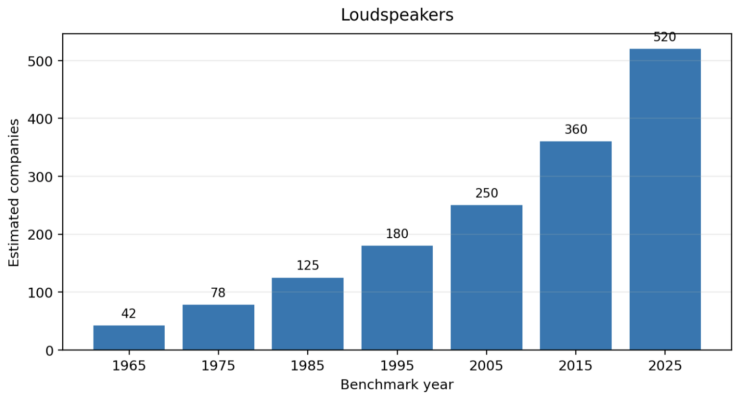
Figure 2. Estimated active manufacturers principally identified with loudspeakers.
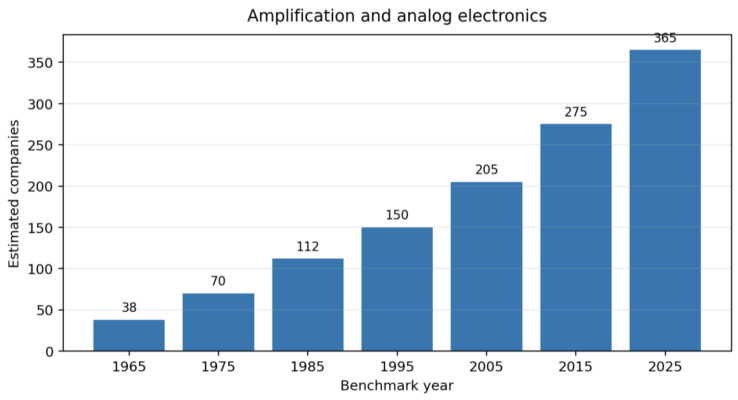
Figure 3. Estimated active manufacturers principally identified with amplification and analog electronics.
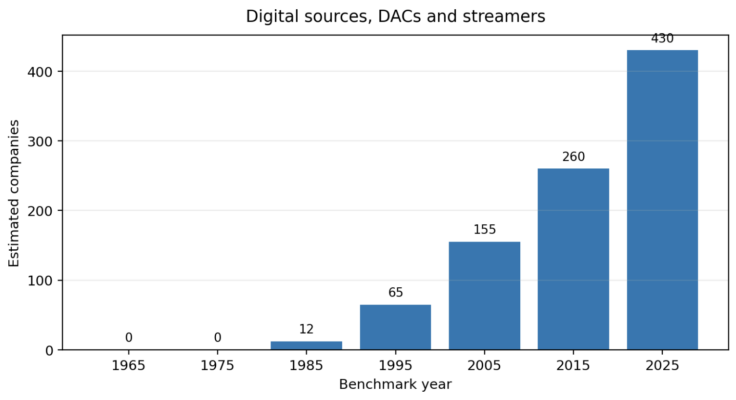
Figure 4. Estimated active manufacturers principally identified with digital sources, dacs and streamers.
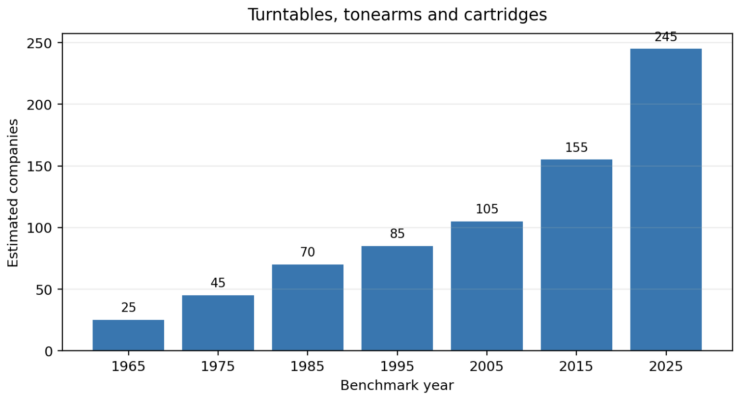
Figure 5. Estimated active manufacturers principally identified with turntables, tonearms and cartridges.
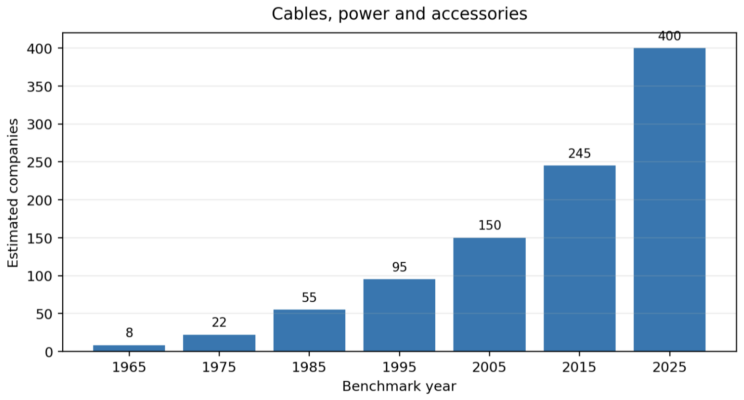
Figure 6. Estimated active manufacturers principally identified with cables, power and accessories.
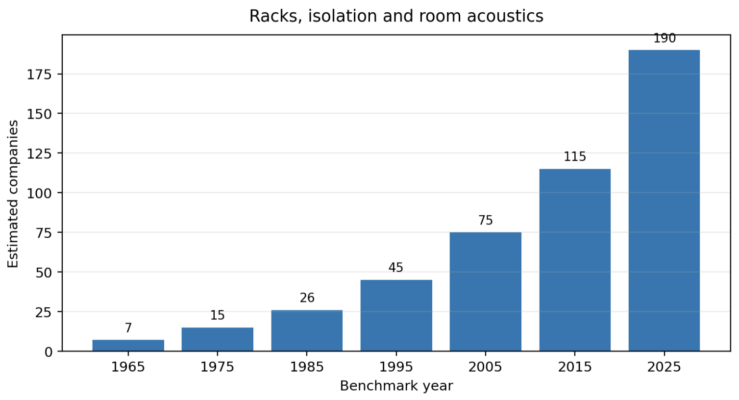
Figure 7. Estimated active manufacturers principally identified with racks, isolation and room acoustics.
Speakers remain the largest category
Loudspeakers have probably supported more specialist manufacturers than any other category throughout the history of high-end audio. The estimated number rises from about 42 companies in 1965 to approximately 520 in 2025.
A small company can design and assemble a loudspeaker without building a semiconductor fabrication plant, transport mechanism, or complex software platform. Drivers, crossover components, cabinet materials, and measurement systems can be sourced from specialist suppliers. The finished product can still express a distinctive philosophy through enclosure construction, radiation pattern, crossover design, driver selection, and voicing.
Speakers are also unusually resistant to commoditization. Two competently engineered loudspeakers can remain dramatically different in directivity, bass extension, maximum output, appearance, and interaction with the room. That leaves room for many competing solutions. Computer modeling, affordable acoustic measurement, and precision manufacturing have lowered development costs, while elaborate cabinetry and luxury finishing have expanded the upper end of the market.
Amplifier makers grew more slowly
The number of companies specializing principally in amplification and analog electronics is estimated to have risen from about 38 in 1965 to approximately 365 in 2025. This is substantial growth, but slower than the expansion in digital products, accessories, and loudspeakers.
Amplifier design is mature, and many firms now buy modules, power supplies, or circuit subsystems from outside suppliers. That makes it easier to enter the market, but it also makes differentiation more difficult. The category nevertheless remains fertile because buyers continue to choose among tubes, solid-state Class A and AB circuits, switching amplifiers, integrated amplifiers, separates, minimalist designs, and products with extensive control and room-correction facilities.
Digital audio created an entire new industry
The most obvious structural change is the emergence of digital-source manufacturers. The category scarcely existed before the compact disc. It grew to an estimated 12 specialist companies by 1985, 65 by 1995, 155 by 2005, 260 by 2015, and approximately 430 by 2025.
At first, digital audio was concentrated in a few large Japanese and European corporations capable of manufacturing disc transports and integrated circuits. Over time, the important building blocks became commercially available: converter chips, digital-receiver chips, sample-rate converters, clock modules, network boards, embedded computers, and software platforms. This allowed smaller companies to design DACs and streamers without inventing every part internally.
Streaming then divided the source component into new subcategories: servers, network bridges, reclockers, streamers, DACs, digital preamplifiers, and all-in-one streaming amplifiers. Digital audio therefore did not eliminate the specialist source business. It multiplied the number of boxes and design decisions available to it.
Analog survived – and then returned
Turntable, tonearm, and cartridge manufacturers declined relative to the rest of the industry during the early compact-disc period, but the category never disappeared. The estimate rises from approximately 25 companies in 1965 to 70 in 1985, levels off during the 1990s, and then climbs to roughly 245 by 2025.
Part of this represents the revival of vinyl. More important, perhaps, is the economic character of analog reproduction. Turntables, tonearms, and cartridges reward mechanical specialization, hand assembly, and incremental refinement. They are therefore well suited to small firms serving enthusiasts rather than mass-market consumers.
Analog equipment also has qualities that make it attractive as a luxury object. Its operation is visible, its materials are tactile, and its mechanical intricacy is easily appreciated even before music begins. In an increasingly virtual media environment, those attributes have acquired renewed value.
The fastest growth is around the system
Cables, power products, and accessories grew from a very small category in the 1960s to an estimated 400 companies in 2025. Racks, isolation products, and acoustic-treatment manufacturers increased from approximately seven to 190.
Some of this growth reflects genuine technical specialization. As systems became more expensive, owners became more willing to address electrical noise, vibration, equipment support, and room acoustics. Measurement tools also made room problems more visible. But barriers to entry are comparatively low. A cable, footer, equipment platform, or acoustic panel usually requires less capital and engineering infrastructure than a loudspeaker, amplifier, or streamer. Products can be manufactured in small batches, sold at high margins, and shipped internationally.
This makes accessories the easiest part of the industry to enter – and sometimes the hardest part for consumers to evaluate. The category contains useful engineering, luxury craftsmanship, speculative claims, and products whose prices bear little obvious relationship to production cost. Its growth reveals both the vitality and the vulnerabilities of the high-end market.
Why so many companies?
Globalization
In 1965, the internationally visible hi-fi industry was concentrated largely in the United States, Britain, Germany, Switzerland, and Japan. Today it includes substantial numbers of manufacturers from Italy, France, Scandinavia, Eastern Europe, Canada, Australia, New Zealand, China, South Korea, Taiwan, Singapore, and many other countries.
Lower development costs
Computer-aided design, circuit simulation, acoustic modeling, affordable test equipment, CNC machining, rapid prototyping, and contract manufacturing allow a small team to accomplish work that once required a large industrial company.
The internet and direct sales
A specialist manufacturer no longer requires a national dealer network before reaching customers. It can establish a reputation through online reviews, discussion forums, videos, social media, and international audio shows. Direct sales make extremely small production runs economically possible.
Specialized suppliers
A new brand can purchase drivers, amplifier modules, DAC boards, streaming platforms, transformers, connectors, cabinets, and metalwork from experienced outside companies. The manufacturer increasingly becomes a system designer, customizer, industrial designer, assembler, and marketer.
Affluent global niches
A company does not need millions of customers when it sells products costing several thousand – or several hundred thousand – dollars. A worldwide audience of a few hundred buyers can sustain a workshop-sized manufacturer.
Streaming abundance
Streaming has made virtually the entire recorded history of music immediately available. A new owner can connect a streamer and gain access to millions of recordings on the first evening. Digital abundance may reduce the perceived value of each individual recording, but it increases the utility of a high-quality playback system.
More companies do not necessarily mean more buyers
The proliferation of manufacturers should not be confused with unlimited market growth. The market increasingly resembles other luxury and enthusiast industries: many small producers compete for a relatively narrow group of affluent, highly involved consumers.
Fragmentation
When more than 2,000 companies divide a niche market, many will remain very small. Some are essentially two or three person businesses. Their products may be excellent, but there will be some limits to marketing and service.
Churn
New brands appear more often than in large industrial markets, particularly in accessories, but a few do not survive a decade. Despite this, most audio companies have significant staying power.
Price escalation
When unit volumes are low, companies often move upward in price to cover development, distribution, and support. The result is an industry with more manufacturers and more products. At the same time, there are many attainable options at traditional middle-class prices because this is where some of the large companies concentrate. In fact, entry-level audio prices, as with other consumer electronics categories, have seen a long-term decline inflation-adjusted prices.
Consolidation behind the scenes
Several famous brands may share an owner, distributor, factory, software platform, or engineering supplier. In audio, it is common for this to lead to some commonality of supply chain elements and portions of the organization like finance or marketing, but many larger audio companies have zealously protected the distinctive ideas behind each brand.
Is high-end audio growing or shrinking?
The answer depends on the measure. As a mass-market activity, component stereo occupies a smaller cultural position than it did when every household needed a record player, receiver, and pair of speakers. As a share of consumer attention, it competes with video, gaming, mobile devices, headphones, and whole-home systems. By those mindshare measures, hi-fi has shrunk, as have most consumer categories. When consumer options grow, each option is a smaller part of the pie.
But as an international field of specialist manufacturers, technologies, design philosophies, and luxury products, it has expanded dramatically. The high-end industry of 2025 is less concentrated, more global, more artisanal, and more segmented than the industry of 1965. The global element of the consumer base is a large growth factor, because of rising incomes. So is the growing level income per capita in many western nations
Audio growth resembles the expansion of craft brewing, mechanical watches, specialty bicycles, high-end cameras, and performance automobiles. A mature technology does not necessarily disappear when the mass market moves elsewhere. It can expand as a field of connoisseurship. Nonetheless, in contrast with pure fashion businesses like mechanical watches, high-end audio has also expanded its offerings at prices levels just above the mass market level.
That is probably the best way to understand modern high-end audio. It is no longer simply the premium tier of the ordinary consumer-electronics business, though it is that. It has also expanded as a worldwide network of small manufacturers serving enthusiasts who care about engineering, craftsmanship, collecting, system building, and the focused experience of listening to music at home. Again, because of the general expansion of consumers markets, along with the proliferation of consumer spending options and habits (like smart phones, home automation, restaurant dining, physical fitness, and health care) the audio industry that can look smaller from outside and much larger from within.
Category data
| Year | Speakers | Amplification | Digital | Analog sources | Cables/accessories | Racks/acoustics |
| 1965 | 42 | 38 | 0 | 25 | 8 | 7 |
| 1975 | 78 | 70 | 0 | 45 | 22 | 15 |
| 1985 | 125 | 112 | 12 | 70 | 55 | 26 |
| 1995 | 180 | 150 | 65 | 85 | 95 | 45 |
| 2005 | 250 | 205 | 155 | 105 | 150 | 75 |
| 2015 | 360 | 275 | 260 | 155 | 245 | 115 |
| 2025 | 520 | 365 | 430 | 245 | 400 | 190 |
Source and uncertainty note
The figures are a modeled historical series, not audited industry totals. Useful calibration points include the 20 exhibitors reported for the first HIGH END show in 1982 and approximately 1,000 represented brands at the 2025 Munich show. Contemporary show directories undercount firms that do not exhibit and overcount when multiple brands share a parent or distributor. Earlier decades are less completely documented, so their ranges are proportionately broad. The estimates should be used to understand the scale and direction of change, not as exact annual census numbers.
Principal reference families: HIGH END SOCIETY historical and exhibitor materials; period audio-magazine manufacturer directories and show reports; contemporary international brand and dealer databases; Futuresource Consulting luxury-audio market reporting; and IFPI global recorded-music reporting.
Tags: HI-FI AUDIOPEDIA INDUSTRY FUTURE AUDIO
Trending Articles
See all



By Tom Martin
More articles from this editor

Read Next From Blog
See all
Australian-founded AudioBro launches globally
- Jun 23, 2026
Jürgen Reis Retires from MBL
- Jun 17, 2026

Buchardt Audio P300 Compact Speaker Review
- Jun 15, 2026
JL Audio Unveils Advanced New Full-Range Loudspeaker
- Jun 10, 2026

