

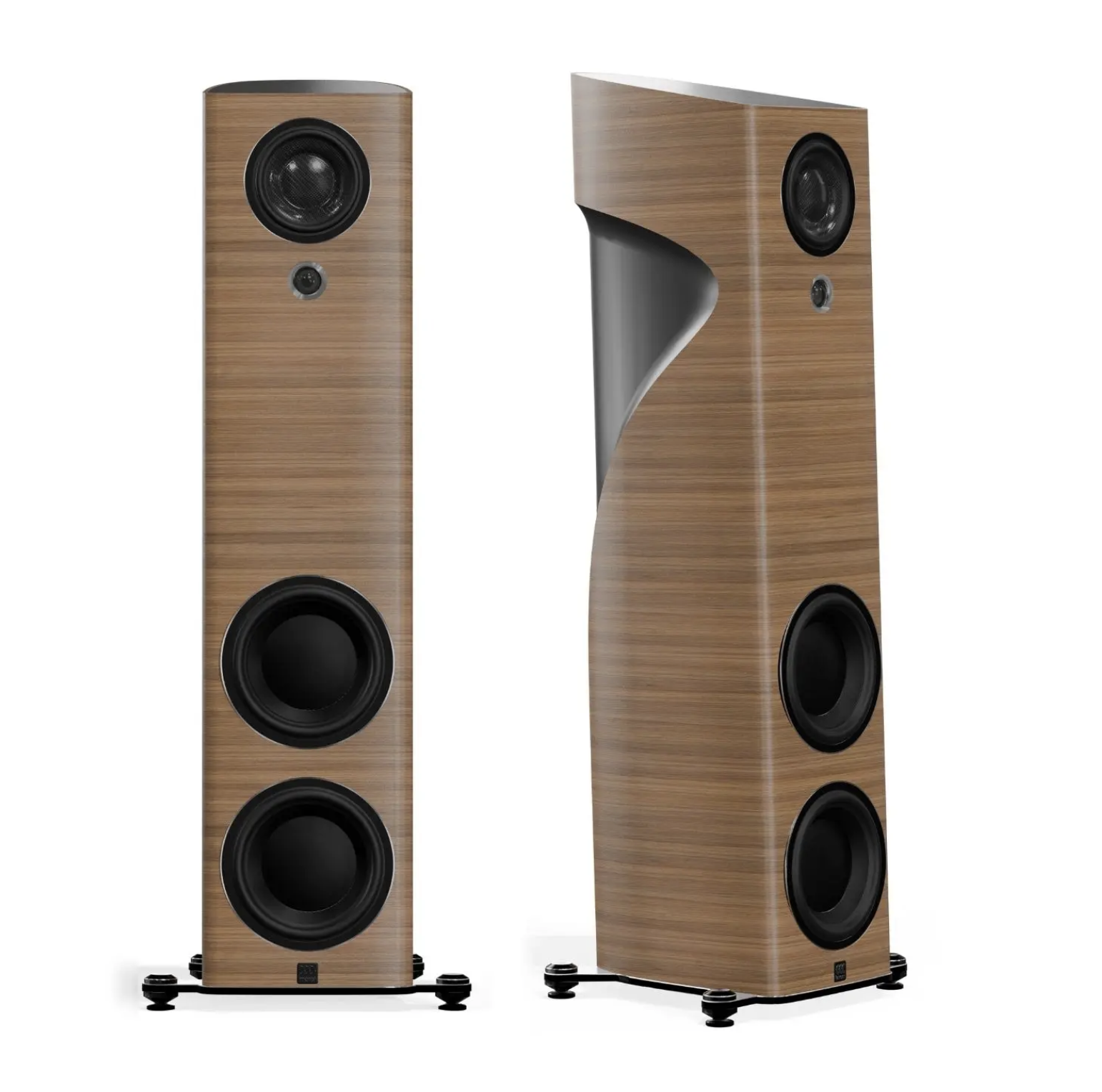
Morel is a hi-fi manufacturer based in Israel and has been making audio components since 1975. In recent years, it has focused more on driver development and manufacturing. innovating and designing some superb off-the-shelf units for other manufacturers, as well as their huge car-audio business, but now it’s getting back into the realm of complete speaker systems with the all-new Sopran floorstanders. The top of the two-model Sopran line is the Sopran 934 reviewed here ($14,999 for white and black; $16,999 for walnut and wenge). The Soprans are Morel’s flagships—as I said—but they’re also a kind of statement. Yeah, Morel hasn’t been making complete speakers lately, but that doesn’t mean they can’t cook up something exceptional. The team over there went all out, designing bespoke, handcrafted, locally made everything, and the result is something exceptional.
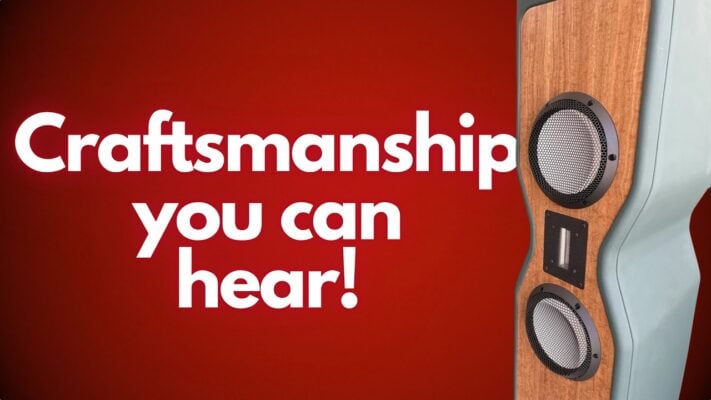
I got the Soprans on a rainy Wednesday afternoon, and after getting them unboxed, right away I was impressed by their gorgeous cabinets. They stand at 47″ tall, 14.5″ deep, and 10.6″ wide with a gently curving wedge shape—the lovely walnut front meeting a matte black in the back. They’re extremely attractive, just all around visually pleasing, and the cabinet work is finished to what must be exacting standards. Each speaker weighs around 110 pounds, which means a pair of them is on the heavy side, with the weight concentrated at the base. That’s thanks to their dual 8″ paper/carbon-cone woofers with titanium in the voice coils—these things are dense and hefty. The Soprans also sport a 6″ carbon-fiber-sandwich midrange driver, which includes a neodymium double-magnet motor and a 3″ aluminum voice coil, along with a 1.1″ handcrafted soft-dome tweeter with neodymium-magnet motor and titanium/aluminum voice coil. There is a ton of technology and premium materials packed into these drivers, and each one was designed, voiced, and built specifically for the Sopran—making it a custom product from top to bottom. Even the crossover is hand-finished using the highest quality Mundorf components. The Soprans are rated at 4 ohms with a 90dB sensitivity. I felt my Parasound Halo Integrated 6 was enough power to drive them (240Wpc into 4 ohms), but more wouldn’t necessarily be a bad thing.
I noticed something on the first day I set the Soprans up. I have a mark on my floor as a general starting spot in an equilateral triangle from my listening position, but most speakers need some adjustment to get them singing. This is normal; every room is tricky, and every speaker will interact with it differently, and it’s my job to account for that. But the Soprans sounded fantastic from the first second I played them, and while I made minor adjustments to dial in the bass, their sonic profile remained surprisingly consistent for the entire time I had them. It was explained to me that this was perhaps thanks to the shallow geometry of the drivers, which allows for a slightly expanded sweet spot and better off-axis dispersion. For the average audiophile, this means that listening rooms with tight tolerances and little space for fiddling would absolutely work well with a pair of speakers that can slot in and sound great without finicky shuffling. However, if finicky shuffling is your thing, fear not: There is no limit to how good great speakers can sound, and you can adjust until your fingers bleed. You have my permission.
I’m going to come back to the tech in these transducers because, of course, the driver materials make a real impact on sound. But what’s the point of hi-fi if all the tech in the world achieves no deeper emotional connection to the music? Put down your voltmeter, my friend, and listen to the music. To that end, I always do this thing whenever I get a new piece of gear, especially something I’m excited about. I pull out all my favorite music and listen to it straight through. It’s an excuse to put on stuff I haven’t bothered with in months, and honestly, I’m not listening critically when I do this. But I am searching for the feeling I got when I played Spiritualized’s “Ladies and Gentlemen We Are Floating in Space” via my phone’s tinny speakers when my first kid was just a baby. I’m looking for a moment long gone now, which the best pieces of gear can resurrect for the duration of a record side or a single track. I don’t expect a revelation every time I sit down to listen, and honestly, that rarely happens. But when it does, I’m back in my first house, and my baby son’s taking a nap, I’m feeling exhausted but happy while flipping through vinyl, and Tatsuro Yamashita’s “Sparkle” plays on my cheap bookshelf speakers for the very first time, and it’s like I’m hearing crystallized joy injected straight into my ear canal. In my office today, years later, playing that same song via the Soprans, loud, my son’s a baby again, not a six year old, he’s sleeping soundly for that precious little break in the day, and I can feel it all again for a while. I haven’t lost what’s gone. That’s what I’m looking for when the speakers turn on. That’s the gift the best gear gives me: deeper access into the music that defines who I am. I got that moment when I first sat down with the Soprans.
Anyway, there’s a fat paragraph about my very first gut-check reaction. Sometimes, sitting around and swapping gear, doing the close listening thing, digging into the differences and similarities, obsessing over minutiae, intellectualizing what I’m hearing against what I expect to hear is worthwhile. But every once in a while, I come across a piece of gear that just hits from the very first note. That’s the Soprans. They’re wonderful speakers—I’ll get into listening details in a second—and technically there are tons of reasons why they sounded great without a lot of tweaking and repositioning, but I don’t really care about that. I mean, as an audio reviewer writing a professional review, yeah, I totally care, but as a guy who loves music, the only thing that matters is how they make me feel. Which I’m aware isn’t all that useful for you, and now it’s my job to translate those feelings into prose. Good luck to me.
The first record on deck is the classic Bill Evans Trio Sunday at the Village Vanguard. It’s part of Craft’s new Original Jazz Classics reissues, and since I’m a sucker for anything Kevin Gray mastered—seriously, that guy’s got to be drowning in business right now, I doubt he sleeps, someone check and make sure Kevin’s okay—I couldn’t resist getting yet another copy. Here, what struck me was how tight and sharp Scott La Faro’s bass sounded, almost as if I could hear each individual pluck of his fingers against the strings. The ambient sounds around the music, the noise of the space in which they recorded, filtered through and gave the whole composition an incredible sense of weight and venue. Attacks were sharp, decays lovely, and overall I found the low end solid and finely articulated. Transients were fantastic, and this is likely thanks to the titanium voice coil. I fell in love with the bass, and not because it was overly deep or dimensional, but for how crisp and accurate it sounded, which are both qualities that do well with beautifully mastered music.
Then there were the cymbals: I feel like I could write a book on these cymbals. Paul Motian’s a brush guy, very soft and lyrical, so gentle it’s like he’s playing with his tongue sometimes—sorry for the gross image. If the Soprans do bass well, the top range certainly played in the same league, helping to establish the full spectrum and conjure up a full soundstage that spread across my backwall. I found the tweeter absolutely sang, never bright, never soft, just the right amount of sparkle to lift every hi-hat and crash. The tweeters are mounted flush to the cabinet from behind to minimize diffraction, and it works wonderfully. That’s what I appreciated about the Soprans: Morel paid attention to the details and didn’t shy away from hard work if it meant an appreciable increase in sound quality.
I haven’t mentioned the piano yet. Why bother when everything else is so good? Well, I’ll skip the reviewer-ese and just say it sounded wonderful. Evans’ lyrical playing was lush with all the wide dynamics that make a good piano sound burst from the speakers. The midrange was never dull, never recessed, always eloquent and precise. Unforgiving might be a word, but it’s not the word I’d necessarily choose; accurate to an unflinching degree might be better. And look, at this level, it’s basically what I’d expect—these aren’t exactly cheap speakers, let’s be honest here. But there are degrees of accuracy, and the Soprans might’ve been the most revealing loudspeakers I’ve had in my listening room in a long while.
That was all one record. Still with me? I bounced around between genres for a while via Tidal. The underrated indie band Luna’s banger of a song “California (All the Way)” features an upbeat guitar riff and whispery lyrics. The guitar during the chorus was pointed, each strum finely resolved, while the soft lyrics remained steady in the midrange. Then on “The Glorious Nosebleed” from Circa Survive, Anthony Green’s screamed singing, his voice moving along that really amazing range he has, sounded fresh and punchy, the whole ensemble getting big as the Sopran rose to the occasion. Then I played Thursday’s song “Signals Over The Air” (I’m on an emo kick—this stuff was my high school experience, so sue me) with its crushing snare slaps surgically defined and with a lot of weight and body. But let’s be honest, these rock songs from the mid-y2ks weren’t exactly the most dynamic things in the world, and the Soprans hammered those flaws in their flat glory. Even still, I can’t recall a time where Thursday sounded so enormous and with such depth. I’ll finish up with a little bleep-bloop music: “Pair A Dice” by Discovery Zone is a throwback to early 80s electronica with lilting female vocals and a hefty beat. The complex arrangement of synths and drum machines interacting with the midrange vocals was engaging and biting all at once, especially that chorus—nothing beats some shimmery synth pop, dreamy lyrics, and a pair of speakers that create a soundstage big enough to handle it all.
That was a fun medley. One last album to wrap it up. Man Man is an experimental rock band from my native Philadelphia with a sound like Tom Waits at his most carnivalesque. I love their album Rabbit Habits, especially the song “Easy Eats Or Dirty Doctor Galapagos.” It has a driving, slamming back beat, and growling, shouted lyrics. It’s honestly kind of a mess, in a good way, and the Soprans did a wonderful job of resolving the chaos into something intelligible. The lead singer Honus Honus has a growly, gritty tone, and the Sopran provided the necessary details, almost like you could see the spit flying from his mouth. Meanwhile, the chorus of voices in the background floated ghostly through each verse, echoing within the soundstage, which extended across my full back wall. Even over this raw noise, the tinkling of what sounded like a toy piano danced over the aggressive guitars and drums, a strange oasis of softness. The Soprans grabbed it all and held tight, giving each instrument its space without getting soft, flabby, or lagging behind.
If it’s not clear yet, I’ll spell it out: I really enjoyed my time with the Sopran 934s. They were sharp, heavy-hitting in the low end with beautiful coherence in the uppers, and totally unflinching regardless of what genre I played. Their sweet spot was somewhat flexible, though they did benefit from some placement. At $14,999 in painted finish, it’s hard to use a word like bargain, but anyone shopping at this price range would be missing something special if he overlooked the Sopran. There is a whole lot of good sound packed into them, and I’d stand them up against speakers at any price. Morel did something very nice here—well done.
Specs & Pricing
Type: 3-way 4-driver floorstanding loudspeaker
Loading: Bass reflex
Drivers: 2x 8″ paper/carbon cellular cone woofers; 1x 6″ carbon-fiber-sandwich cone midrange; 1x 1.1″ soft dome tweeter
Frequency response: 30Hz– 22kHz (45Hz–18kHz ±1.5dB)
Nominal impedance: 4 ohms
Sensitivity: 90dB/2.83V/1m
Crossover: 250Hz/2.2kHz
Dimensions: 10.6″ x 47″ x 14.5″
Weight: 110 lbs.
Price: $14,999 for white and black; $16,999 for walnut and wenge
MOREL AMERICA
1820 E Ray Rd.
Suite A206B
Chandler, AZ 85225
(877) 667-3511
morelhifi.com
Tags: FLOORSTANDING LOUDSPEAKER MOREL
Trending Articles
See all
High End Vienna 2026: Loudspeakers Under $50k
- Jun 17, 2026
SVS Ultra Evolution Pinnacle Loudspeaker
- Feb 18, 2025
Wilson Audio Sabrina V
- Apr 14, 2026

By Drew Kalbach
I have a degree in English from Temple University and a Masters in Fine Arts with a specialty in poetry from the University of Notre Dame. I’m a full-time self-published author with over 100 books in both romance and men’s adventure fiction.
More articles from this editor
Read Next From Review
See all
Simco Audio Simco ONE Loudspeaker Review
- Jul 07, 2026
YG Acoustic Carmel 3 Loudspeaker
- Jul 07, 2026
Editors’ Choice: CH Precision M10
- Jul 07, 2026
Editors’ Choice: JR Transrotor Orion Reference FMD
- Jul 04, 2026

