

If the term nerd has a negative connotation to you, if you believe it’s all about thick glasses and pocket protectors, you are sadly behind the times. We’ve long since moved on from Arnold Horshack and Steve Urkel to Hermione Granger and Peter Parker. Nerdiness doesn’t automatically signal social ineptitude but, instead, high intelligence, focus, and a single-minded devotion to solving problems and getting things done. The political commentator and author Charlie Sykes had this advice: “Be nice to nerds. You may end up working for one. We all could.”
YG Acoustics was started by a nerd and is currently run by a representative of the species. I remember sitting next to Yoav Geva at an elegant restaurant when he excitedly thrust his laptop between the wine carafe and bread basket to ensure that a point he was making about tweeter breakup modes was clear. And Dr. Matthew Webster—first a YG customer, then a contributor to the design of the manufacturer’s crossovers, and now, based in the UK, its CEO—brings a background in astrophysics and mathematical simulation to bear on the art of loudspeaker design. I commend to all the YG white paper outlining the technical advances made with the Reference 3 line of products and will touch on those shortly. But as committed as Webster is to the quantifiable, he’s not lost his awe for the ineffable qualities of music and sound. I asked Dr. Webster about this apparent paradox and his response is worth citing at length: “When I started with YG, the first thing I wanted to understand was the source of that ‘magic’ feeling I had been chasing in audio systems for as long as I could remember. It is so obvious when you experience it; yet, when I looked, there was remarkably little research into it. Academic psychoacoustics tended to focus on compression (how far you can squeeze audio data before it becomes noticeable), hearing loss, or noise pollution.
“So, at the start of this process, we spent a huge amount of time just trying to understand that magic. We used our industry-leading measurement facilities, and we listened. We didn’t just listen ourselves; we got as many other people as we could find to listen, too. That process was beautiful and enlightening. It turns out that what makes audio ‘magic’ is remarkably consistent across listeners. The same criteria work for a kid with perfect hearing extending beyond 20kHz as they do for someone older with diminished hearing. They apply across every genre of music. They create acoustic transient realism—that strange, visceral feeling that the music is ‘live’—and they are also what make the spatial location 100% believable to the brain.
“Turning those learnings into loudspeakers, however, took cutting-edge math, physics, engineering, and computing, and that is where my background had the biggest impact. I had the passion of an addict—I knew exactly what I was chasing—but I also had the resources and the lack of fear that comes from a background in astrophysics and 30 years of running scientific simulation companies. When I say lack of fear, I mean that I wasn’t intimidated by the fact that the answers weren’t obvious.
“Delivering that ‘magic’ in a real product required layer upon layer of advanced modeling, measurement, and optimization. Each task, whether designing the Peaks series or our new Lattice tweeter, was a massive challenge requiring techniques and resources usually reserved for designing cars or rockets, not loudspeakers. But because I came from industries where those resources are standard—or before that, from an academic environment where we were simulating huge swathes of the universe—it never felt impossible. Just hard.”
Currently, YG divides its products into four groups—the entry-level Peaks Series, with six models including a subwoofer; the Reference Series, the heart of the manufacturer’s product range, with a dozen options; the Live Series, three powered loudspeakers; and the Ultimate Series that features just a single product, the million-dollar Titan. My previous at-home YG experience was with the Peaks Series Tor (TAS 327), a stand-mount that excelled in many ways, especially with reproduction of the human voice.
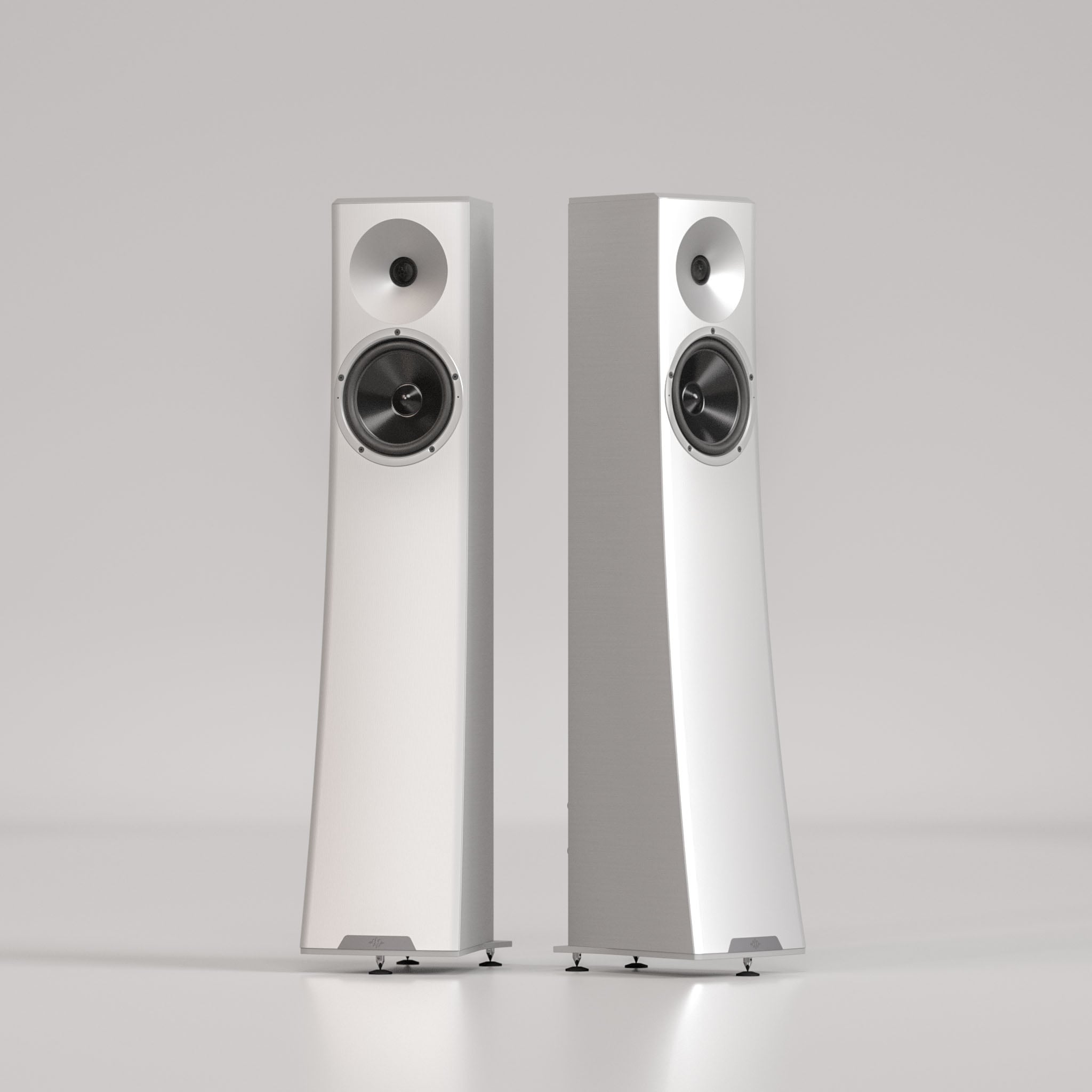
The Carmel 3 is the smallest and, at $29,800 per pair, the least expensive loudspeaker in the Reference range. This slender 2-way floorstander was first introduced in 2010, with an updated version following in 2015. The Carmel 3 made its North American debut at Capital AudioFest in November 2023. As with all Reference Series speakers, its enclosure is constructed entirely with an aluminum alloy, the 48 parts of the cabinet produced in Arvada, Colorado, by YGs eight hard-working CNC machines. (The Peaks range products have an aluminum front baffle but the remainder of the enclosure is fabricated from a dense resin material sourced in Europe.) The Carmel 3 stands 41″ tall with a gently sloping front baffle. Although it weighs in at a solid 85 pounds, it has a relatively small footprint, and YG has incorporated a substantial weighted base plate that helps prevent the speaker from being knocked over. In addition to providing mechanical stability during “real-world usage”—i.e., kids and pets invading the listening space—the plate also has a damping function and contributes to the tuning of the internal volume.
A key driver innovation of Webster’s Cambridge team is the Lattice airframe, an advance in the design of the metal part that is glued to the voice coil under the silk dome to extend the frequency response and maintain pistonic behavior at very high frequencies. Previously, the corresponding item was a three-armed structure that was notoriously difficult to manufacture; it’s now a more robust pentagonal piece of aluminum machined from a special alloy that’s been heat-treated prior to milling. It provides better support for the fabric dome and transmits impulses from the voice coil more efficaciously, with less distortion and wider dispersion. (For further insights into YG’s loudspeaker design over the years, I refer you to any and all reviews of the company’s products by Kirk Midtskog, TAS’s resident expert on the manufacturer, his most recent write-up being his review of the Sonja 3.2 in Issue 361.)
Famously, YG’s BilletCore drivers are each milled from a solid block of aluminum, most of which—more than 99%—ends up on the factory floor. Although YG does recycle the “extra” material, it’s an inefficient process by any standard. This is about to change with, after two years of “prototyping and production proving,” the introduction of YG’s new FormCore drivers that are manufactured from sheets of metal with a thin, hard layer on both surfaces and, Webster notes, “represent a significant step forward in sustainability. They match the performance of our milled drivers so precisely that we do not require any crossover changes, and the sound is practically indistinguishable.” By the time you read this, Carmel 3s will likely be equipped with FormCore drivers, which will eventually make their way into every YG speaker.
The Carmel 3’s crossover network—the handoff is centered at 1750Hz—was developed with YG’s usual methodical approach of computational modeling, measurement, and listening. The capacitors and resistors are meticulously selected for low levels of susceptibility to mechanical noise, and the circuit board is a proprietary multilayer design that Matthew Webster is quite proud of. “We carefully recorded the microphony of every component, measured the vibrations induced in the boards, and simulated the effects of the entire assembly,” he told me. “For example, the copper traces on the boards are designed not just for their electrical performance but also to account for how their shape impacts the resonant behavior of the populated board. It is a small detail, but optimized, nonetheless.”
Crossover design contributes importantly to the exceptional phase coherency of all YG speakers. In the case of the Carmel 3, the tweeter-mid/bass duo is phase aligned (relative phase +/–5 degrees) over a frequency range of 700 to 3300Hz. Webster told me that over 95% of production-driver pairs actually do much better than that—every pair is tested before leaving the factory—with the range of tight phase alignment more like 400 to 6000Hz, around four octaves.
On the sample provided for review, there were two sets of binding posts, for those who wish to bi-wire or bi-amplify their Carmels, something that YG neither promotes nor discourages. “The standard model comes with a single pair of binding posts because 90% of our customers do neither. In those cases, a single pair of binding posts simulates better, measures better, and—most importantly—sounds better than two pairs [of binding posts] with jumpers.” Should you order the Carmel 3’s with double binding posts, YG provides two sets of AudioQuest jumpers.
Standard finishes are silver and black, though other colors are available for an upcharge.
It didn’t take long for Duncan Taylor, YG’s Marketing Manager, to set up the Carmels to his satisfaction. For this review, the speakers were driven by Tidal Ferios G2 monoblock amplifiers, and they didn’t object to the copious amount of power provided, their small size notwithstanding. In terms of speaker cables, surveying what I had on hand, Duncan’s decision was to connect the amplifiers to the YGs with a single pair of AudioQuest Zero cables, rather than my usual Siltech 880L wires or one of several bi-wire options. Local and streamed digital files were played with a Baetis Reference 5 server, CDs and SACDs with a Sony X1100ES universal player employed as a transport. The digital data from both were processed by a Tidal Contros controller. Other cabling included Siltech 880i balanced interconnects, a Wireworld Platinum AES/EBU digital cable from Baetis to Contros, and an Apogee Wyde Eye coaxial/SPDIF from disc player to pre/pro. In my 15′ x 15′ room (see below), the Carmel 3’s were positioned farther apart than usual with speakers of this size, about nine feet from the center of one front baffle to the other. It was the same distance, nine feet, from the speakers to the prime listening position with only minimal toe-in, and two feet from the back of each Carmel to the wall behind them, lined with ceiling-to-floor polycarbonate discs and roughly 13 square feet of GIK quadratic diffusers.
The first musical selection I listened to after Duncan Taylor’s departure, just because it happened to be up next on my Roon review playlist, was the first movement of Beethoven’s Pathétique sonata, played by Peter Tákacs. Sometimes only a cliché will do: With the volume serendipitously set to exactly the right level, I felt like I was present at a piano recital in a small hall sitting close to the stage. Such was the immediacy of the Carmel 3’s presentation that I sensed both the mass of the Bösendorfer Imperial Grand that Tákacs played as well as the nuances of the pianist’s touch. It was more than a little surprising that such a diminutive loudspeaker should have such commanding presence, but it did. I experienced much the same thing all the way through BluesQuest, an SACD sampler of Joe Harley-produced selections issued by AudioQuest on its AQM label, featuring such artists as Mighty Sam McClain, Terry Evans, Doug MacLeod, and Robert Lucas. The elemental power of this music was fully communicated with dynamics that were impactful and believable. More complex music, played at a high volume level, did provide a dose of reality: The Finale of the Saint-Saëns Symphony No. 3, the Philadelphia/Eschenbach recording, showed signs of stress when organ and orchestra were playing full out. But that can happen with my reference Magico M2s if I get overenthusiastic with the gain. Really, you won’t be steering clear of symphonic warhorses just because your loudspeaker is the Carmel 3.
Speed and transparency were other areas of superb performance, perhaps not unexpectedly given the loudspeaker’s phase coherence. A track that I frequently employ to assess this parameter is from pianist Marc-André Hamelin’s Kaleidoscope, our “Recording of the Issue” in March. On that album, Hamelin’s own tongue-in-cheek Essercizio per pianoforte (Omaggio a Domenico Scarlatti) has passages with more notes played per unit of time than ought to be humanly possible. The breathtaking clarity of Hamelin’s technique is something one never forgets when hearing him perform in person, and the Carmel 3’s manage to reproduce the blistering passagework without smearing or unevenness. Yet these YGs are not “clinical” or “mechanical” sounding—you can tell there’s a human being responsible for the superhuman level of execution.
As mentioned above, one of the glories of the YG Tor I reviewed in TAS 327 was its way with the human voice. I won’t pretend that any meaningful product-to-product comparison is possible at a distance of four years—only that the newer, larger, and more costly speaker is another star in this regard, an observation that followed assigning myself the enviable task of a listening session devoted entirely to my favorite pop and jazz singers, the likes of Bonnie Raitt, Lyle Lovett, Mel Tormé, and Ella Fitzgerald. There was utter fealty to the essence of these highly characteristic vocal instruments. Another clue to the Carmel’s capacity to parse nuances in tonality came from Decca/RCA’s famed 1959 Royal Ballet Gala set, conducted by Ernest Ansermet. In one of the Swan Lake movements, the concertmaster applies a mute for a solo, and not only is the violin perceived as softer, but its entire overtone structure is altered to great musical effect. This is quite apparent with the Carmels.
Spatiality—a metric that’s especially important to me—was impressive, with a broad and continuous soundstage established by Duncan Taylor’s wide lateral spacing of the two speakers. Imaging was excellent, again likely a consequence of the Carmel’s phase coherence that allows for subtle timing differences to register. I could readily appreciate that the 12 singers of Stile Antico were arranged in an arc for “Never weather-beaten sail” from Tune thy Musicke to thy Hart, with those in the middle farthest from the listener, and that the winds of the Royal Concertgebouw Orchestra were sitting in two rows, flutes and oboes in front and clarinets and bassoons behind them, for their 2010 live recording of the Shostakovich Symphony No. 15. And when the artists and their engineers working on a pop/rock project decide to go for a 3-D effect utilizing phase manipulation, as with Donald Fagen’s “True Companion” at 2:56, the results are knocking on the door of an actual multichannel production.
Predictably, prodigious low-bass production was not an attribute of the Carmel 3’s (though the “usable output” LF specification of 32Hz could lead you to believe that the speaker is an overachiever in this regard.) My final assessment was that the speaker’s overall bass performance is quite good and that any observed deficiencies are very much “sins of omission” that ought to be acknowledged and respected.
The quality of the upper bass and top of the midbass range—subjectively down to around 100Hz—was as good as I’ve heard from any loudspeaker close to this size in terms of impact, articulation, and tunefulness. The sound of electric bass and kick drum together was clean and punchy, precisely what’s needed for most pop material. Synth-heavy dance music, pipe organ, and the most exuberant examples of orchestral “power music” could seem undernourished. This was not exactly a surprise for a two-way with a single 7.25″ midbass driver. I’ll add that augmenting the bass with a subwoofer is something that needs to be done with care, if at all, so that one doesn’t end up with a bottom octave with a “tacked-on” quality that detracts from the loudspeaker’s exceptional coherence from the midbass on up.
For sure, $30k can get you a very good speaker with more deep bass than the Carmel 3s can generate. But that doesn’t change one bit my impression of the YG Carmel 3 as a superb transducer, one that delivers a nonpareil listening experience with most of the music I played through them. I can heartily recommend the YG Carmel 3 as an attractive and relatively affordable loudspeaker that excels in all meaningful sonic parameters in small to medium-sized rooms.
For some, YG Acoustics will represent the ultimate expression of the high end’s quest to offer products that represent an ideal mix of head and heart. The company’s iterative sequence of design/listen/measure has been the basis of genuine advances in the science of loudspeaker building. But the teams in the UK and Colorado are also receptive to the subjective aspects of experiencing music and sound: These are nerds with soul. They have a comfort level with the math, physics, and engineering that underlies their efforts and can relish the magic of the audiophile endeavor all the more.
Specs & Pricing
Type: 2-way sealed box
Driver complement: 1″ Lattice fabric dome tweeter; 7.25″ aluminum BilletCore mid/bass cone
Frequency response: 32Hz-40kHz
Impedance: Nominal 6 ohms (3.2 ohms minimum)
Sensitivity: 87dB
Dimensions: 9″ x 41″ x 13″
Weight: 85 lbs.
Price: $29,800/pair
YG ACOUSTICS
4941 Allison St, Unit 10,
Arvada, CO 80002
(303) 420-9120
yg-acoustics.com
Trending Articles
See all
High End Vienna 2026: Loudspeakers Under $50k
- Jun 17, 2026
Building a Listening Room
- May 28, 2019
Wilson Audio Sabrina V
- Apr 14, 2026


By Andrew Quint
More articles from this editor
Read Next From Review
See all
Simco Audio Simco ONE Loudspeaker Review
- Jul 07, 2026
Editors’ Choice: CH Precision M10
- Jul 07, 2026
Editors’ Choice: JR Transrotor Orion Reference FMD
- Jul 04, 2026
ES Labs ES-2α Headphone Review
- Jul 03, 2026

