


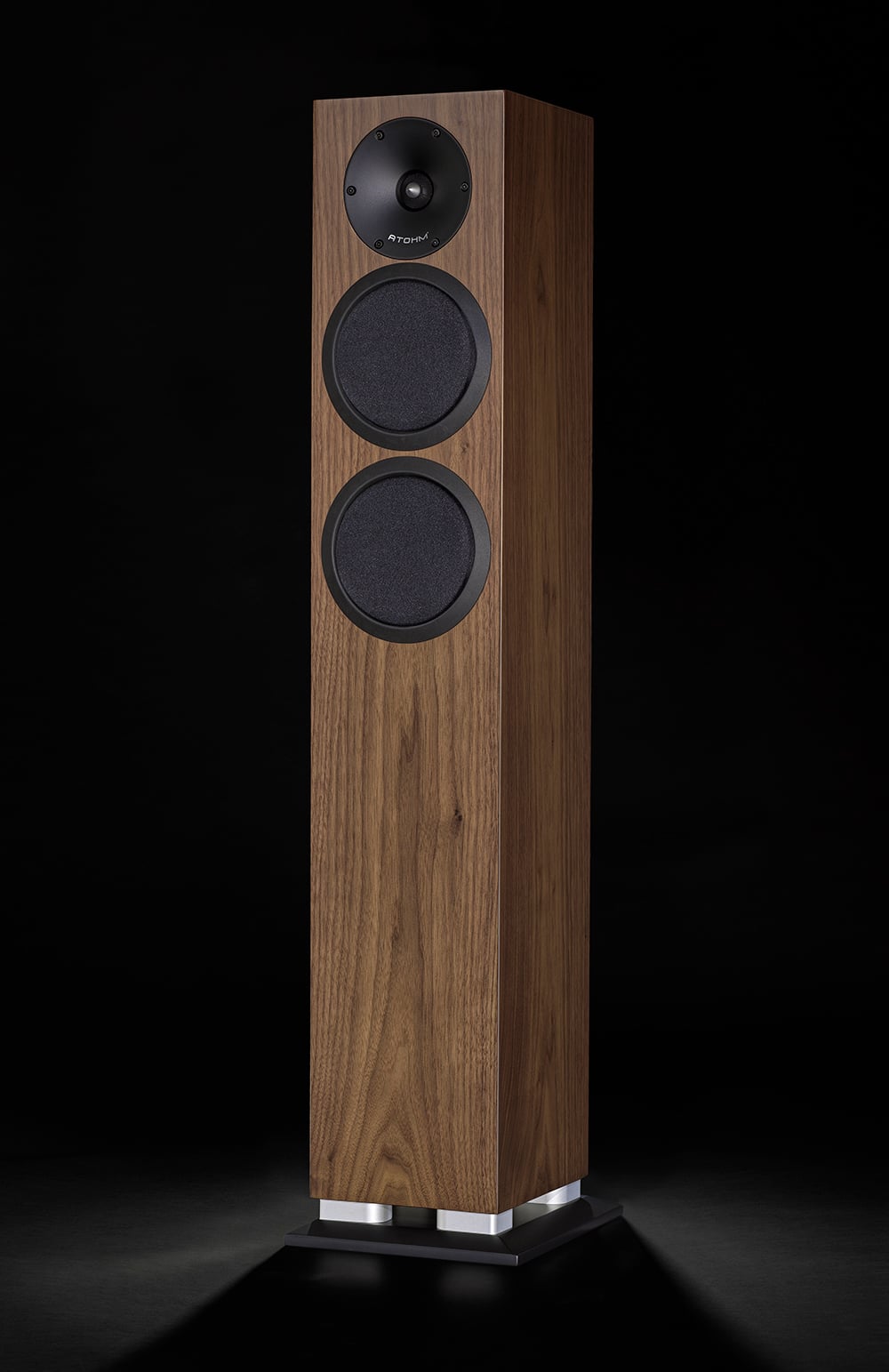
Last year, the French loudspeaker manufacturer Atohm unveiled the latest iteration of its Sirocco Series. The redesigned range—modestly priced by contemporary standards—comprises the floorstanding Sirocco 2.24 ($3800/pair) and the compact stand-mount Sirocco 1.24 ($2400/pair). A center-channel Sirocco Center is also available. In addition, Atohm also offers a flagship line, its GT Series. Atohm was founded in 2000 by Thierry Comte (previously the technical director for Triangle) and engineers and manufactures its proprietary drivers and loudspeakers at the company’s state-of-the-art facility in Pin, France. The Atohm philosophy walks the seemingly contradictory line between being a specialist manufacturer offering high-performance loudspeakers and keeping physical dimensions modest and prices reasonable.
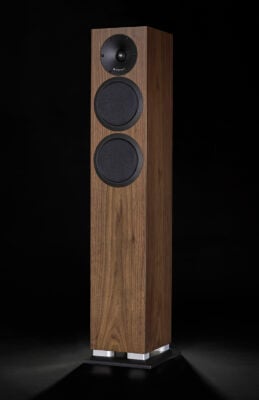
The focus of this review is the Sirocco 2.24, a handsome 2.5-way floorstander in a bass-reflex enclosure. The dual mid/bass drivers and tweeter are closely arrayed in-line. Since the tuned port exits from the bottom, the enclosure is secured on a raised plinth via aluminum spacers that lift the bottom of the speaker enough to allow the port to do its thing. At 39″ tall and sporting a narrow baffle, the 2.24 is ideal for smaller rooms, virtually disappearing into the surroundings. Attractive in a minimalist fashion, it neither draws attention nor downplays its presence. Its intention is to get the job done.
The Sirocco 2.24 is the result of a three-year development period. There have been improvements across the board that include the drivers, cabinet enclosures, and crossovers, combined with meticulous fine-tuning and precision manufacturing. Transducers are crafted in-house with each undergoing a series of rigorous tests to ensure its quality before being integrated into the loudspeaker cabinets. The 18mm MDF cabinets have also been updated and now include Atohm’s SWD (Standing Wave Damper) technology, which utilizes a laminar absorption cavity to effectively neutralize resonances and reduce standing waves, keeping the upper bass and lower midrange free of coloration.
As for the drive units, the Sirocco Series tweeter incorporates a 20mm lightweight silk dome with aluminum phase plug and top-notch neodymium magnets, backed by a calibrated, sound-absorbing rear chamber. It operates via a die-cast aluminum waveguide. The 6″ mid/woofers employ short-fiber, paper-cone diaphragms and low-diffraction rubber surrounds and use 84mm-diameter ferrite magnets paired with linearity-optimized pole pieces and a 25mm voice coil, with Atohm’s proprietary dual TICR (Thermal and Inductive Control Rings) technology in the voice-coil pole plate. All drivers are matched to a tolerance of 0.25dB.
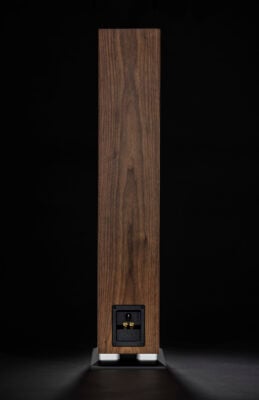
The Sirocco crossovers employ “simple 6dB/octave slopes complemented by impedance-correction circuits to ensure sonic precision while making the speakers easy to drive and compatible with a wide range of electronics.” The crossover frequency is 3.5kHz. The Atohm team states that the shallow slopes can be effectively implemented due to the time-aligned and phase-optimized drivers. Conveniently, on the back panel, there is a three-position, switchable treble attenuator, adjustable in 2dB steps. Personally, I wish more manufacturers would offer this handy and effective fine-tuning option. Acoustics and placement issues can often be ameliorated with the flick of a switch. The back panel speaker terminals are single wire only. Sirocco models are available in a choice of four finishes: oak or walnut natural wood veneer and black or white satin lacquer.
For this evaluation, Atohm’s U.S. distributor Audio Excellent provided electronics from Atoll Electronique, namely the PR400 Evolution preamp and AM300 Evolution 150Wpc amplifier. They joined my Clearaudio Concept Signature turntable (Issue 368); Pass Labs XP-17 phonostage; Lumin X2 Media Player (review forthcoming); dCS Bartók Apex; MBL Corona C51 integrated; and Wireworld Silver Eclipse 10, Shunyata Theta and Audience Front Row, and Snake River Audio Takshaka cabling.
Before delving into Sirocco’s sonic particulars, a couple set-up impressions. First, there’s no such thing as one-room-fits-all. And small compacts and floorstanders like the 2.24 are always on the lookout for bass reinforcement. In the case of the 2.24, it’s a placement-specific speaker, so be prepared to work with it. In order to achieve the best balance between low frequencies and midrange clarity, character, and focus—that is, to get these factors to gel—moving the Sirocco a few inches to and fro relative to the wall behind the speaker can make all the difference in the world in terms of LF foundation, energy, output, and extension. Also, I settled on reducing toe-in, which in my setup allowed the drivers to integrate more effectively. Gone were the marginally lean and clinical character and the uneven midbass output that characterized the Sirocco initially. Ultimately, this experimentation paid off in spades as I’m sure it will for most owners. The process might seem tedious at first, but you’ll thank yourself afterwards.
That said, I like to approach every review with a clean slate. Without anticipation or expectations. This was made all the easier since I have no history with an Atohm loudspeaker in my listening room. As first encounters go, the Sirocco acquitted itself very well indeed. Sirocco immediately made it known that it wanted to musically engage with the listener. By that I mean it presented itself as upfront (not laid-back), energetic, and, for the most part, tonally neutral through the midrange, without any obvious frequency peaks or suckouts. It had a high instant likability factor, a potent midrange, and some roll-off at the edges of the frequency spectrum. Personality-wise, it had a cooler balance. Its power range was very good for a 2.5-way, and it skillfully navigated macro-dynamics, although lower-octave dynamic energy and impact were slightly softened. But altogether, its presentation was quite impressive given its modest proportions. Transients were quick and nicely detailed. The sibilance range was sparkling but not overheated. A prime example is BS&T’s classic track “Spinning Wheel.” Bobby Colomby’s drum kit was crisp and tight, his high-pitched snare drum fast on attacks, the band’s famous Lew Soloff-led horn section bracingly clean. Turning to piano, I noted that with the Bill Evans track “Sometime Ago,” while maintaining much of the soundboard warmth, weight, and density I expect from this cut, the Sirocco still skewed a bit drier on top, wanting a little more air and lift.
Vocals, always primary to me, were full bodied, physically tactile, and balanced. There wasn’t a hint of gender bias here—male and female singers shone equally well. Vocal timbres and placement were colorfully captured, from chesty bass-baritones like Bryn Terfel, to throaty rock voices like Springsteen or Melissa Etheridge, to velvety, buttery sopranos like Renee Fleming.
Timbre, in general, was eerily naturalistic. During Ricki Lee Jones’ “My One and Only Love” [Pop Pop], for example, the accordion, acoustic bass, and guitar sounded remarkably present and immediate. The Sirocco acquitted itself admirably in expressing the lower-level details and staging cues that are key to bringing an acoustic performance alive. To this point, Aaron Copland’s “Fanfare for the Common Man” [Copland Conducts Copland, LSO] was conveyed with finely layered string sections, gorgeous brass flourishes, and low-level percussion detailing at the back of the orchestra.
While the Atohm was not able to achieve genuine bottom-octave reproduction, through the careful positioning that I outlined earlier, I achieved a satisfying 40–50Hz extension, body, and musicality that changed the character of the speaker. (The downward-firing tuned port aided in this assignment and rarely if ever sounded overworked.) The rapid-fire bassline during BS&T’s “Smiling Phases” was appropriately fast, punchy, and precise in pitch, despite some loss of definition in the lowest reaches. Overall, the low end was impressive for this class of loudspeaker. The Sirocco’s performance came into even better focus when I cued up the Eagles “Hotel California” (Hell Freezes Over). The reproduction of the repeated bass-drum impacts is complex, a low-octave stew of fundamentals, transients, long immersive sustains, and decays—tough going for any loudspeaker unaccompanied by a subwoofer. Kudos to the Sirocco for doing a more than credible job getting the bass out.
Obviously given its size and specs, there are limitations. The Sirocco falls a little short in conveying the grandest scale and weight that music is capable of. Low frequencies could be more specific, and staging might be a little more dimensional and immersive. The Sirocco has little trouble playing loudly, but when it is pushed too hard, image details can cloud over somewhat, with the upper treble sounding a little short of air. Nonetheless, these subtractions were relatively mild and easily overlooked, given the Sirocco’s overall musicality.
The Sirocco met or exceeded my expectations for what a 2.5-way compact tower can do in 2026. It strikes a rewarding musical balance that, coupled with its smaller footprint and low profile, will make it a crowd pleaser in most domestic settings. In weather circles, “sirocco” is a powerful Mediterranean wind that blows into Southern Europe from the Sahara. But for me, Sirocco was a breath of fresh air. A solid performer that proudly represents the crème de la crème in its price range.
Specs & Pricing
Type: Floorstanding, 2.5-way, bass-reflex
Drivers: 20mm tweeter; two 6″ mid/bass
Frequency response: 40Hz–25kHz (–3dB)
Sensitivity: 88dB
Impedance: 6 ohms (3.5 ohms min.)
Dimensions: 8.5″ x 39″ x 10.1″
Weight: 30.9 lbs.
Price: $3800/pr.
AUDIO EXCELLENT LLC
(847) 774-4619
audioexcellent.com
atohm.com
Tags: LOUDSPEAKER FLOORSTANDING ATOHM
Trending Articles
See all
High End Vienna 2026: Loudspeakers $50,000 and Up
- Jun 10, 2026
Metaxas & Sins Emperor Loudspeaker
- May 23, 2026
Building a Listening Room
- May 28, 2019



By Neil Gader
My love of music largely predates my enthusiasm for audio. I grew up Los Angeles in a house where music was constantly playing on the stereo (Altecs, if you’re interested). It ranged from my mom listening to hit Broadway musicals to my sister’s early Bob Dylan, Joan Baez, Beatles, and Stones LPs, and dad’s constant companions, Frank Sinatra and Tony Bennett. With the British Invasion, I immediately picked up a guitar and took piano lessons and have been playing ever since. Following graduation from UCLA I became a writing member of the Lehman Engel’s BMI Musical Theater Workshops in New York–working in advertising to pay the bills. I’ve co-written bunches of songs, some published, some recorded. In 1995 I co-produced an award-winning short fiction movie that did well on the international film-festival circuit. I was introduced to Harry Pearson in the early 70s by a mutual friend. At that time Harry was still working full-time for Long Island’s Newsday even as he was writing Issue 1 of TAS during his off hours. We struck up a decades-long friendship that ultimately turned into a writing gig that has proved both stimulating and rewarding. In terms of music reproduction, I find myself listening more than ever for the “little” things. Low-level resolving power, dynamic gradients, shadings, timbral color and contrasts. Listening to a lot of vocals and solo piano has always helped me recalibrate and nail down what I’m hearing. Tonal neutrality and presence are important to me but small deviations are not disqualifying. But I am quite sensitive to treble over-reach, and find dry, hyper-detailed systems intriguing but inauthentic compared with the concert-going experience. For me, true musicality conveys the cozy warmth of a room with a fireplace not the icy cold of an igloo. Currently I split my time between Santa Fe, New Mexico and Studio City, California with my wife Judi Dickerson, an acting, voice, and dialect coach, along with border collies Ivy and Alfie.
More articles from this editor
Read Next From Review
See all
Editors’ Choice: Gryphon Commander
- Jun 15, 2026
Hana Umami Black Phono Cartridge
- Jun 09, 2026
Editors’ Choice: AGD Solo
- Jun 09, 2026
Audio Solutions Vantage M Loudspeaker Review
- Jun 06, 2026

