


When I was a lad Swedish design was all the rage. Design Research, who specialized in Scandinavian modernism, had a large four-story Cambridge showroom that rivaled the Harvard Coop as the largest retail establishment in Harvard Square. At the time Swedish design epitomized the ne plus ultra of form-follows-function ergonomic elegance. Then along came Apple and suddenly Swedish design didn’t look all that special anymore. But all those Swedish designers didn’t skulk off to Uzbekistan; no, they kept at it. Urbanears demonstrates that modernist Swedish design is very much alive and well.
Unlike most of the manufacturers whose products appear in Playback, Urbanears isn’t a traditional audio products company. Instead, Urbanears is a design collective. And unlike most Hi-Fi firms with their multiple skews of similarly styled earphones at different price points, Urbanears only a handful of models, each addressing a specific need or filling a particular niche. Each one has a unique design created for a particular purpose. The Bagis is Urbanears only earphone (as in, in-ear headphone). The Medis, which is Urbanears’ other semi-in-ear earphone, has a completely different physical design and optimal usage environment (the Medis is more of an earbud than a true earphone, meaning it rests in your outer ears–not in your ear canals). Conceivably, you could own every model in the Urbanears lineup and have almost no usage overlap. According to Urbanears, “An Urbanears product is typically conceived through a vision of how a headphone is used and why.” Different listening environments require different physical designs.

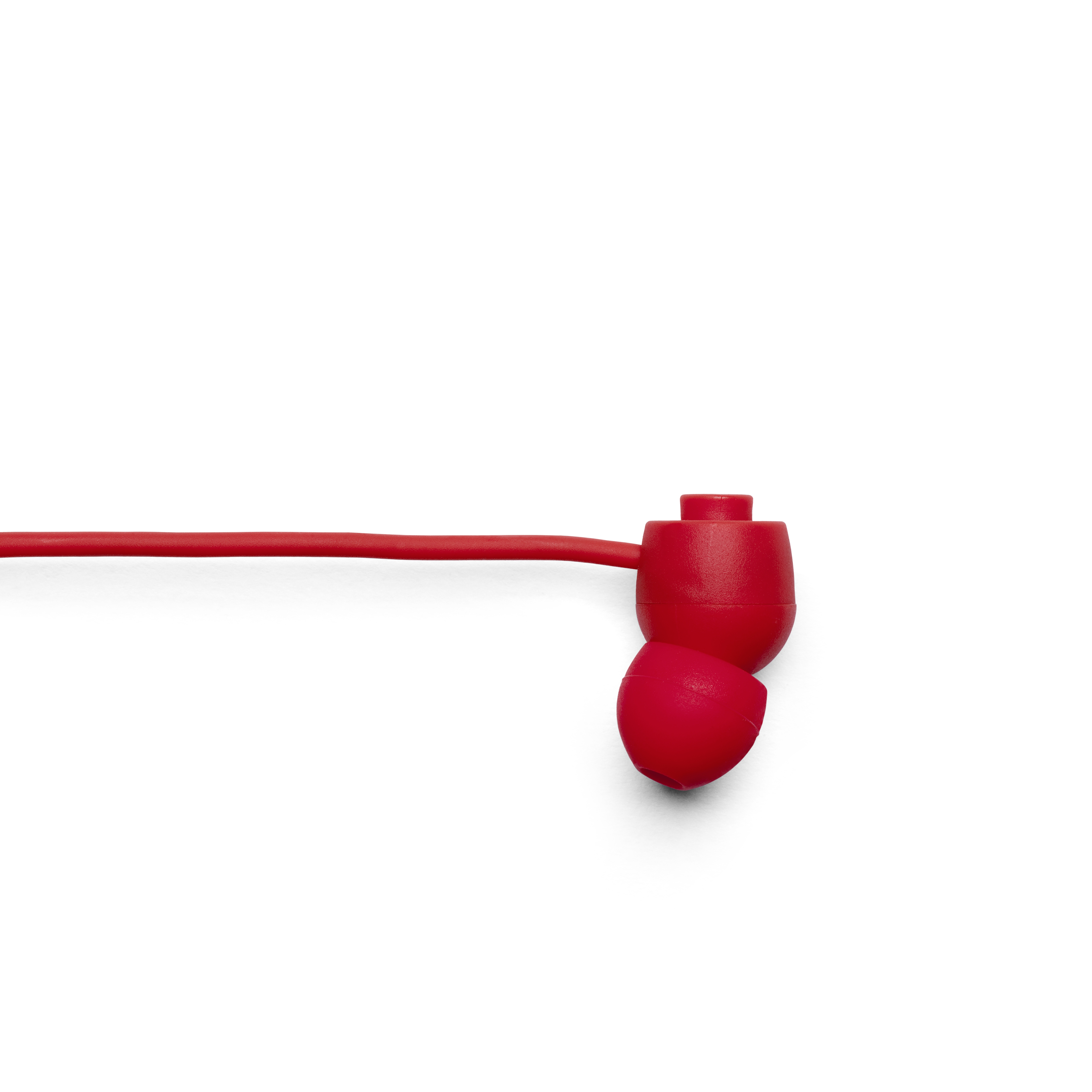
Urbanears Bagis ‘phones are available in fourteen different colors, but depending on the season your retailer may only have ten, since for each season Urbanears changes which colors are available based upon a summer/spring/fall/winter set of Pantone-matched colors. My review samples were white, a color that is available year-round. Whichever color you choose, your Bagis ‘phones will come with a set of small, medium, and large eartips in that same color. Some colors are subtle, such as Mocha, while others like Mustard and Grape are Day-Glo bold. Urbanears let’s you decide how much you want your earphones to be noticed.
Sonically, the Bagis could be best described as a music-lover’s design—they aren’t bass blasting hip-hopping bad boys or super-high resolution audiophile monitors. Instead the Bagis are medium resolution earphones that get the midrange largely right, have enough bass energy for most listeners, and avoid upper frequency issues due to a gently downward sloping response above 2 kHz.
With a list price of $35 and a street price around $30, the Bagis earphones deliver surprising sound quality, an elegant physical design, and rugged overall construction. For an urban traveler, fitness fan, or anyone who wants a musically satisfying earphone, the Bagis are an exceedingly cost-effective choice.
FEATURES
- 9mm handmade drivers.
- Special “snap construction” neck connection.
- Comes with remote-compatible stereo plug for i-Phone, Blackberry, HTC, etc.
- Has adapter cable for standard stereo MP3 players.
- Includes 3 sizes of ear tips
Ergonomic Highlights and Lowlights
Although the Bagis lack a travel case, they can be carried in a unique way when not inserted in your ears—by design the left and right earpiece housings snap together so the Bagis can be turned into a necklace of sorts. The snap system also serves a second, and in my eyes, even more useful function: you can easily identify the left from the right bud since the right is the “male” side while the left is the “female’ one. Even in a locked coal cellar at midnight you can tell which earpiece is right and which earpiece is left by feel alone. I like that.
With only three differently sized tips, all of similar design, the Bagis doesn’t offer the range of fit options you’ll find from Shure or Etymotic, but I found the largest tips did a good job of sealing my outer ear canal and providing decent isolation. The isolating qualities of the Urbanears are not quite as effective as the Sure SE215 or Etymotic ER4P, and while Urbanears supplies no isolation specifications, my ballpark guess on their isolation is around 20 db. Near the end of the review period I looked through my extensive tip stash and found a pair of soft eartips that were slightly larger than the largest ones supplied by Urbanears, which gave me a slightly more secure fit. With these tips it took a quite a bit of downward force to unseat them. There was a sonic tradeoff, however; the third-party ear-tips boosted the mid-bass by several decibels.
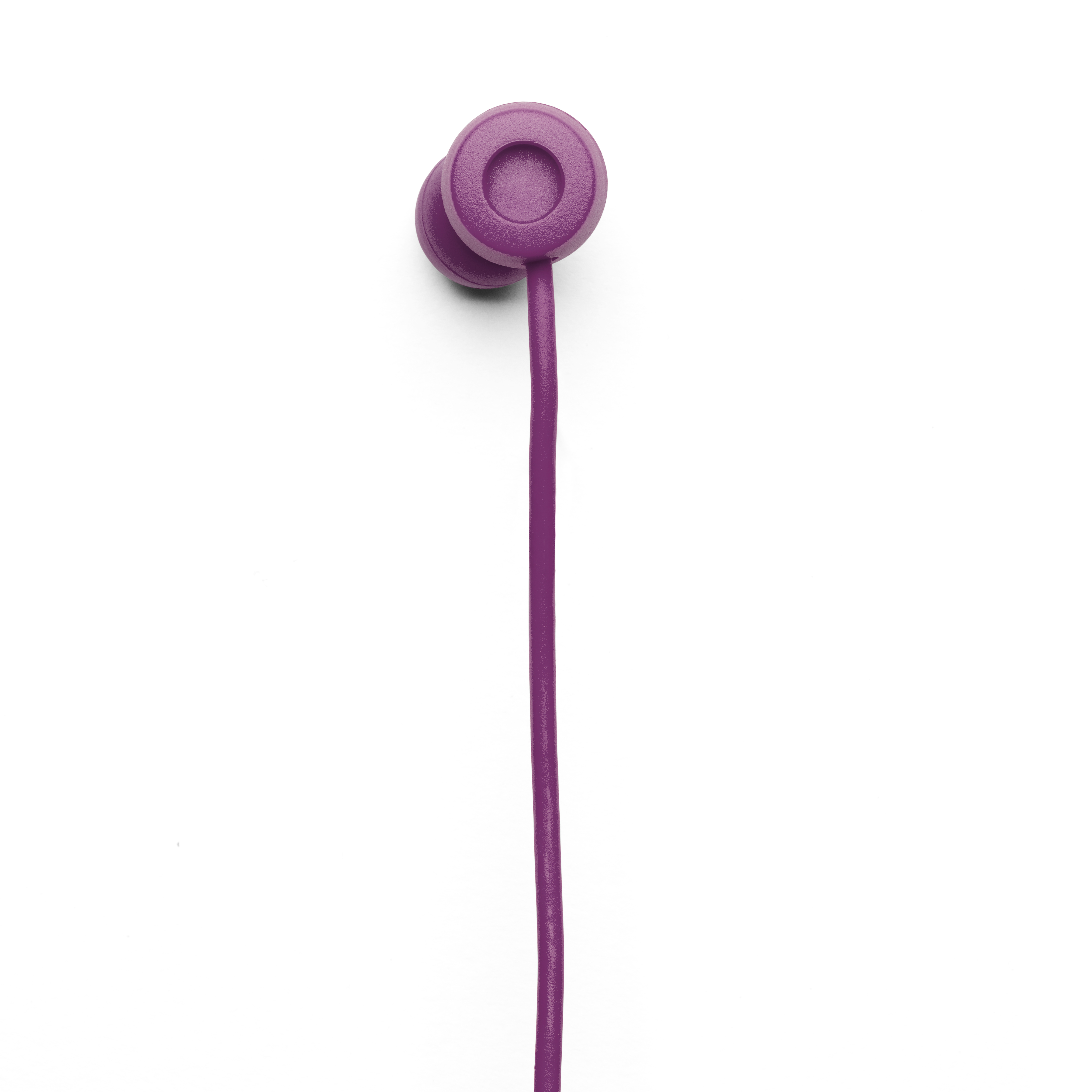
The Bagis ‘phones are designed to be worn with their signal cables dropping straight down from your ears. I tried to use them with the cables routed up and around the tops of my ears and down my back, but they didn’t stay seated in my ears and the mute button on the cable was impossible to use. If you have to run the cables behind your ears, the Bagis won’t be your first choice.
Even the Bagis cabling shows an attention to ergonomic detail not usually found in $30 earphones; the first fourteen inches of cable before the left and right junction utilizes a different cover material. This rubberized surface was made to slide easily to minimize any microphonics from rubbing against your shirt collar or neck. After the junction the cable covering changes to a rugged cloth that will withstand abrasion and physical trauma better than the rubber covering. The 47” cable length was long enough to reach an MP3 player even if located in a hip or back pocket.
While the Bagis cable is not removable or replaceable, if you use the Bagis with a standard MP3 player the (included) 5-inch standard stereo adapter cable will act as “quick release” break-away that will protect the rest of cable from trauma. The first time I used the Bagis during a workout this design feature saved the cable from damage when it got caught on a leg abductor machine; instead of breaking, the adapter cable merely pulled out of its socket with no harm done.
The Bagis come with a one-year “premium” replacement warranty. What this means is that for a year, if the product fails the original authorized dealer, at their discretion, can replace it. Not only is this warranty longer than for most under $100 earbuds, it doesn’t require returning them to directly to Urbanears for warranty replacement. Of course the warranty doesn’t cover abuse, which would include trying to use the earbuds under water or in outer space.
SONIC CHARACTER
- Darker than neutral voicing with reasonable bass energy.
- Smooth euphonic midrange.
- Sweet and rolled-off high-end.
- Adequate imaging specificity.
- Decent dynamic contrast.
Designing a harmonically neutral earphone is a delicate balancing act, whether it costs $35 or $350. It’s all too easy to end up with an earphone that is bass-heavy or bass-light. Judged in terms of absolute neutrality, the Bagis bass is overly richly endowed (especially in the kick-drum range), and slow. But somehow the Bagis manage to survive this extra dollop of bass without irrevocably interfering with the midrange.
The Bagis bass resolution was slightly soft and woolly, especially when compared with the clarity and control of its’ midrange. The bass was also a bit slow, meaning it hung around after a note had stopped, giving you the sort of response you might hear if listening to bass instruments in an overly reverberant space. The bass tended to “bloom” so that the listener
perceives a slight increase in low-end volume after the initial attack, which obscured some bass definition and detail. But despite these sonic issues the Bagis bass was qualitatively superior to the $49 Paradigm Shift E1 earphones. The Bagis bass was cleaner and better controlled with no renegade bass notes interfering with the midrange. The Bagis also avoided the E1’s occasional sympathetic resonances during high-level bass passages.
It’s hard not to like the Bagis’ midrange presentation. Judged by the Occam’s razor of absolute neutrality, the Bagis’ midrange balance is definitely on the dark side of neutral. But most music benefitted from the Bagis’ sympathetic ministrations. Male voices had real presence and weight, and while female vocalists, especially altos, such as Mary Chapin Carpenter, sounded somewhat darker than usual, they still retained some clarity and sparkle.


The Bagis’ upper midrange and treble regions were smooth but hooded. If you look at Urbanears’ published frequency curve you can see a roll-off beginning as early as 2kHz, and pronounced attenuation between 10 and 20 kHz where upper frequency response drops by more than 30 dB! Violins and flutes don’t have much, if any, air. The good news is that edgy mixes, especially those with peakiness problems between 2 and 4kHz, should sound a bit more listenable through the Bagis than through a more neutral earphone such as the Shure SE-215.
Imaging through the Bagis was nothing to write home about. Yes, the Bagis image better than a pair of Apple earbuds, but not by much. The overall soundstage was smaller than my reference in-ears, the Etymotic ER4Ps. Edge definition was also noticeably inferior to my ER4Ps, but it was on par with the Paradigm Shift E1s.
The Bagis ‘phones are reasonably dynamic sounding, thanks in part to their high sensitivity, especially if the music has some midbass energy. That’s clearly the Bagis’ dynamic “power zone.” Kick drums definitely kick, but the further you go up from the midbass, the more truncated dynamics become. On material such as the Jam’s All Mod Cons [Ume Imports], the cymbals and high-hats weren’t nearly as dynamic as with earphones that had a more extended upper range such as the Ultimate Ears UE-200s.
MUSICAL EXAMPLES
On Alex Harte’s “As Long As You Come Home” from 6 Spoons of Honey [CDBY] the acoustic guitars sound warm and rich but they lack some of their sparkle and bite on top. Also the handclaps that begin at the 00:55 mark and continue throughout the rest of the song were relegated to the back of the mix instead of leading from the front. Harte’s voice sounded very natural through the Bagis, but it wasn’t nearly as firmly defined in space as through a pair of HiFiMAN RE-272s.
Listening to Anthony Rooley and the Consort of Musicke perform “Look On Me Ever” from Walter Porter: Madrigals and Ayres, 1632 [Musica Oscura/Columns Classics], I was captivated by the lucidity and euphony of the Bagis’ overall presentation. On midrange-centric music such as this it’s easy to focus on what the Bagis do well: namely, present a coherent and musical picture of the live performance. And while Emma Kirkby’s voice was slightly darker than usual, it was impossible not to be pulled in by her seductive tonality.
On classical music that commanded a larger performing force, such as Mahler’s 1st conducted by Ben Zander on Telarc, the Bagis did a convincing job of simulating the full orchestra’s dynamic punch, especially when driven by the kettle drums. Even though the upper frequencies were attenuated, which was especially noticeable on the bells and triangle, strings still had cutting power and presence.
CONCLUSION
Consider this product:
- You want an earphone that fits comfortably in the outer ear canal (in other words, the Bagis works properly without needing to be seated deep within the ear canal).
- You prefer an earphone with a warmer than neutral frequency response.
- You need a very efficient headphone.
Look further if:
- You need a headphone with a multitude of fit options.
- You prefer a headphone with a big bottom end and/or extended top end (the Bagis has some bass lift, but a rolled off top end).
- You need an earphone with replaceable signal cables (though admittedly this isn’t a feature commonly seen on earphones in this price class).
Ratings (relative to comparably-priced earphones
- Tonal Balance: 8
- Frequency Extremes: _8(Bass)/_8(Treble)
- Clarity: 8
- Dynamics: 7
- Comfort/Fit: 8
- Sensitivity: 9
- Value: 9
BOTTOM LINE
What do you get for your $35 from the Urbanears Bagis? You get a very well made and carefully designed pair of earphones that deliver a euphonic and musically involving sound. Well-suited for use with low-powered portable MP3 players due to their high 107 dB sensitivity, the Bagis are an ideal step-up earphone for anyone who wants to get more music out of the iPod than is possible with the stock earbuds. The only real question is whether you’re bold enough to wear mustard, grape, or tomato colored earbuds.
SPECS & PRICING
Urbanears Bagis Earphones
Drivers: 9mm hand-assembled
Sensitivity: 107 dB
Frequency Response: 20 Hz – 20kHz
Cord: 47” (120 cm) cord
Plug: 3.5 mm iPod/Blackberry/HTC-compatible tip
Warranty: 1 year.
Price: $35 list, $30 street
Manufacturer Information
Urbanears/Zound Industries
011 +46 730 355543 (Stockholm, Sweden)
www.urbanears.com
Trending Articles
See all






By Steven Stone
More articles from this editor


Read Next From Review
See all
Editors’ Choice: Hana SL Mono MKII
- Jun 02, 2026

Technics SL-1500CS turntable
- Jun 02, 2026
Gauder Akustik Elargo 200 Loudspeaker
- May 30, 2026
Editors’ Choice: Accuphase E800s
- May 30, 2026

