

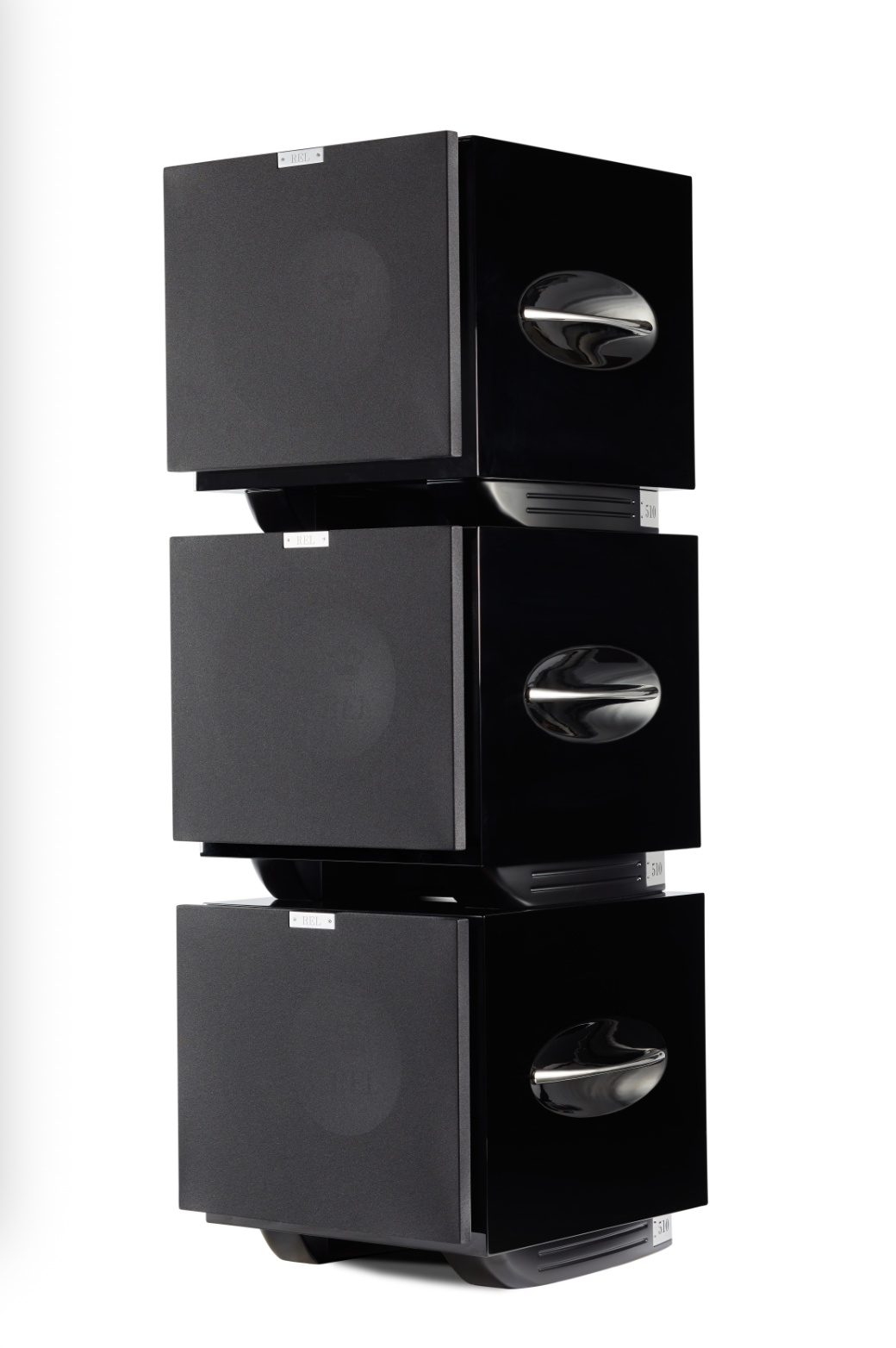
Editor’s Note: This review was designed to examine REL’s line-array approach to subwoofer bass. Though the models used for this review have since been replaced by a new model (S/550) the fundamental conclusions about REL’s line-array approach to subwoofers holds true.
I have been a stereo and music enthusiast for 40 years. I have been a reviewer for 16 years. In that time, like all of you I have been on a quest for the perfect system. My perception of the perfect system implies full-bandwidth reproduction, 20Hz to 20kHz. Of course, I can’t hear 20kHz, and I don’t think my room can accommodate a 60-foot 20Hz sound wave. But that didn’t stop me from wanting it.
When my budget was limited, I tried sub/satellite systems and sub/floorstanding systems to attain that holy grail. But again like so many of you, I learned that while subs do a great job of adding that low-frequency punch for home theater, adding subs for music is much more challenging. When you reach a certain level of expectation and refinement, the integration of the subwoofer with the speakers (floorstanding or bookshelf) becomes an overwhelming challenge. While many subwoofers utilize digital frequency-response correction to overcome this issue, I have found that route leads to more problems than solutions. The simple truth is, meticulously placing the subwoofer (or subwoofers) to achieve a properly unified wavefront, and even more meticulously adjusting crossover frequency and gain to correctly create an integrated transducer system is the way to do it right—and is also nigh impossible. I consider myself reasonably well skilled in speaker setup, room treatment, and room integration; and no matter what I’ve done, a sub never sounded right. Eventually, I decided that the best solution was to focus on speakers that could, without additional help from subwoofers, reproduce the entire frequency spectrum; and thus, my options became larger, heavier, and more and more expensive.
There is no paucity of full-range speakers these days, and the quality and performance of those speakers have reached absolutely epic levels, as has their size and cost. I hunkered down, embraced the solution, and enjoyed a myriad of exceptional full-rangers. As my transducers grew in size, quality, and performance, they required more and more power to properly control the woofers needed to push the air I needed to create the full-range experience I had now achieved and loved. Examples of such wonderful equipment I have reviewed for TAS include the Wilson Alexia V, Alexx V, and Estelon XB Diamond.
I need to take a moment to step back and openly state that in certain cases, the quality of the speakers I reviewed or experienced was so damn good that even if they didn’t go all the way down to 20Hz, I was willing to sacrifice the deepest octave to experience what some speakers could do with everything above, say, 30Hz. The Kharma Exquisite Midi 3 comes to mind, as does the Rockport Atria 2. But I did miss the visceral experience and the palpable emotional connection that a full-range system offers. Plus, there is an added sense of harmonic integrity and textural complexity that extends into the higher registers when the low frequencies are correctly reproduced; you have to experience it to appreciate it.
So, I settled into my audiophile reality. Big speakers, big amps, big budget, and spectacular performance…ah, the life of a reviewer!
Welcome to 50+. The back doesn’t work so good; moving heavy speakers up and down the stairs isn’t so much fun; pushing my spectacular Alexx Vs out of the room to review another pair of speakers wasn’t that much fun either; and I have to admit I found myself listening more for reviewing and less for enjoyment, not because my system wasn’t spectacular, but I couldn’t get out of my head how much I had invested in my stratospherically expensive gear, and I was longing for smaller speakers that were easier to move for reviews. It was time for a smaller, more conservatively priced system that was going to focus on engagement, allowing me to connect with the music emotionally yet maintain the level of accuracy and reproduction I expected and needed as a reviewer. That left me at an impasse. If I went back to using non-full-range speakers (even if they were close to full range), then my only option was using subwoofers.
My first steps
Now I’m looking at more conservative amplifiers, maybe an integrated amp (man, I did love that darTZeel CTH-8550 mk2) or a DAC that can function as a real preamp (Lampizator Poseidon), possibly a Linux-based Aurender server instead of my amazing but very expensive and Windows-based Taiko Extreme. And maybe I’d finally hear a pair of Rockport speakers in my room, since I have always respected the company’s ethos, methods, and quality. A diminutive process to extract maximum performance from the most affordable of top-tier componentry. Bang-for-buck implementation of reductive expansion. Addition by subtraction, as it were. But I still needed my 20Hz, dammit! I was not giving that up. But subwoofers…ugh! Back to the impossible task of integrating the un-integratable!
I cannot remember for the life of me (and so cannot give credit where credit is due—so thank you if you know you were the one) who told me about the concept of the REL Line Array, three-box-per-side stereo subwoofer towers, each tuned to slightly different crossover frequencies and gains. All set up by an expert who has the skill and experience to not only lock in the proper location for the subs but to expertly set up and tune in each sub in the stack to its optimum performance. Color me intrigued, and phone calls were immediately made!
Let me now introduce you to John Hunter, CEO of REL and speaker/subwoofer set-up Jedi master. John is an industry veteran and icon and has spent his life learning how to master speaker (and subwoofer) setup to extract every last ounce of performance. His technique is teachable and repeatable, and it works. Finally, someone broke the code! Yes, a single subwoofer will bring the boom into the room, but for music, stereo subs are a necessity. While I have heard well set-up stereo subs used with two-channel audio, I have always been able to hear a discontinuity between enclosures and drivers. With REL’s set-up techniques, that is finally gone. Are there people out there not affiliated with REL who can set subwoofers up to work ideally with speakers? Of course. I am sure that companies like Wilson, Magico, Focal, JM Lab, Kharma, and others that sell ultra-reference subwoofers to augment their ultra-reference speakers have their own versions of cracking the code. But REL has introduced the idea of the REL Line Array, which achieved a level of integration I have not heard with any other system other than full-range speakers that add subs to reinforce/augment (i.e., Wilson Alexx V or XVX plus Loke or Submerge, etc.). Do not interpret this as “better” than Wilson or Magico or Focal. I am desperately trying to avoid the “b” word. What I am saying is that REL has cracked the code on adding six subwoofers (three per side) to a pair of speakers that, on their own, are not full range and making them more than just full range but better in almost every conceivable way—not just more bass.
The New System
Aurender N30S music server. Lampizator Poseidon DAC/preamp. Lamm M1.2 Reference monoblock amplifiers. Rockport Technologies Atria 2 loudspeakers. Six REL S/510 subwoofers (two REL Line Arrays). (This system was approximately one quarter of the cost of my previous system, but wow!)
The Big Day
John and Isaac (subwoofer set-up assistant extraordinaire) came over and unboxed two pallets of REL S/510s (six subs total). My room is 15′ 1″ x 18′ 5″ x 9′ 2″, and the S/510 was selected for its size, speed, and ability to integrate with my speakers, the Rockport Atria 2s, which are lightning fast and go down to 28Hz on their own at –3dB. The subs are connected via speaker-level connectors to the Lamm mono amps and Neutrik connectors to the bottom subs on each side, and then serially connected from bottom to middle to top to convey the audio signal. I have to add that anyone who dismisses the Atria 2 as unworthy because it is Rockport’s most affordable model has never heard the Atria 2; it is astoundingly good!
The S/510 Subwoofer
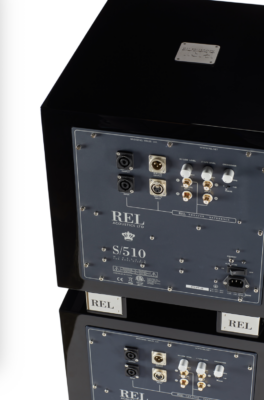
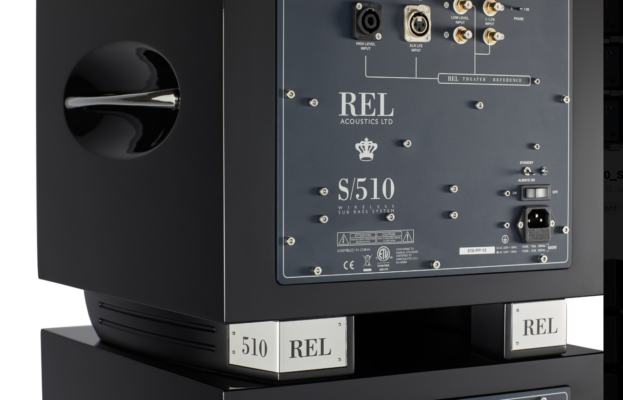
The S/510 is the smallest of the Serie S subwoofer series, and the series just below REL’s Reference No. 31 and 32 subwoofers. Utilizing REL’s 10″ ContinuousCast alloy cones in a front-firing active and down-firing passive configuration within a reflex enclosure, each 15.7″ wide x 16″ tall x 18.25″ deep subwoofer is powered by a 500W NextGen 3 Class D amplifier. The enclosure is very well reinforced, and the driver is fast and responsive. There was much debate regarding utilizing the S/510 or moving up to the S/812 or even the Carbon Special, which is even faster. For this first experience, the decision was to focus on what the smaller S/510 could do in a REL Line Array configuration and then pursue the difference their higher-end subs would make in comparison as we progressed through this experiment (i.e., stay tuned for more as we move up the REL ranks). The subs have a pair of low-level RCA inputs to be fed from the preamp, a single RCA LFE input to be fed from a surround processor or receiver, and a high-level Neutrik speakon input fed directly from the speaker posts of your amplifier. Low-frequency extension is reportedly –6dB at 20Hz for one sub; no measurement for six subs, but we can presume extension below 20Hz at reasonable output is probable. At 70 pounds per sub, each stack weighs in at 210 pounds. Retail is $2999 per sub (so around $18k for each stereo REL Line Array).
Considering the 15′ 1″ width of my room, the S/510s fit well physically on the outsides of my Rockports and had room to breathe between speaker and walls. The S/812 is 17″ wide and 17.5″ tall, which would have added 1.3″ of width per side and 3″ of height overall. The Carbon Special would have added an additional 0.5″ per sub or 1.5″ total to the stack height, while keeping the S/812’s width of 17″. Needless to say, these dimensions are not so great that my room could not accommodate the differences. Moving up to a No. 32 (29.25″ wide and 21″ tall) or a No. 31 (25.125″ wide and 17″ tall) would make a significantly larger footprint visually and physically. My room cannot fit No. 32s, and the No. 31s are each 10″ wider than the 510s. So, 20″ extra width overall—that is a lot, and likely more than my room could manage (although I would be happy to try).
REL’s preference is high-level inputs from the amp to the subs to realize the same voicing that the primary speakers receive from source to amp. I agree with this as it increases the voicing synergy between speaker and sub significantly. Three leads come off the Neutrik speakon—red (right positive), yellow (left positive), and black (speaker or chassis ground depending on whether the amp is unbalanced or balanced). When used in a mono (one sub per channel) configuration, the yellow lead is floated and red and black are utilized. In my case specifically, with my balanced Lamm monoblock amplifiers, I floated the black lead as well and used a separate RCA from an unused amp input to the LFE input on the bottom sub on either side (LFE input turned to zero) to share common signal ground. This gave me the quietest connection compared to using the chassis ground on the amp.
Setup and Impressions
There is a YouTube video of John setting up the REL Line Array that you should watch. But the basic premise is that he fine-tunes main speaker placement first, and then he focuses on placement and integration of the bottom left sub, then the bottom right sub, and then stacks the remainder and adjusts crossover points and gain from bottom to top. Each gets isolated attention with no others playing. The process takes many, many, many hours. and Isaac is moving boxes 1/16th of an inch at a time and adjusting crossovers and gains one click at a time to implement changes.
Listening to My New System
I have three primary points to make. First, the line array’s ability to subtract by addition is near mind-bending. The arrays’ outputs corrected the few nodes and peaks I was struggling with while simultaneously creating near perfect linearity, not just from 20Hz–80Hz but from 20Hz to 20kHz. I thought my Atria 2s were perfectly linear, but the REL Line Array corrected my room’s interpretation of the speakers’ output, greatly improving overall performance.
Second, after 40 years as an audiophile and over a decade reviewing, the addition of a REL Line Array forced me to redefine my expectation for proper and realistic bass reproduction in a way that was astonishing. The recreation of impact and resonance became less about visceral effects and more about the texture and transmission of sound through substances and the transition of those waves between substance and air. You hear the wave propagation of frequencies through and out of a drum, for example, and the reverberations of the instrument’s body in a way that most full-range speakers I’ve heard can’t come close to reproducing.
Third, the addition of the line array brought forth an improvement in texture, timbre, and realism, while raising, widening, and deepening the stage. The REL Line Array was not just reinforcing fundamentals; it was also restructuring the entire audible foundation of the system, like improving a cabinet’s rigidity as opposed to adding a driver. Its effects resonate through the entire frequency spectrum.
So?
Yes, I am impressed. Yes, I am ecstatic. Yes, I have a system that I can rely on to review and is emotionally engaging. No, it is not perfect. The challenge of adding six more components that require AC, all connected to each other and to the wall and to the amplifier, has introduced a bit of noise that previously was not there. The noise floor from the speakers is dead quiet and unaltered. But I am getting some noise from the subs that I am working through. A pair of VooDoo PowerMatik 4 power distributors running the sub AC to the same outlets as the amps helped to reduce ground-loop issues. Moving the ground from the amp chassis to shared RCA signal ground also made a big improvement. Getting the most from your system isn’t easy; even the most experienced of us have to put in time and elbow grease to squeeze that last bit of performance out of our systems.
Yes, I did add some complexity with six subs as opposed to a pair of full-range speakers, but overall I have achieved what I set out to do. I have reclaimed funds, established a wonderful and “simpler” system that draws me in and won’t let me go, and I have a pair of speakers that, while heavy, are movable as needed for other reviews. I have less, but I have more. I have reduced and removed but increased and added. I should have titled this, “My audiophile dichotomy.”
Also, there is no such thing as the perfect system. Just the one that works best for you at that moment in time. For me, the REL Line Array does just that.
Specs & Pricing
Type: Front-firing active driver, down-firing passive
Active driver: 10″ (250mm) long throw, Continuous CastAlloy cone, die cast alloy chassis
Passive radiator: 12″ (300mm), carbon/carbon flat cone structure, steel chassis
Low-frequency extension: –6dB at 20Hz
Input connections: Neutrik Speakon (high level), 2 RCA, 1 LFE RCA, 1 LFE XLR (low level)
Output connectors: Neutrik Speakon (high level), 1 LFE RCA, 1 LFE XLR (high level)
Integral amplification: NextGen 3 Class D, 500W RMS
Wireless capability: REL AirShip II (sold separately)
Dimensions: 15.7″ x 16″ x 18.25″ (400 x 410 x 464 mm); add 1.75in (44.5mm) in depth when using Hi-Level connector
Weight: 70 lbs. net
Finish: Piano black lacquer, gloss white lacquer
REL Acoustics Ltd.
800 Addison Street
Berkeley, California 94710
(510) 990-6005
rel.net
Tags: LOUDSPEAKER SUBWOOFER REL
Trending Articles
See all




By Matthew Clott
More articles from this editor

Read Next From Review
See all
DALI KUPID Bookshelf Speaker Review
- Jul 21, 2026
Editors’ Choice: Estelon XB Diamond
- Jul 21, 2026

Opera Prima V2 Bookshelf Speakers Review
- Jul 18, 2026
REL T/7x Subwoofer
- Jul 18, 2026

